

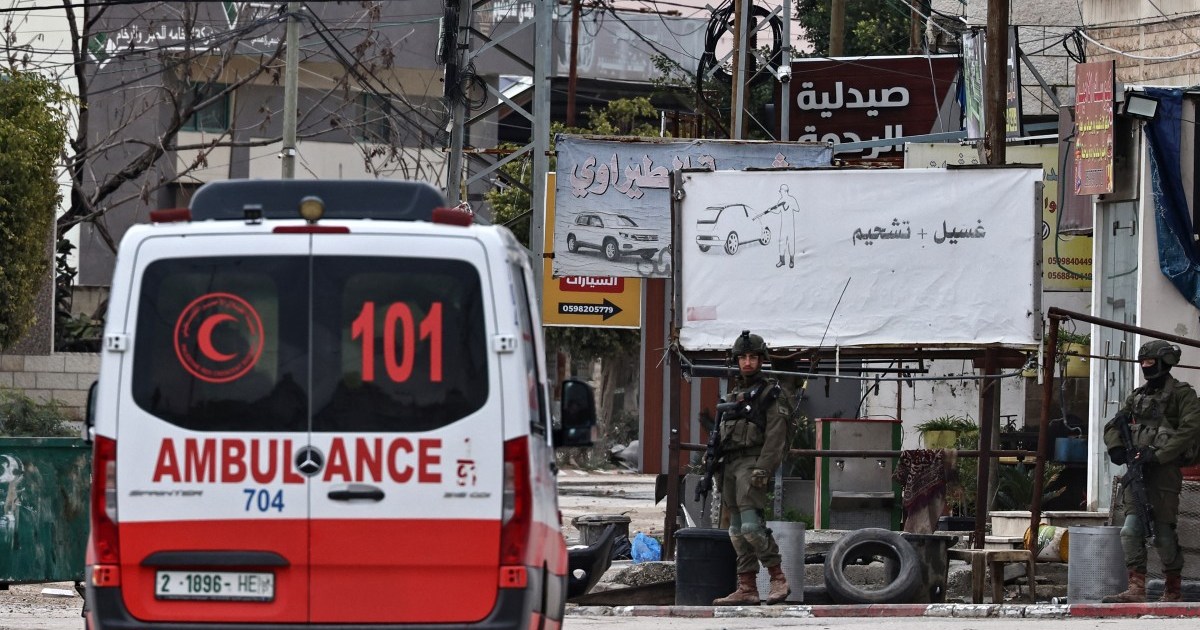

On Friday evening, after Israeli Prime Minister Benjamin Netanyahu ordered a “wide-scale military operation” across the occupied West Bank following a settler attack in the village of Tal that morning, Palestinian ambulance driver Yousef Diriya, 50, found himself trapped for four hours at Awarta checkpoint while transporting kidney dialysis patients.
In the days since, much of the West Bank – particularly Nablus Governorate, but also Ramallah and towns stretching as far south as the Bethlehem Governorate – has been sealed off, forcing ambulance crews to navigate lengthy detours and prolonged checkpoint delays to reach hospitals.
- list 1 of 3Trump expresses frustration with Netanyahu before White House meeting
- list 2 of 3‘We’re here to stay’: West Bank Palestinians defy Israeli attacks
- list 3 of 3Why has Iran’s economy not collapsed under US war pressure?
end of list
An ambulance trip that normally required Diriya to drive 20 kilometres (12 miles) can now require as much as 100 kilometres (60 miles), by his estimation. And even with prior coordination and permission to pass, it has taken hours at a time for Diriya to pass checkpoints to bring patients to hospitals in Nablus, the closest place offering sufficient medical services for critical cases from the surrounding villages, but which has had its entrances sealed off completely in recent days.
“Even if you’ve coordinated in advance, and they know the same woman is with you – it makes no difference,” said a tired Diriya. “Whether you’re entering Nablus or leaving through the checkpoint, it’s the same procedure every time: inspection, photographing IDs, photographing the ambulance, and then you just wait.”
Waiting at the checkpoints as each precious minute slips away for his patients requiring emergency medical attention leaves Diriya on edge.
Advertisement
“It wears us down enormously,” Diriya said. “Our job is saving people’s lives. Every minute counts for us.”
Early on Monday morning, ambulance driver Bashar al-Qaryuti picked up a six-month pregnant woman from Qaryut, southeast of Nablus, who was severely bleeding. But before they could reach Nablus, the ambulance stopped at Awarta, this time for half an hour. According to testimony that al-Qaryuti gave to Palestinian state news agency Wafa, the soldiers forced him to turn off the vehicle, causing the medical support equipment inside to stop working. The passengers were searched, including the pregnant woman, who was bleeding and in severe pain.
Following the delay, the woman’s unborn baby died before reaching the hospital, leaving the mother, and al-Qaryuti, devastated.
‘Collapsing’ healthcare system
Israel’s illegal settlements have choked Palestinian life in the occupied West Bank in the past few decades, but restrictions have grown on Palestinians since a far-right government came to power in Israel at the end of 2022, and Israel’s genocidal war on Gaza began in October 2023.
Even before the de facto lockdown that began on Friday evening, towns and villages in the West Bank have had checkpoints multiply and entrances increasingly sealed off entirely – with fatal results.
On July 5, in Deir Ammar refugee camp northwest of Ramallah, three-month-old Ahmad Zaid stopped breathing, and his family raced to get him past a locked Israeli military gate that has blocked the camp and two neighbouring villages from Ramallah’s hospitals since February.
Soldiers refused to open the gate even after Ahmad’s father carried the infant towards them, pleading to be let through. By the time the family reached an ambulance by another route, it was too late; the infant was pronounced dead en route to a hospital.
Then, on July 18, less than a week before the lockdown began, 30-year-old Sujood Fuqahaa from Sinjil died of cardiac arrest after soldiers would not allow her ambulance to pass while the town experienced a weeklong siege that sealed off all of its entrances. Such recent cases follow two years in which paramedics often reported being stopped on the way to reach injured victims of attacks from Israeli soldiers and settlers.
Adding to such access restrictions is the worsening medical supply shortage across the West Bank, as well as a healthcare system that is barely able to fund itself as a result of Israel’s systemic withholding of tax revenues designed for the Palestinian Authority. “The whole healthcare system is collapsing,” said Imran Anati, a researcher at Physicians for Human Rights-Israel.
Advertisement
The United Nations has recorded roughly 925 Israeli-imposed obstacles to movement across the territory, affecting an estimated 3.4 million Palestinians. But Diriya and other medical professionals interviewed by Al Jazeera describe the widespread closures that have gripped Nablus since Friday evening as the most severe restriction on movement the area has experienced since October 2023.
“This is another case of collective punishment that Israeli authorities are doing to Palestinians,” said Anati.
The systemic attacks on the West Bank’s healthcare system remind Anati of tactics employed in Gaza. On Friday, Israeli forces entered Nablus Specialised Hospital, where they handcuffed medical personnel in the course of detaining two brothers who had been admitted with injuries from the shooting near Tal, according to Wafa.
The World Health Organization documented 233 attacks on healthcare facilities, workers, and ambulances across the West Bank in 2025 alone.
“The attacks they were doing on medical teams in Gaza, you are seeing them do the same thing in the West Bank,” said Anati.
‘Demoralising’
In Aqraba, a village near Nablus, Dr Ayser Bani Jaber’s small clinic is minimally equipped, so serious injuries or cases are typically transported to hospitals in Nablus.
Until this week.
Bani Jaber described two women arriving within hours of each other early Sunday morning – both in labour, yet both unable to reach Rafidia Hospital in Nablus, the nearest facility equipped for complications. “We as a medical team were genuinely terrified,” he said, listing the array of blood, medication and equipment typically demanded to be on hand for medically safe births.
Lucky for the two babies, Bani Jaber’s wife, Dr Yusra Dweikat, is a gynecologist at Rafidia Hospital. Sequestered at home in Aqraba due to the roadblocks, she came to the clinic shortly after the first woman arrived at around 1am. She determined there was no time to wait, delivering the baby in spite of the inadequate conditions.
The second woman arrived at 3:30am, crying in fear, according to Bani Jaber. Every ambulance crew told the physician that the closures made the trip to Nablus impossible. Dr Dweikat again delivered the baby at the clinic. After the second birth was complete, the mother began bleeding – a complication the clinic could do nothing about, since Aqraba has no blood bank; the nearest one is in Nablus. It took half an hour of calls, coordination, and negotiation before an ambulance was cleared to transfer her to Rafidia.
“Sealing off entire communities while preventing ambulances from reaching patients or evacuating the wounded places civilians’ lives at immediate risk,” Anati said, calling on Israeli authorities to “immediately ensure safe and unimpeded access for ambulances and medical personnel” in line with obligations under international humanitarian law.
After the woman from Qaryut’s miscarriage early on July 27, Diriya suggested restrictions were finally easing somewhat later in the day. But late that night, Diriya relayed another rushed update from the road, sirens audible in the background: another woman had gone into labour and was bleeding.
Advertisement
With Nablus’s checkpoints still closed, he reported, his crew had no choice but to redirect her towards the hospital in Salfit, more than 25km (16 miles) south of Nablus, instead. “She just gave birth on the road, in the ambulance,” he announced, “minutes before we would have reached the hospital.”
Straddling a fine line between life and death amid settler attacks, the Nablus countryside’s sealed villages – and their local paramedics and doctors – are left with few resources. “Providing [sufficient medical assistance] in the villages is just incredibly difficult,” said Bani Jaber. “All of this has a direct bearing on whether the patient survives.”
“Whatever we manage comes down to whatever we can pull together ourselves.”
When Diriya and his kidney dialysis patients were stopped at the Awarta checkpoint all those hours on Friday, he noticed an Israeli ambulance simply passing through the checkpoint. “Israeli yellow-plated vehicles pass through even when the roads are closed,” he commented.
“In our job as paramedics, we serve everyone: Arabs, Jews, Israelis, Palestinians,” said Diriya. “All I care about is giving humanitarian care to whoever needs it. So of course it’s demoralising: I’m stuck waiting for long stretches, while my colleague in another ambulance – because he’s not Palestinian, because he’s Jewish – goes through freely. But I have no freedom at all.
“That does something to you psychologically – it really does.”
Related News
Dodging snipers, housing crisis forces Yemenis to live on front line

India’s youth protesters are fighting Modi with irreverent humour and memes

Mapping Iran’s Ali Khamenei funeral: Where mourners will gather each day