
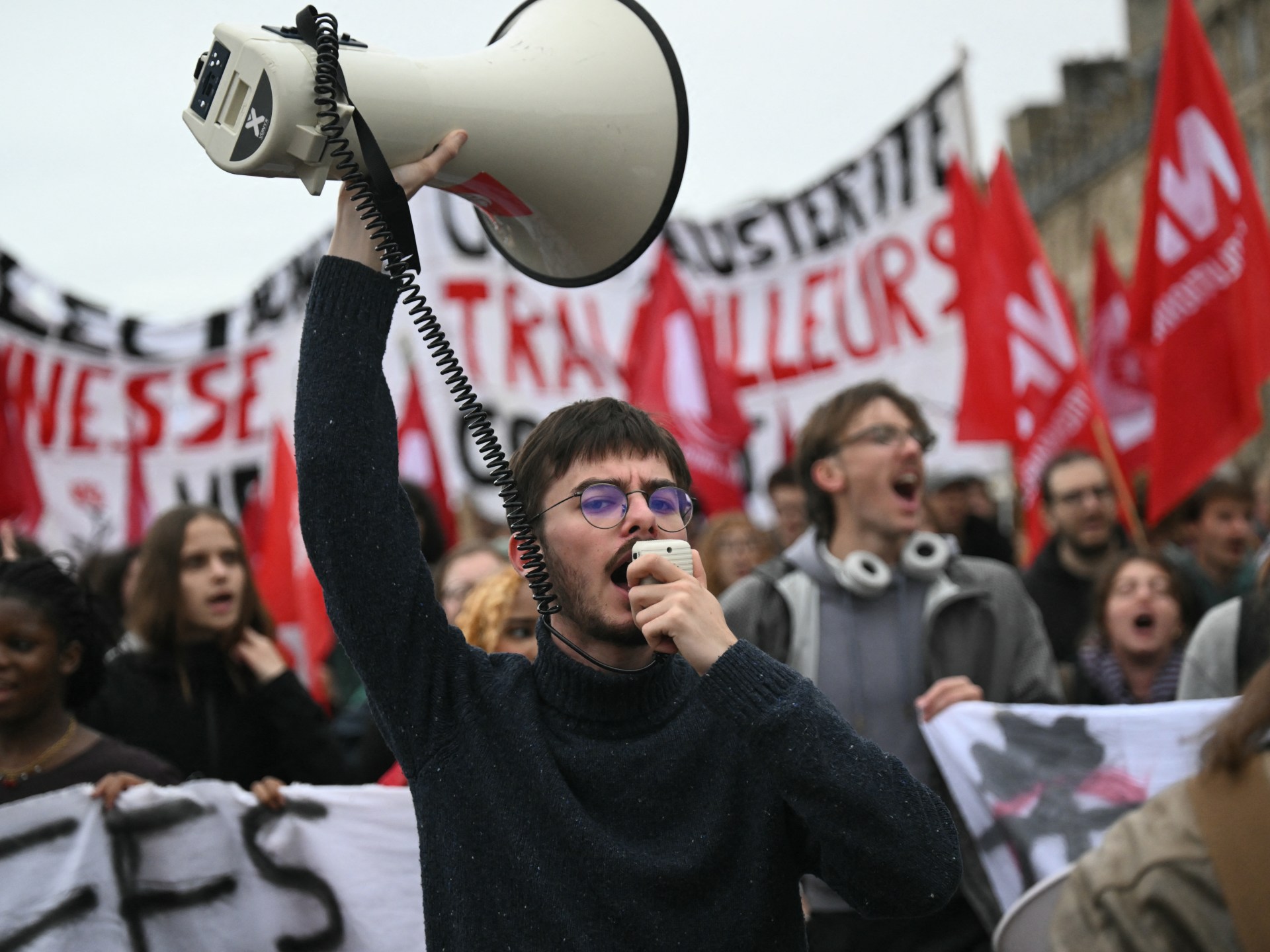

More than 100,000 people have taken to the streets in France to protest against the high cost of living, with public sector workers demanding pay increases.
The Interior Ministry said on Tuesday that a total of 146,000 people took part in the protests, with 28,000 in Paris alone. The CGT trade union put the nationwide total at just over 500,000 demonstrators.
- list 1 of 3Young French students who see ‘no change’ keep up protests in Paris suburbs
- list 2 of 3Why are Europe’s governments struggling to respond to growing protests?
- list 3 of 3France summons Iran’s ambassador over supermarket fridge ‘sabotage’
end of list
Several trade unions had called for a day of strike action. Participants included public sector workers, as well as school pupils and university students.
France’s 5.8 million public sector employees were pushed to mobilise after talks with Prime Minister Sebastien Lecornu on Friday failed to satisfy union demands. Union representatives left the meeting organised by Lecornu saying the proposed measures failed to address the urgency of the pay situation.
Tuesday’s rally is the third call for a united day of action and strikes in the public sector since September.
Unions have been pushing for across-the-board pay rises since last week’s boost to the minimum wage for private-sector workers.
Protesters say “they simply can’t make ends meet, and they want the government to help them put more money into funding in terms of salaries, in terms of raising the minimum wage”, Al Jazeera’s Natacha Butler reported from Paris.
“The government’s already offered about $30 extra a month on the minimum wage, but those here say that is simply not enough. With inflation, with the way the prices are going up, they say they actually need more.”
The unions put the loss of purchasing power for public servants at 16 percent since 2017, leading to increasing numbers of public employees ending up on or close to the minimum wage against a backdrop of inflation.
Advertisement
“The government doesn’t have much margin or wiggle room financially, because of France’s ballooning debt, and the government’s in the middle of trying to push through a budget with cost-cutting measures in it,” Butler said.

Public-sector workers aim to pressure the government to unfreeze the pay scale point used to calculate their basic salary. However, the government has ruled out any general pay rise for the fourth consecutive year in its draft budget.
“The people in the street know there is only so far you can go; the government knows they do not have a lot of economic wiggle room. Yet nobody really is coming up with another solution,” Butler said.
Despite the government’s efforts to ease tensions, demonstrations have roiled the country for over a month.
Student-led protests demanding better conditions in education erupted in mid-September, but the movement has since expanded in scope to cover a range of issues, from high fuel prices to wages and social housing
Protests for higher wages, lower costs of living and better public services have also spread across Europe.
Related News
US Pentagon rejects allegations linking deputy to a Goldman Sachs banker
Hundreds of Ethiopians cross into Kenya to flee regional fighting

Smoke from wildfires killed 3,500 people in Indonesia in September: Report