
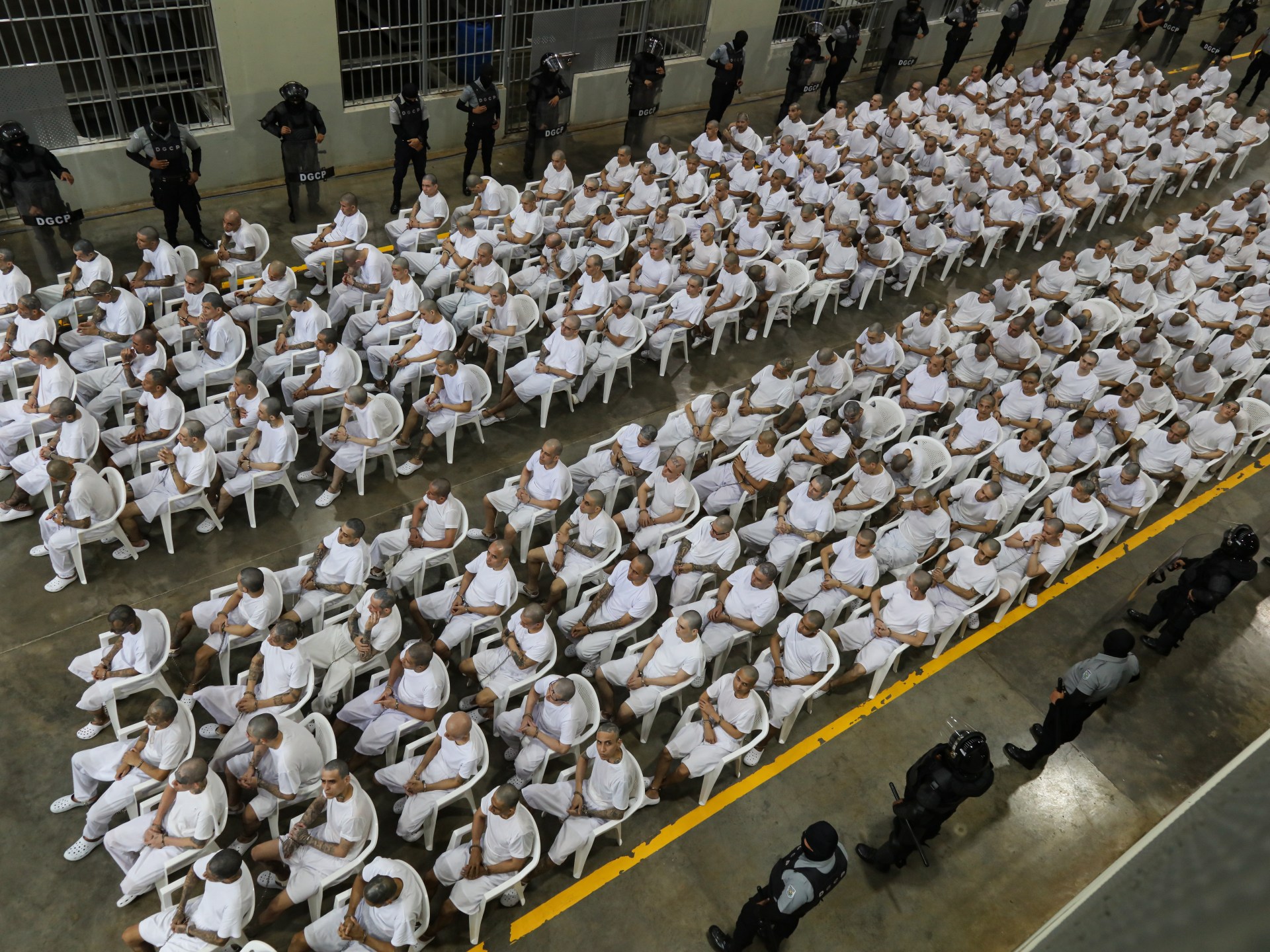

Human Rights Watch (HRW) has released a report documenting widespread violations as part of El Salvador’s mass trials, in which hundreds of people can be tried and convicted together.
The report, released on Wednesday, reviews four indictments covering more than 600 defendants and a single court ruling that involved more than 120 people.
- list 1 of 3El Salvador publishes law allowing life sentences for minors as young as 12
- list 2 of 3Trump rallies Latin American allies against drug cartels
- list 3 of 3Who Is Nayib Bukele? El Salvador’s ‘coolest dictator’
end of list
It also includes interviews with 15 defence lawyers, who say their clients were denied their due process rights and were therefore unable to adequately defend themselves at trial.
The report concludes that defendants in the mass trials face vaguely defined charges, weak evidence and faulty proceedings. In some cases, defence lawyers have reportedly been restricted from viewing their clients’ case files and communicating privately with the defendants.
“El Salvador’s mass trials are a mockery of justice,” said Juanita Goebertus, the Americas director at HRW, in a statement. “These hearings are designed to produce guilty verdicts, not to weigh evidence under due process.”
The mass trials are part of President Nayib Bukele’s sweeping security crackdown, launched in response to a surge in organised crime in the country.
Bukele first issued a state of emergency to address the crime wave in March 2022, suspending certain civil liberties in favour of greater powers for law enforcement officials. Those efforts included mass arrests.
The following year, El Salvador’s Congress passed a bill clearing the way for mass trials as well, allowing courts to decide cases involving hundreds of individual defendants.
Advertisement
The Salvadoran government has defended the trials as necessary to dismantle gangs, given the scale of crime in the country. But critics have repeatedly warned that such tactics violate basic human rights and have led to unlawful imprisonment.
Bukele himself has acknowledged that innocent people have been swept up in his crackdown. In 2024, he said some 8,000 people who had been arrested were later released.
“We are going to free 100 percent of the innocent people,” he pledged at the time, arguing that no system was perfect.
More than 93,000 people, including more than 3,000 children, have been detained under El Salvador’s emergency order, which has been renewed multiple times since 2022.
An estimated 120,000 people are currently imprisoned in El Salvador, equivalent to about 2 percent of the country’s population. The country has one of the highest incarceration rates in the world.
HRW noted that many convictions in the mass trials are secured by accusing the defendants of being “collaborators” with gangs, a vague legal standard.
In a single trial reviewed by the group, more than 120 people were convicted of unlawful association and sentenced to 30 or 45 years in prison. No one was acquitted, HRW said.
HRW reported that, for the vast majority of prisoners convicted on such charges, the only evidence connecting them to a gang was a statement by one of two anonymous witnesses, who had received immunity from prosecution.
“Prosecutors say a person is a gang member because a police officer says so,” one lawyer anonymously told HRW. “The prosecutor relies on the police report, and the police report relies on unspecified official intelligence or public rumours.”
There have also been questions about the system overseeing the mass trials.
The cases have been presented before the Tribunals Against Organized Crime, a court system overseen by El Salvador’s Supreme Court that critics accuse of a lack of transparency.
The identities of the tribunals’ judges have not been disclosed, even to the lawyers involved in the proceedings.
Still, despite concerns about human rights in the country, Bukele’s government has historically enjoyed a relatively high approval rating in public polls.
Bukele has cited such statistics as a sign of public support for his anti-crime tactics.
In April, Attorney General Rodolfo Delgado also defended a mass trial of nearly 500 alleged MS-13 members, saying in a social media post that the gang had operated systematically for years, causing “fear and mourning among Salvadoran families”.
Advertisement
The Salvadoran government did not immediately respond to a request for comment.
In its report, HRW called for independent reviews of cases brought under the state of emergency. It also demanded that people detained without credible evidence be released.
Related News

Republican midterm convention wraps up in Dallas, Texas: Key takeaways
Gaza’s Christians mourn mother and daughter killed in Israeli attack
Niger mutiny exposes growing reliance on Russia