


CIENFUEGOS – Although, of course, the four large photovoltaic solar farms in the province are the most promoted due to their vital importance, in Cienfuegos, the commitment to solar energy is accompanied by other projects that also contribute to the necessary alternative of prioritizing renewable energies for Cuba's development.
None of these projects are insignificant, however small their individual output may be, because the sum of many contributes to obtaining more energy in multiple areas, with the inherent benefit of improved quality of life for the communities, institutions, and homes that benefit.
IN WATER PUMPING
The use of solar panels for water pumping systems began in Cienfuegos with the installation of the first such equipment in the San Marcos settlement of Lajas.
Later, communities in Las Pitas and La Reforma, also in the municipality of Lajas, benefited from this initiative. Meanwhile, in Cumanayagua, the communities of Gaviña and Vega Vieja were included, and this phase was completed in the sugar mill community of 5 de Septiembre, in the municipality of Rodas.
The first stage of the program to change the energy matrix in Cienfuegos included the installation of 63 pumping stations with motors of less than 10 kilowatts (kW) of power in areas that did not have motor pumps or that received water by tanker truck.
Most of these projects are located in the municipalities of Lajas, Aguada, and Abreus, with a combined savings of 780 kWh (kilowatt-hours) and benefiting more than 20,000 people.
The largest of these systems was installed in 2023 in the community of Real Campiña, in Aguada de Pasajeros, with 64 photovoltaic modules and a capacity of 20 liters per second (L/s). However, most of the systems consist of six panels and a capacity of 6 L/s.
Mayra Águila, an operator at Campo de Tiro, said the change is considerable, because unlike the other pump, this one is automatic and works as long as the well has water and there is sunlight.
This advantage means the 215 homes in the area have access to water for much longer.
Lajas is one of the areas in Cienfuegos province with the most severe problems related to the water table. That's why the replacement of the pumping systems in the wells known as Acopio 1 and 2 was so well received, with the installation of 24 panels that converted solar energy into electricity to power the motors.
Belonging to the Pepito Tey People's Council in the provincial capital, the settlement of Quesada was fortunate enough to have its pumping station among those selected for the energy matrix change. Some 178 homes benefited from the transformation. What once seemed like a dream became a reality: the enjoyment of water for eight hours, as long as the sun shines.
In the community of Espartaco, part of the municipality of Palmira, residents experienced a similar situation. Ileana Veitía González, the operator of the local pumping station, stated that the implementation of the new energy system is a great benefit. She indicated that the use of solar panels allows for electricity savings and brings satisfaction to the community. The new technology provides electricity to 895 consumers, including students and staff of the Juan B. Jiménez Polytechnic Institute.
JAPANESE SOLIDARITY IN ABREUS
In March 2025, Kazuhito Nakamura, Japan's ambassador to Cuba, inaugurated a project in the municipality of Abreus that provides potable water to more than 1,200 residents of the communities of Carmelina, Guasimal, San Ignacio, and Mijalito.
The initiative, funded by Japan, cost over €63,000 and was implemented in coordination with the Spanish non-governmental development organization Mundubat and the National Institute of Hydraulic Resources (INRH).
It consisted of the installation of four water pumps powered by photovoltaic solar panels and an equal number of dosing pumps.
Now, pumping stations like the one installed in Mijalito operate even without electricity in the area, and the photovoltaic solar energy makes it possible to supply the precious liquid to the population.
SOLAR-POWERED WATER PUMPS IN THE ESCAMBRAY MOUNTAINS
In August 2025, the Vilma Espín Cuba-Switzerland Solidarity Committee donated a solar-powered water pump to the Teatro de los Elementos (Theater of the Elements) artistic collective, located in El Jobero, in the municipality of Cumanayagua, in the Guamuhaya Massif.
The technology was intended to optimize water access for 87 families and sustain two hectares of community gardens linked to the Jobero Verde Arte y Vida (Green Jobero Art and Life) project.
According to José Oriol González, director of the theater group, the solution eliminates dependence on fossil fuels and strengthens the food self-sufficiency of the prestigious performing arts institution, freeing up resources for its artistic creations, which involve, in one way or another, the 210 inhabitants of the area.
Solar Panels for the Home: A Great Advantage
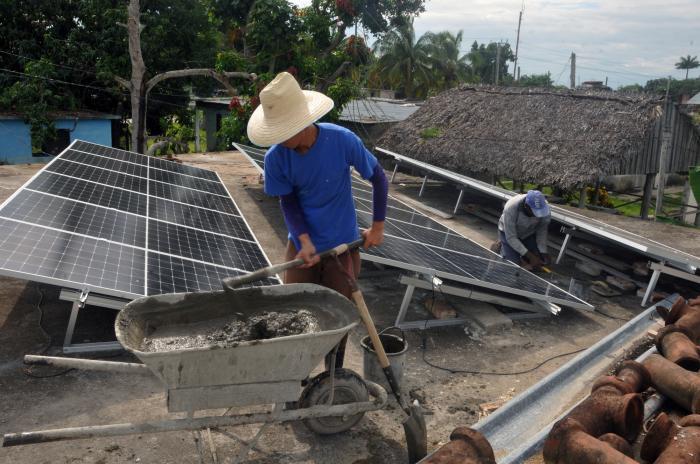
Some 470 representatives from the Education and Health sectors in the province were selected to receive solar panel modules for their homes through payment plans. This decision has been met with widespread praise within both sectors, and it is hoped that the program will be expanded to include these and other areas.
With a long career in Education spanning over 42 years (retired and then reinstated), teacher Gonzalo González, from the municipality of Abreus, is one of the beneficiaries.
The dedicated educator expressed his gratitude to the sector's leadership and the Cuban government for considering him and for never forgetting those who work for the benefit of their people. Beyond the savings and convenience, Gonzalo saw the panels as a recognition of his outstanding work.
PUBLIC LIGHTING TRANSFORMATION
One of the visible pillars of the energy transformation in Cienfuegos is the program to replace public lighting with solar-powered lights, implemented on main thoroughfares such as San Fernando Boulevard, the Prado, 56th Avenue (San Carlos), José Martí Park, and Villuendas Park.
The installation, in the middle of last year, of 78 solar lights by the Cienfuegos municipal government (18 of 500 W and 60 of 1,000 W) represents a total power of 69 kW.
With an average of ten hours of service per day, these lights generate savings of approximately 690 kWh per day and 25,185 kWh per year.
Considering a generation cost of $0.25 per kWh, the estimated annual savings exceed $65,000.
CONSTRUCTION OF PARKS CONTINUES UNSTOPPED
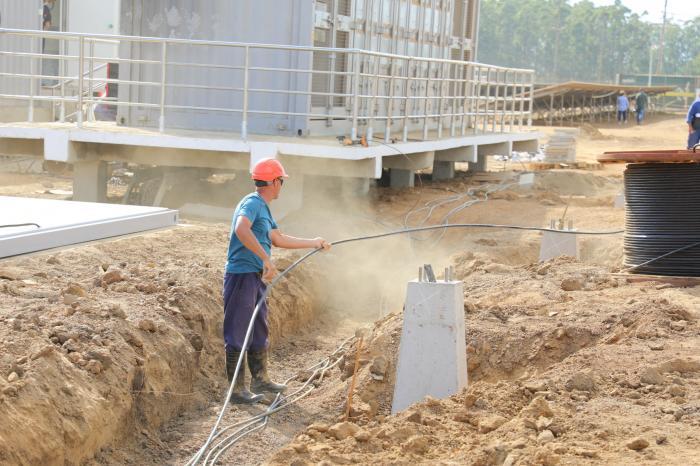
Following the completion of the fourth photovoltaic solar park, with a capacity of 21.87 megawatts (MW), located in the town of Pepe Rivas, the province will begin construction of another new one, with a capacity of 5 MW, situated in the CEN-Juraguá area. This new park is part of a 120 MW donation from China and will include a 2 MW battery for nighttime power supply.
Salvador Vera Hernández, Director of Projects for the Provincial Electric Company, explained that Cienfuegos plans another group of four parks, each with a capacity of 21.87 MW, bringing the total to eight large-scale installations of this type.
Adding the approximately 18 MW of previously installed small solar parks to this fourth newly completed site in Pepe Rivas, the province now has a capacity of approximately 127 MW. This is equivalent to saving about 41,000 tons of fossil fuels annually, according to estimates.