
‘Imperial’ agenda: What’s Trump’s Gaza development plan, unveiled in Davos?
 23 January 2026

Glittering towers lining the Mediterranean coastline, a “New Gaza” and “New Rafah” in the offing, with more than 100,000 housing units alongside orderly industrial parks – and even a new airport.
All without consultation with the people this development is supposed to benefit.
This is the skeleton of a “masterplan” for post-war Gaza, presented by Jared Kushner, United States President Donald Trump’s son-in-law and a real estate developer, at the World Economic Forum in Davos, Switzerland this week.
“There is no Plan B,” said Kushner, as he unveiled the ambitious plan.
Israel’s genocidal war on Gaza has killed more than 71,000 Palestinians – with thousands more missing and presumed dead under the rubble – in Gaza since October 7, 2023, the day Hamas launched an attack on villages and army outposts in southern Israel and Israel began its bombardment. More than 470 Palestinians have been killed since a ceasefire was announced by Trump on October 10 last year.
Presented as a plan to rebuild the Palestinian territory, the Trump administration’s proposal this week, however, offers no insight into core issues such as property and land rights — let alone justice for war crimes — amid plans to construct shimmering buildings atop an estimated 68 million tonnes of rubble and war debris, where thousands of bodies remain buried.
Praising the redevelopment plan, Trump, who also spoke at length at the forum in Davos, argued that the war in Gaza “was really coming to an end”, even as Israeli forces killed at least 11 Palestinians, including two children and three journalists, in separate strikes on the Gaza Strip on Thursday.
Advertisement
“I’m a real estate person at heart, and it’s all about location,” Trump said about the development plan. “And I said, look at this location on the sea, look at this beautiful piece of property, what it could be for so many people.”
Experts have strongly criticised the “imperialist” vision of Trump’s so-called master plan, which they say does not include any consultation with Palestinians and reduces the ongoing catastrophic genocide to an “investment opportunity”.
Trump’s proposal reeks of “imperial plans for Gaza,” Palestinian-American writer Susan Abulhawa wrote in a post on X. “This is a plan to erase Gaza’s indigenous character, turn what remains of her people into a cheap labor force to manage their ‘industrial zones’ and create an exclusive coastline for ‘tourism’.”
During more than two years of bombardment on Gaza from October 2023, Israel, which is diplomatically supported and armed by the US, destroyed or damaged more than 80 percent of the Strip’s buildings, with residential blocks completely flattened.
All major hospitals and universities, and most of the Strip’s electricity and water systems, roads and municipal services have been destroyed.
Nearly all the territory’s 2.3 million residents have been displaced, many of them multiple times. People face hours-long queues for basic food and water, and aid into the territory has been restricted by Israel, which controls everything that goes in and out.
So, what’s in the Gaza reconstruction plan, part of Trump’s launch of a “Board of Peace”; could it be realised — and at what cost, especially for the people of Gaza?

What’s the Board of Peace?
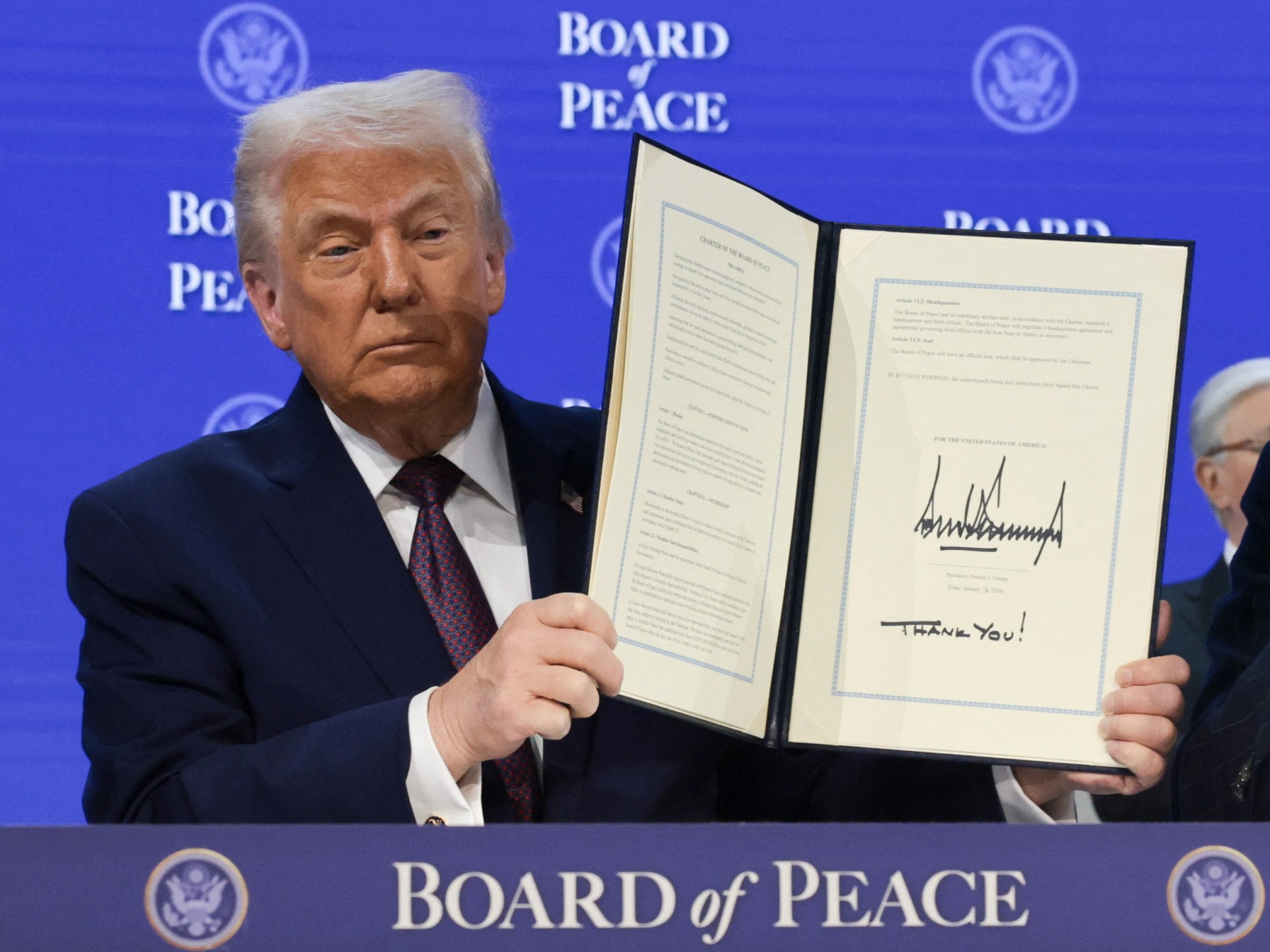
In Davos on Thursday, Trump formally announced the charter for his “Board of Peace”, which he has pitched as the next phase of his administration’s 20-point peace plan and a mechanism to oversee the reconstruction of Gaza. Membership on the board has a three-year cycle. Those seeking a permanent seat must pay $1bn.
But the 11-page charter for the Board of Peace does not mention Gaza and appears to have morphed into something far more ambitious – an international disputes forum and a potential rival to the United Nations.
The executive board so far includes former United Kingdom Prime Minister Tony Blair, US Secretary of State Marco Rubio and Kushner, with Trump as the chairman himself with veto power. It also includes Israel’s Prime Minister Benjamin Netanyahu, even though he faces an arrest warrant from the International Court of Justice (ICJ) for war crimes in Gaza.
Advertisement
At least 50 countries’ leaders have confirmed that they have received invitations, including US adversaries China and Russia — and several have agreed to join. However, Trump withdrew Canada’s invitation on Thursday, in what appeared to be a retaliatory move following Prime Minister Mark Carney’s speech at the World Economic Forum, in which he denounced Trump’s aggressive stance over Greenland.
Speaking at the forum, Trump said the board was going to be “very successful in Gaza” and “we can spread out to other things as we succeed with Gaza”.
Kushner then outlined details about the board’s development plans for Gaza without mentioning plans for a path to Palestinian statehood.
Hamas, which currently governs Gaza, condemned the proposal, saying: “Our people in the Gaza Strip will not allow these plans to pass.”

What’s in the Gaza plan?
Trump’s development plan includes projections to raise Gaza’s gross domestic product (GDP) to $10bn by 2035, after the size of the territory’s economy crashed to just $362m by 2024 amid the war; 500,000 new jobs; and at least $25bn in investment for modern utilities and public services.
Kushner did not specify who would fund the redevelopment. “As you guys know, peace is a different deal than a business deal, because you’re changing a mindset,” he said, calling the Gaza peace efforts “very entrepreneurial”.
However, he also focused on security. “[The] number one thing is going to be security,” Kushner said. “Without security, nobody’s going to make investments, nobody’s gonna come build there. We need investments in order to start giving jobs,” Kusher said.
He added that the US is working “very closely with the Israelis to figure out a way to de-escalation, and the next phase is working with Hamas on demilitarisation”.
There is no evidence that Palestinians or their leadership have been consulted over any of these plans. Amjad Shawa, director of the Palestinian NGOs Network in Gaza, said Palestinian civil society and official bodies were not included in discussions with the Board of Peace.
“We were surprised, as Palestinian actors on the ground, after 10 years of work, and especially the last two years of work in Gaza, that no one consulted us about the plans for Gaza and its future,” he said.
“At the time these leaders are holding ceremonies, Israel is using this period to continue its actions in Gaza.”
Here are some of the highlights of Trump’s redevelopment plan:
Four phases of development
Presenting a four-phase development timeline beginning in Rafah, southern Gaza, and then moving its way north, Kushner displayed colour-coded maps showing coastal tourism zones, mixed-use towers, and residential and industrial areas, as he unveiled the plan in Davos.
Phase one of Trump’s plan for rebuilding is set to start in Rafah, Gaza’s southern-most city, and some parts of Khan Younis. Phase two will include other parts of Khan Younis, while phase three aims to develop refugee camps in central Gaza. Phase four will cover Gaza City, which is in the north of the territory.
Advertisement
Kushner told attendees at Davos that construction of new developments in all these areas will take two to three years. However, he did not provide details about where Palestinians would live during reconstruction, and how new properties would be allocated.

Coastal tourism plans
In maps showing the Gaza plan, Trump’s administration has pink-coloured nearly the entire seafront and marked it as a “coastal tourism” zone that will include as many as 180 skyscrapers.
The proposal also shows a port at the southwestern end of Gaza, alongside the border with Egypt, and an area zoned for an airport close by, a few miles from the site of the original Gaza airport, which was destroyed in Israeli attacks two decades ago.


Employment and investment
In a report published in October 2025, the Palestinian Central Bureau of Statistics said unemployment in Gaza rose by 80 percent during the war, with more than 550,000 people currently without jobs.
GDP plunged 83 percent in 2024 compared with the previous year, and by 87 percent over two years to $362m. GDP per capita plummeted to $161 annually, placing it among the lowest in the world.
“Before the war, the Gaza Strip witnessed economic growth, with the opening of many commercial, tourism, and industrial projects, and it became a haven for many investments in all sectors,” Maher Altabbaa, the director-general of the Gaza Governorate Chamber of Commerce and Industry, told Al Jazeera earlier last month.
The proposal presented by Kushner claims more than 500,000 jobs in construction, agriculture, manufacturing and services will be created, with a $1.5bn investment in an initiative called “Vocational Schools and (Re)-Training for Full Labor Force”.
He added that the board aims to use “free market principles” to shift Gaza’s dependence on foreign aid, and unveiled plans for a new “logistics corridor”, a new “trilateral” crossing at Rafah, and roads connecting Gaza’s urban centres in the proposal. The plan seems to suggest the new crossing would be built at the point where Gaza, Israel and Egypt’s Sinai region meet.
The main, existing Rafah crossing between Gaza and Egypt, meanwhile, is expected to open in both directions next week.

‘New Rafah’, ‘New Gaza’
Kushner presented a slide showing artificial intelligence-generated images titled “New Rafah”, which showed plans to build more than 100,000 permanent housing units in Gaza’s southern city.
About 200 schools and more than 75 medical facilities will be built, he claimed.
Another slide, titled “New Gaza”, showed plans to turn the enclave into a centre of industry, heavy on data centres and other digital infrastructure.

Kushner said the reconstruction plan would only commence following full disarmament by Hamas and the withdrawal of the Israeli military after that.
Advertisement
Israel backed several armed groups and gangs in Gaza during the war, and Kushner said these would either be dismantled or “integrated into” the National Committee for the Administration of Gaza (NCAG) — a body of 15 Palestinian technocrats tasked with the day-to-day running of the territory.
All of Hamas’s heavy weapons are to be decommissioned immediately, and the remaining smaller arms would be decommissioned gradually by a new Palestinian police force, under the plan. Hamas, on its part, has not committed to disarming – amid worries that this could eliminate what little armed resistance Palestinians in Gaza might be able to offer to future Israeli attacks.
During the presentation in Davos, Kushner’s slide presentation said that Hamas members who cooperate and disarm would be “rewarded with amnesty and reintegration, or safe passage”, and some would be “integrated” into the new Palestinian police force after “rigorous vetting”.
Mahmoud Abbas, president of the Palestinian Authority (PA), has called for the full implementation of the peace plan, including the withdrawal of Israeli forces and a central role for the PA in administering Gaza.
Related News
What lies ahead for Venezuelan opposition leader Maria Corina Machado?
‘We just sit and cry’: Gaza’s cancer patients die waiting for treatment

What are potential ‘hard ways’ Trump could try to take Greenland?