
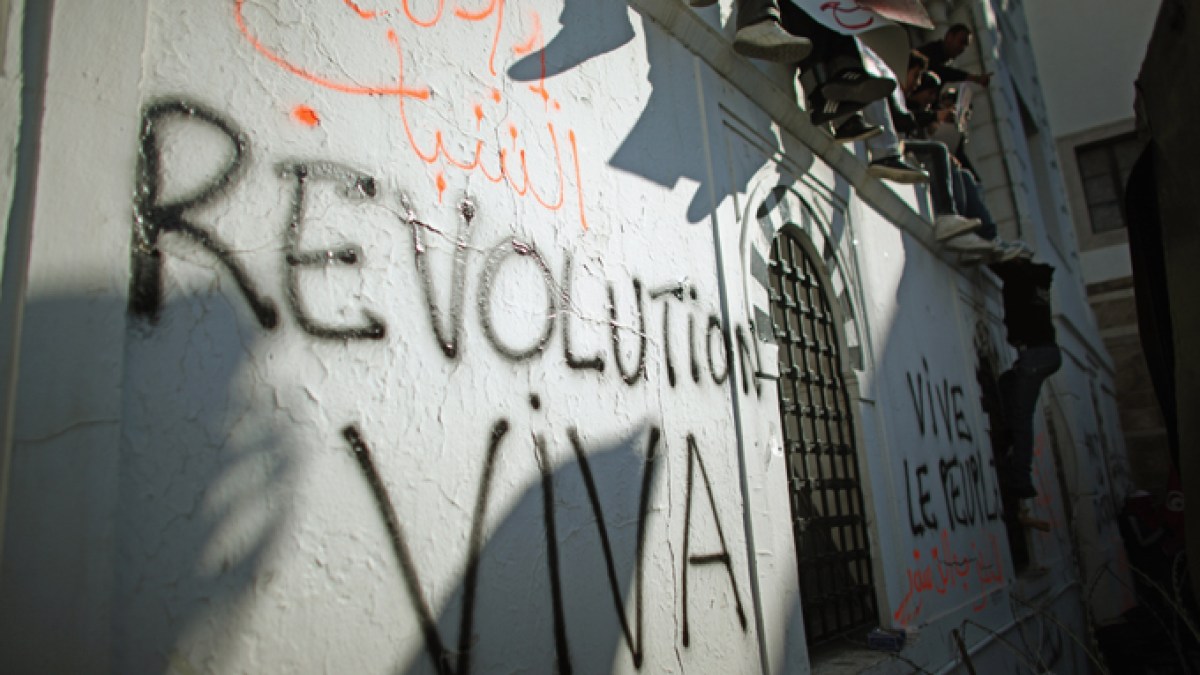

Fifteen years ago, a Tunisian fruit seller, Mohamed Bouazizi, despairing at official corruption and police violence, walked to the centre of his hometown of Sidi Bouzid, set himself on fire, and changed the region forever.
Much of the hope triggered by that act lies in ruins. The revolutions that followed in Tunisia, Libya, Egypt and Syria have cost the lives of tens and thousands before, in some cases, giving way to chaos or the return of authoritarianism.
- list 1 of 4‘Enough repression’: Thousands of Tunisians protest against Kais Saied
- list 2 of 4Tunisia hands long prison sentences to opposition, business, media figures
- list 3 of 4Tunisia sentences opposition leader Abir Moussi to 12 years in jail
- list 4 of 4Presidents the Arab Spring toppled, where are they now?
end of list
Only Tunisia appeared to fulfil the promise of the “Arab Spring”, with voices from around the world championing its democratic success, ignoring economic and political failings through much of its post-revolutionary history that stirred discontent.
Today, many of Tunisia’s post-revolutionary gains have been cast aside in the wake of President Kais Saied’s dramatic power grab in July 2021. Labelled a coup by his opponents, it ushered in a new hardline rule in Tunisia.
Burying the hopes of the revolution
Over the following years, as well as temporarily shuttering parliament – only reopening it in March 2023 – Saied has rewritten the constitution and overseen a relentless crackdown on critics and opponents.
“They essentially came for everyone; judges, civil society members, people from all political backgrounds, especially the ones that were talking about unifying an opposition against the coup regime,” Kaouther Ferjani, whose father, 71-year-old Ennahdha leader Said Ferjani, was arrested in February 2023.
In September, Saied said his measures were a continuation of the revolution triggered by Bouzazzi’s self-immolation. Painting himself a man of the people, he railed against nameless “lobbyists and their supporters” who thwart the people’s ambitions.
Advertisement
However, while many Tunisians have been cowed into silence by Saied’s crackdown, they have also refused to take part in elections, now little more than a procession for the president.
In 2014, during the country’s first post-revolution presidential election, about 61 percent of the country’s voters turned out to vote.
By last year’s election, turnout had halved.
“Kais Saied’s authoritarian rule has definitively buried the hopes and aspirations of the 2011 revolution by systematically crushing fundamental rights and freedoms and putting democratic institutions under his thumb,” Bassam Khawaja, deputy director at Human Rights Watch, told Al Jazeera English.
In the wake of the revolution, many across Tunisia became activists, seeking to involve themselves in forging what felt like a new national identity.
The number of civil society organisations exploded, with thousands forming to lobby against corruption or promote human rights, transitional justice, press freedom and women’s rights.
At the same time, political shows competed for space, debating the direction the country’s new identity would take.

“It was an amazing time,” a political analyst who witnessed the revolution and remains in Tunisia said, asking to remain anonymous. “Anybody with anything to say was saying it.
“Almost overnight, we had hundreds of political parties and thousands of civil society organisations. Many of the political parties shifted or merged… but Tunisia retained an active civil society, as well as retaining freedom of speech all the way up to 2022.”
Threatened by Saied’s Decree 54 of 2022, which criminalised any electronic communication deemed by the government as false, criticism of the ruling elite within the media and even on social networks has largely been muzzled.
“Freedom of speech was one of the few lasting benefits of the revolution,” the analyst continued.
“The economy failed to pick up, services didn’t really improve, but we had debate and freedom of speech. Now, with Decree 54, as well as commentators just being arrested for whatever reason, it’s gone.”
In 2025, both Amnesty International and Human Rights Watch slammed Tunisia’s crackdown on activists and nongovernmental organisations (NGOs).
In a statement before the prosecution of six NGO workers and human rights defenders working for the Tunisian Council for Refugees in late November, Amnesty pointed to the 14 Tunisian and international NGOs that had their activities suspended by court order over the previous four months.
Included were the Tunisian Association of Democratic Women, the Tunisian Forum for Social and Economic Rights, the media platform Nawaat and the Tunis branch of the World Organisation against Torture.
Advertisement
Dozens of political figures from post-revolution governments have also been arrested, with little concern for party affiliation or ideology.
In April 2023, 84-year-old Rached Ghannouchi, leader of what had been Tunisia’s main political bloc, the Ennahdha Party, was arrested on charges of “plotting against state security”.
According to his daughter, Yusra, after a series of subsequent convictions, Ghannouchi currently faces a further 42 years in jail.
Later the same year, Ghannouchi’s principal critic, Abir Moussi, the leader of the Free Destourian Party, was jailed on a variety of charges.
Critics dismiss the charges, saying the criteria for arrest have been the person’s potential to rally opinion against Saied.
“This is not just the case for my father,” Yusra continued, referring to others, such as the leading post-coup opposition figure Jawhar Ben Mubarak.
“Other politicians, judges, journalists, and ordinary citizens … have been sentenced to very heavy sentences, without any evidence, without any respect for legal procedures, simply because Tunisia has now sadly been taken back to the very same dictatorship against which Tunisians had risen in 2010.”

Ghannouchi and Moussi, along with dozens of former elected lawmakers, remain in jail. The political parties that once vied for power in the country’s parliament are largely absent.
In their place, since Saied’s revised 2022 constitution weakened parliament, is a body that is no longer a threat to the president.
“The old parliament was incredibly fractious, and did itself few favours,” said Hatem Nafti, essayist and author of Our Friend Kais Saied, a book criticising Tunisia’s new regime. He was referring to the ammunition provided to its detractors by a chaotic and occasionally violent parliament.
“However, it was democratically elected and blocked legislation that its members felt would harm Tunisia.
“In the new parliament, members feel the need to talk tough and even be rude to ministers,” Nafti continued. “But it’s really just a performance… Nearly all the members are there because they agree with Kais Saied.”
Hopes that the justice system might act as a check on Saied have faltered. The president has continued to remodel the judiciary to a design of his own making, including by sacking 57 judges for not delivering verdicts he wanted in 2022.
By the 2024 elections, that effort appeared complete, with the judicial opposition to his rule that remained, in the shape of the administrative court, rendered subservient to his personally appointed electoral authority, and the most serious rivals for the presidency jailed.
“The judiciary is now almost entirely under the government’s control,“ Nafti continued. “Even under [deposed President Zine El Abidine] Ben Ali you had the CSM [Supreme Judicial Council], which oversaw judges’ appointments, promotions, and disciplinary matters.
Advertisement
“Now that only exists on paper, with the minister of justice able to determine precisely what judges go where and what judgements they’ll deliver.”
Citing what he said is the “shameful silence of the international community that once supported the country’s democratic transition”, Khawaja said: ”Saied has returned Tunisia to authoritarian rule.”

Related News
Ukraine reports large Russian mechanised assault in battle for Pokrovsk
Gaza authorities struggle to recover bodies from rubble amid winter storms

US Senate passes $901bn defence bill