

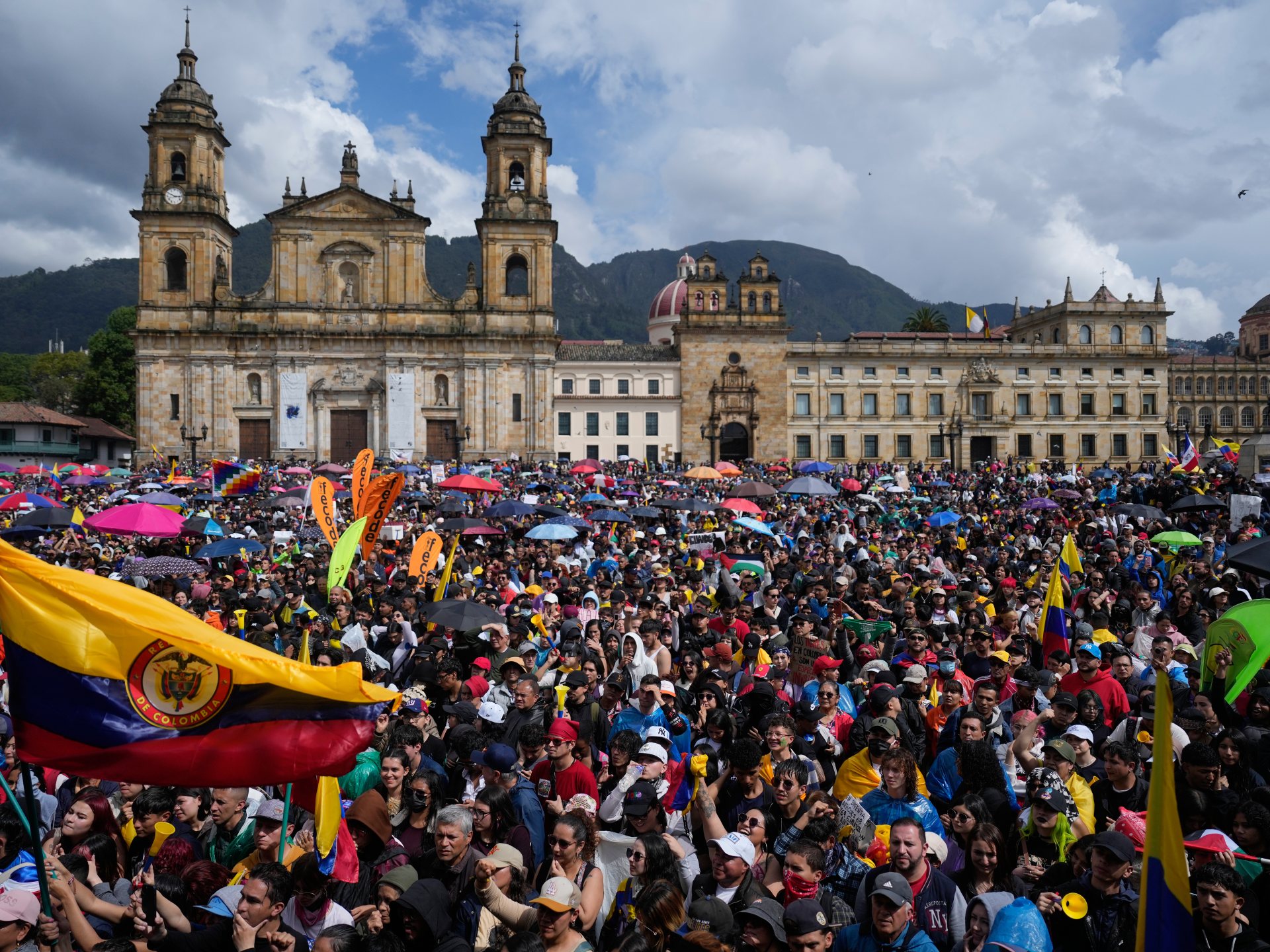

A coalition of opposition parties, trade unions, indigenous groups and social movements has protested in Colombia against a series of economic and security policies advanced under right-wing President Abelardo de la Espriella.
Thousands marched in major cities including the capital Bogota on Wednesday, the first day of a nationwide campaign led by the country’s former left-wing President Gustavo Petro.
- list 1 of 3Colombia extradites leader of armed group to US in shift towards Washington
- list 2 of 3Colombia peace tribunal charges ex-FARC members with anti-Indigenous crimes
- list 3 of 3Colombia opens embassy in Jerusalem and restores free trade with Israel
end of list
Under Petro, Colombia expanded access to public universities, increased the minimum wage and improved labour protections for workers.
Opposition groups say many of those reforms are now under threat, as de la Espriella’s government embraces cuts to government programmes.
Colombia’s Congress has until Tuesday to approve its 2027 fiscal year budget. But as part of the new administration’s austerity measures, allies of de la Espriella are advancing proposals to reduce government spending.
De la Espriella has also pledged to turn Colombia away from his predecessor’s left-wing leanings and towards more free-market policies aligned with those of United States President Donald Trump.

The government issued new rules for police ahead of the protests, handing expanded powers to law enforcement to more quickly deal with protesters who vandalise public property or disrupt access to essential services.
“The right to protest is respected, but there is no right to destroy, attack the security forces, assault others or sow chaos,” de la Espriella said in a social media statement announcing the decree.
Advertisement
He added that “violence, vandalism and blockades that trample on the rights of millions of citizens will not be tolerated”.
Indigenous communities and political groups in rural parts of the country sometimes block roads as part of their protests, with impediments to traffic sometimes lasting weeks.

But critics have pointed out that the protests this week have been largely peaceful.
Many chanted “It will fall”, a reference to the perceived failure of de la Espriella’s government.
A former defence lawyer and millionaire businessman, de la Espriella was a political newcomer when he ran for the presidency this year on a far-right ticket.
He was elected in a June runoff race by a narrow margin. He campaigned on a hardline platform to address crime, immigration and the economy, including proposals to expel millions of migrants from Colombia and shrink the size of the government.
De la Espriella also pledged to backtrack on reforms made under Petro, Colombia’s first left-wing president. He took office in August.
A former left-wing fighter-turned-politician, Petro took part in protests on Wednesday. He was not eligible for re-election in this year’s presidential race; Colombian law currently caps presidents at a single term.
He wrote on social media that the mobilisations were a wake-up call “two months into the start of a tyrannical and imposed government”.

Protesters also expressed concerns about cuts to labour protections and healthcare under the new administration.
“I feel like we have no guarantees and that the little we did obtain … we’re about to lose,” teacher Ester Guerra, 32, told the news outlet AFP in Bogota.
Some demonstrators also took issue with the new administration’s overtures towards Israel. Several carried Palestinian flags, in a sign of solidarity.
On Wednesday, de la Espriella’s government opened a Colombian embassy in Jerusalem, a controversial move as Israel and Palestine have both claimed parts of the city.
Petro had been a staunch supporter of Palestine and had cut relations with Israel over its genocidal war against Gaza. But de la Espriella has moved to restore the severed ties since taking office.
That struck protesters like Jimena Rodriguez, a 20-year-old student, as an effort to ignore accusations of Israeli abuses against Palestinians.
Advertisement
Several noted that de la Espriella’s actions towards Israel mirrored Trump’s, who moved the US embassy to Jerusalem during his first term in 2018.
President de la Espriella “just wants to hand the country over to the United States, to Israel,” Rodriguez said. “I feel dark times are coming.”
Related News

New tiger cat species identified in Bolivia, first in over a century
EU chief von der Leyen proposes ‘associate member’ status for Canada
Tennessee prisons official resigns after Christa Pike’s failed US execution