

Zawtar al-Gharbiyeh, Lebanon – Every year on August 4 since 2020, families of the victims of a massive explosion at Beirut port gather outside the site of what was one of the largest non-nuclear blasts in modern history.
They continue to press Lebanese authorities for justice and accountability for the explosion of ammonium nitrate that was unsafely stored with highly inflammable materials.
Yet there has been none, despite a change in leadership that promised to support an independent judiciary into the blast that killed more than 200 people.
This year I couldn’t attend the commemorations because I was covering another tragedy – only the latest to devastate Lebanon.
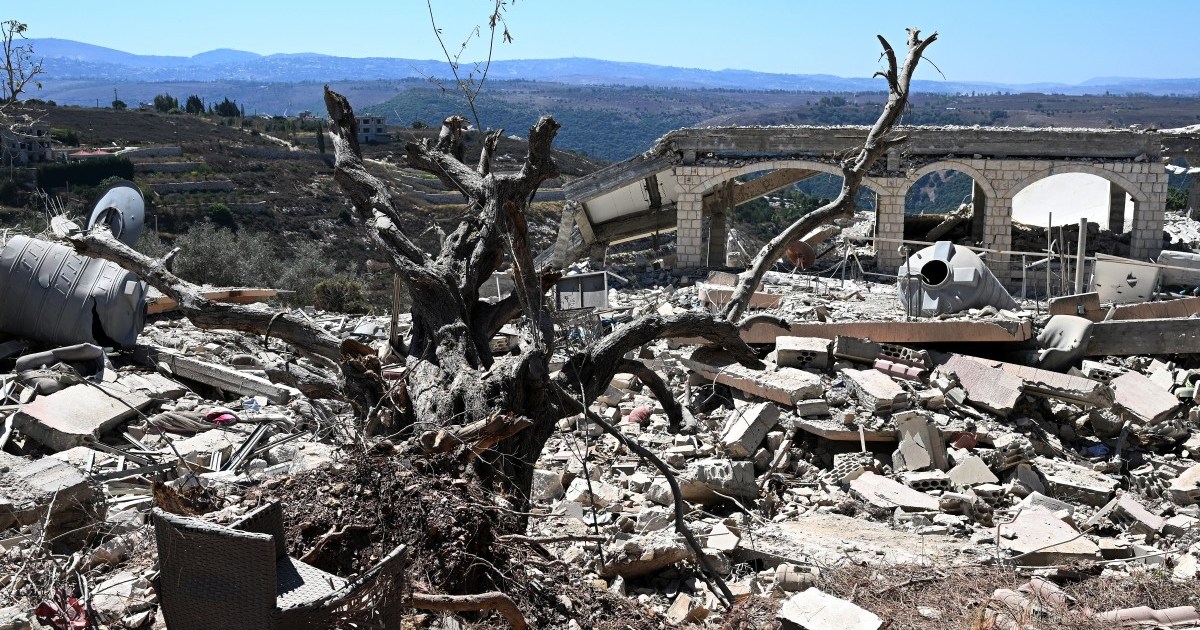
I was in Zawtar al-Gharbiyeh, a small town in southern Lebanon that lies in ruins after weeks of Israeli air attacks, shelling and at times deliberate demolitions of people’s homes amid fighting with the Lebanese group Hezbollah.
Residents are trying to start again – but they can’t.
Israel and Hezbollah have been fighting since October 2023, with different levels of intensity, but the former has twice escalated the conflict – first in September 2024 and then in early March this year, after the start of the US-Israel war on Iran.
People in Zawtar al-Gharbiyeh had not recovered from the first escalation before they found themselves escaping bombing and displaced yet again.
The majority of houses in the town are so badly damaged they are uninhabitable.
I watched a man in his 80s cry as he showed me the mountain of concrete that used to be his home. “I feel humiliated,” he said. “I have no choice but to collect the scrap metal from my destroyed home to sell in order to be able to survive.”
Advertisement
In 2019, Lebanon’s economy, local currency and the banking sector all but collapsed, leaving people unable to access their savings. And little if anything has been done by the political class to carry out required financial reforms to bring in much-needed international funds.

The reconstruction bill for the latest escalation is in the billions of dollars. Officials do not have an exact figure but say it could climb to $20bn.
It might be a conservative estimate. I have been visiting villages across southern Lebanon since the reduction in violence a few weeks ago. The devastation is unprecedented. Basic services are no longer available. In some areas, there are no telecommunication networks.
And then there are the dozens of villages that we cannot access because they are occupied by the Israeli military.
There, homes continue to be demolished, water facilities destroyed, and agricultural land and olive groves torched. The deliberate destruction continues regardless of what is supposed to be a ceasefire, a framework agreement with Lebanon and condemnations by Lebanese officials who took the controversial and divisive decision to engage in direct talks with Israel.
Reconstruction as a card
When hostilities escalated in March this year, reconstruction from the previous round of fighting in 2024 had not even begun. Then, the World Bank estimated losses at $11bn – money the nearly bankrupt Lebanese government did not have.
Then, like now, there was no offer to help by international donors. Reconstruction aid was and continues to be used as leverage to force the disarmament of Hezbollah.
It was not just the lack of funds.
During the 15 months following a November 2024 ceasefire and the latest escalation, the Israeli military maintained pressure by systematically targeting all recovery and rebuilding efforts in southern Lebanon.
They bombed heavy machinery and construction equipment, destroyed factories and prefabricated house units, and attacked workers clearing rubble to prevent displaced residents from returning. Nearly 100,000 people were already displaced before this year’s war that forced more than a million people from their homes.
More destruction
On the sixth anniversary of the port blast, Lebanon has had to face more destruction.
I remember writing the same words last year, on the fifth anniversary. Like in 2025, this year’s destruction came from outside the country – from Israel. Areas where Hezbollah has influence remain covered in rubble following Israel’s attacks.
Advertisement
Yet again, there is a need to rebuild. Yet again, many Lebanese have to pick up the pieces of their lives on their own.
While they try, they live in fear. In the front-line town of al-Mansouri, we met the head of the municipality, Haidar Mudayhi, who told us not to approach the hills around the town’s centre.
“The Israelis drop stun grenades every time someone tries to reach those areas … every day there is machinegun fire around the village … the other day there were air strikes in the hills … there is no stability,” he said.
It is a story we hear time and time again in villages north of the occupation zone.
The relative calm is fragile. No agreement exists that guarantees Israel and Hezbollah will not go to war again.
Israel acts as if there is no ceasefire, while the signed agreement between Lebanon and Israel, which the United States has called “historic”, does not include a commitment or a timeline for an Israeli withdrawal from southern Lebanon.
Related News
Israel kills Palestinian, destroys mosque in Gaza

VIDEO: Spain defeats France to reach FIFA World Cup final
Thieves steal Renaissance artworks in museum heist during Italian holiday