
At the origin of France’s education protests, students refuse to give up
 17 November 2026
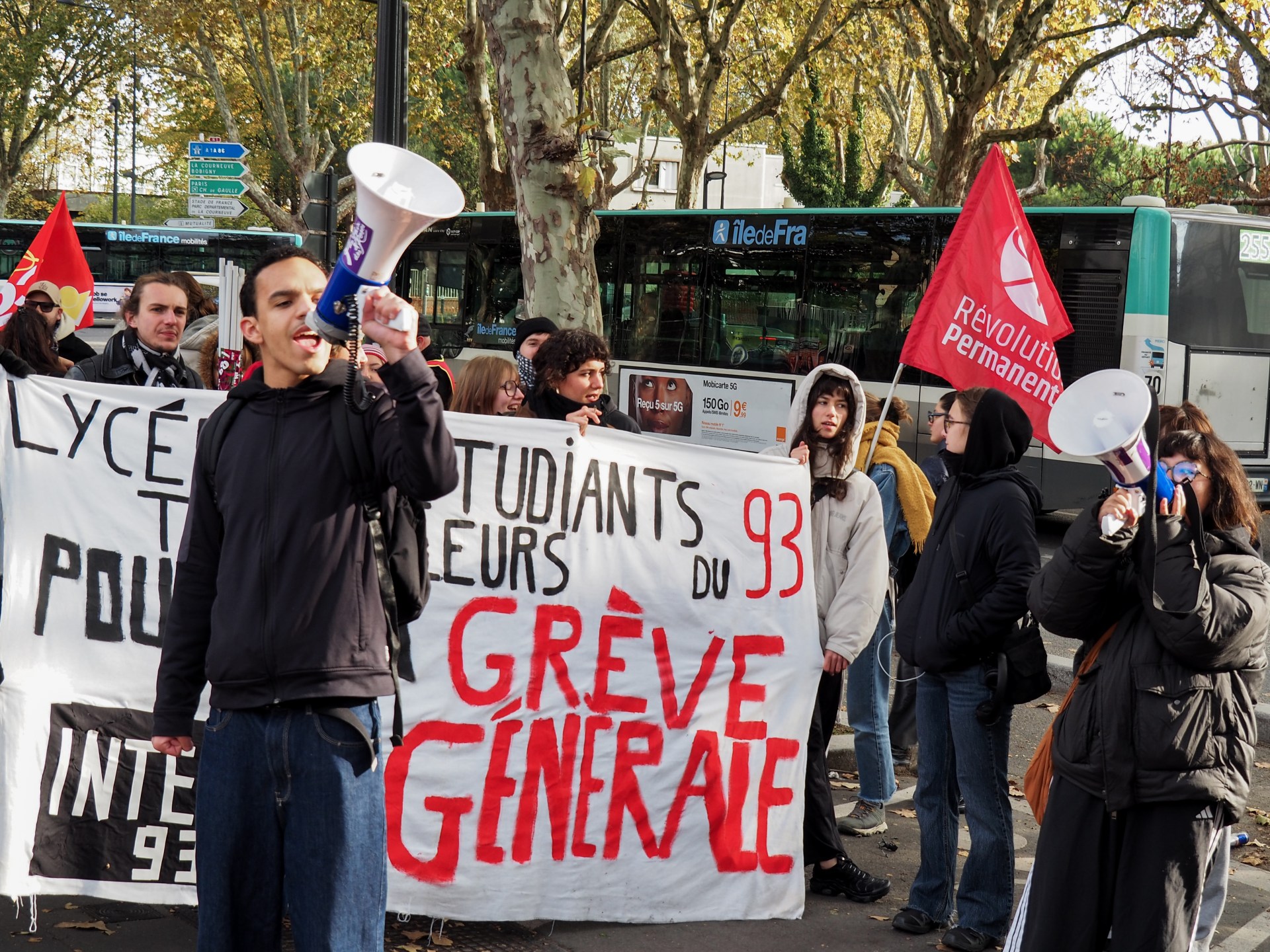

Paris, France – On a cold, rainy morning in early November, students and teachers met outside the locked gates of Paul Eluard, a high school in Saint-Denis north of Paris. Some were wearing costumes. For 17-year-old Kamelia, dressing as a dinosaur helped her to maintain the joy and hope that coexisted with the anger driving the student movement in mid-September.
“Costumes are the fun part. They show that it’s not all about violence. There’s also good cheer and fun in all of this,” Kamelia told Al Jazeera. “Today there are huge protests all over France, and it’s very important. I got up early, and even though I’m a little tired, I came anyway.”
- list 1 of 4Radical or hero?: France debates leftist candidate Jean-Luc Melenchon
- list 2 of 4‘Nobody can stop them’: Who are Europe’s Black Bloc protesters?
- list 3 of 4Mapping how France’s protest wave spread across Europe
- list 4 of 4France accelerates minimum wage hike in bid to quell protest
end of list
Four days after students at Paul Eluard returned from a mid-term break, they joined a national strike on November 5. Nearby, students from the trade school Bartholdi had blockaded the gates of their school. Although the size of the student protests peaked in early October, many young people, especially in the suburbs, are refusing to return to the classroom until some of their demands are met.
“Sometimes, we see rats in the courtyard and in the restrooms. The restrooms are a mess. We don’t have enough water; it flows very slowly. We don’t have enough to drink, and the restrooms are dirty. The hallways are dirty, the classrooms are dirty, and there are cockroaches,” 17-year-old Nohlan, a student at Bartholdi, told Al Jazeera outside the school’s blockade.
The movement started at a high school in Creteil, a suburb southeast of Paris in the Val-de-Marne region, on September 17, and rapidly spread to Saint-Denis, then the rest of France. Students blocked the entrances to their schools to protest poor classroom conditions and took to the streets.

“The movement started in the suburbs, then Paris followed suit. Now the whole world is watching us,” Kamelia said. “[In Saint-Denis], we’re basically ignored, even though we’re part of this country. But we’re here, and we are the future of this country.”
Advertisement
By the end of September, an estimated 400 schools across France, including some universities, had joined the student movement. Protests on October 17 in Paris saw an estimated 550,000 participants, according to the interior minister, while organisers put the number at 800,000.
Although this is not the first time in recent years that students in working-class suburbs have protested against school conditions, the scale of this year’s movement has been remarkable.
“It really started to gain momentum, and when everyone started to get involved, it was incredible. It really moved me because last year, we set up a few blockades, but no one heard about them,” Kamelia said.
Although students are at the heart of the movement, many teachers have since joined, expressing solidarity with their students and deploring the conditions under which they have to teach.
High school students are setting the pace for the movement, said Lucie Sabze, an English teacher at Paul Eluard.
“I’m impressed by the students, their demands and their political discourse, which is very lucid and very clear,” she told Al Jazeera. “I think the scale of the movement can be explained by a growing frustration.”
Teachers at Eluard are celebrating one “victory”. They had been calling for the resignation of the head teacher, who they accused of letting an officer from France’s notoriously violent motorised antiterrorism brigade into the school to arrest a student.
On Sunday, a government agency announced Xavier Artaud had stepped down “as a safety precaution”.
“Given the unacceptable public accusations made against the high school principal by name, he requested protective measures requiring his removal from the Saint-Denis area,” said the Academic Director of National Education Services.
Bruno Gbalou, an English teacher at neighbouring Bartholdi, noted that conditions have only deteriorated in recent years.
“It’s been about 15 years since I came back from England and started teaching here, and things have only gotten worse. So there are more students, but we have fewer resources,” Bruno Gbalou told Al Jazeera. “It’s not fair to the students, and it’s not fair to us, and that’s one of the reasons why we’re going on strike.”
In a statement to the media in early October, President Emmanuel Macron said the government planned to respond to students’ demands “in the most concrete way possible”.
“I understand the anxieties, sometimes the anger, that our youth can have, whether about the climate, technological changes or geopolitical situations,” Macron said.
Advertisement
But the students who spoke to Al Jazeera said they do not believe the government has offered them real solutions. The November blockade at Bartholdi in Saint-Denis was in response to a lack of solutions, said student Nohlan.
“There’s still no change. We’re hoping for change, but we’re waiting, and waiting,” he said.

Louis Boyard, a member of the French National Assembly for Val-de-Marne, the administrative area where the protest movement started, explained that the government’s policies have significantly reduced educational resources.
“Macron pursued a policy of austerity, and as a result, he gradually dismantled public education while providing massive subsidies to the private sector because he supports private education over public education,” Boyard told Al Jazeera. “Macron thinks that by sweeping the problem under the rug, people will just go home. That’s not true. The people speaking out can’t really afford to eat any more. One in three French people are skipping meals. People – young people – have gone too far in this movement to back down now.”
The left-wing France Unbowed (LFI) party, whose leader Jean-Luc Melenchon is currently polling about 20 percent in France’s upcoming presidential elections, has been accused of weaponising the student movement for political gain. But Boyard insisted that the movement was organic, and that LFI had simply followed because the party is “always on the side of those who fight”.
“Whenever there’s a struggle led by young people, I participate because I believe that young people have every right to get involved and fight,” Boyard said. “The movement took off because all the high school students looked at each other and said: ‘We’re not being respected. So we’re going to make sure we’re respected’.”
When he was a high school student, Boyard participated in a blockade, prompted by an asbestos problem, in 2018. Thanks to the protests, the students were able to get the school rebuilt.
“I’ve already won a victory this way, and we were justified in doing it. [The current students], too, are justified in doing it,” Boyard said.
As she inflated her dinosaur costume to join the protests in the centre of Paris, Kamelia wanted to send a message of hope.
“Everyone is rising up – all the young people. We’re a generation who’s truly awakened. It makes me so happy,” she said.
Related News
Spain’s deadly train crash redraws electoral battle lines
Israeli strikes hit Gaza as Health Ministry urges Rafah opening
Has Pakistan reopened its border with Iran for trade?