Afghanistan’s emerald miners struggle with tools but attract global buyers
 09 October 2026

Panjshir, Afghanistan — At a packed hall in the offices of the Panjshir provincial government, an auction is under way and the bidding is brisk.
The buyers, many from Kabul and some from overseas, have already closely examined the small piles of roughly cut green stones, shining their phone flashlights through them to check their quality.
- list 1 of 4The former Afghan soldiers turning to gem mining to survive
- list 2 of 4Developing Afghanistan’s mines will uplift Afghans
- list 3 of 4The benefits of Afghanistan’s mineral riches may not be so forthcoming
- list 4 of 4Taliban secures pragmatic global alliances without formal recognition
end of list
Bidding for the best stones is competitive.
“Panjshir emeralds have many buyers around the world because of their very high quality,” gem merchant Ghulam Mustafa Habibi told Al Jazeera. “This is why their price is higher compared with other emeralds around the world.”
![Afghanistan's Taliban government has identified hundreds of new sites to mine gemstones [Mohsin Khan Momand/Al Jazeera]](https://www.aljazeera.com/wp-content/uploads/2026/09/6af0b991-fcb0-4aa6-928f-f9b31ad0a7c6-1790670633.jpg?w=770&resize=770%2C513&quality=80)
By the end of the auction, nearly 3,000 carats of the precious stones were sold – the 23rd sale of its kind so far this year. The value of emeralds sold to date in Afghanistan is estimated to be nearly 400m Afghanis ($6.12m), a steep rise compared with last year.
For a country impoverished by years of war and burdened by international sanctions, the trade in precious minerals is a valuable resource, especially in the remote corner of northeastern Afghanistan.
“Thankfully, more than 15,000 people are currently employed in Panjshir’s mining sector,” says Muhammad Aman Rezaii, a mining official responsible for overseeing the operation of many small artisanal mining operations dotting the Panjshir valley.
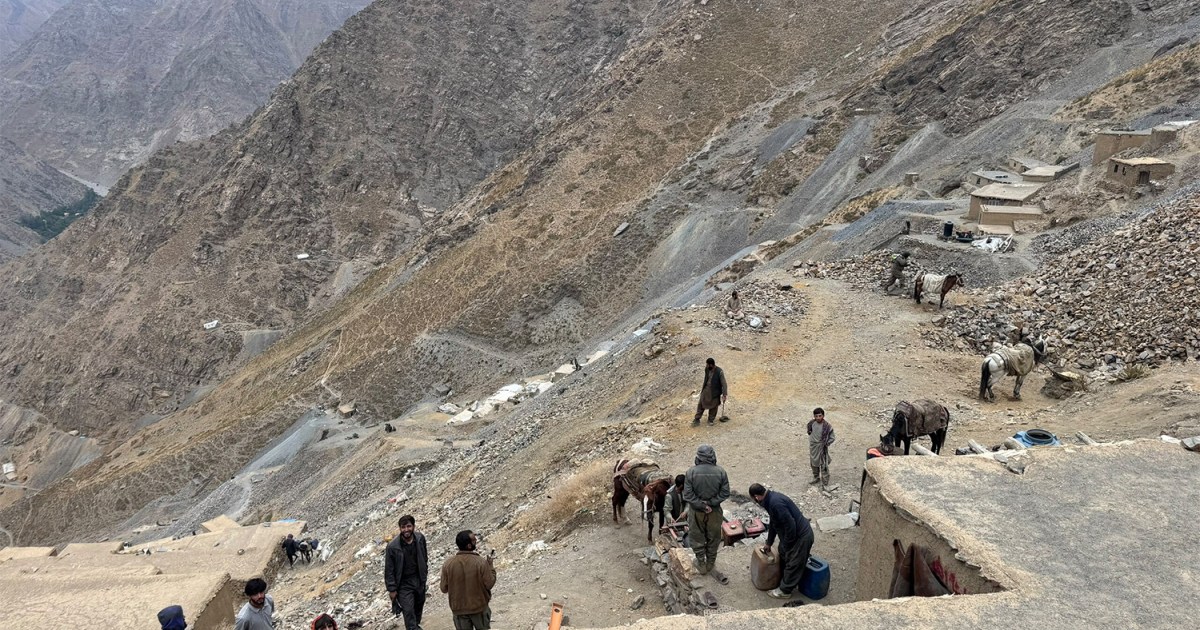
On the valley’s steep hillsides, miners toil for hours underground to make a living. In the otherwise barren and rocky landscape, which yields little, the precious stones are a lifeline.
Advertisement
“There are hardly any companies or manufacturing factories here. The main source of employment is the mining sector,” said Rezaii, adding that they have identified more than 2,000 other mining sites which could be developed.
![Afghanistan's Taliban government has identified hundreds of new sites to mine gemstones [Mohsin Khan Momand/Al Jazeera]](https://www.aljazeera.com/wp-content/uploads/2026/09/be8b8562-a1e2-4e96-aaa5-eecd1e2e7d1b-1790670636.jpg?w=770&resize=770%2C513&quality=80)
Since taking power in 2021, the Taliban say they have signed deals with dozens of investors, mainly Chinese, Russian and Iranian, to mine gemstones and other valuable minerals.
According to the World Bank, state revenues rose 22 percent year-on-year in April and May, boosted by the auction of mines and other resources such as oil and precious minerals.
But Afghanistan’s gemstone mining sector is still lacking in international investment and expertise.
“There have been various proposals to establish an international market for Afghanistan’s precious minerals, particularly in Kabul,” Hafiz Muhammad Agha Hakim, the Governor of Panjshir province, told Al Jazeera.
“Processing machinery could be brought in so that these minerals can be processed and standardised here before being exported to markets around the world. At the moment, there is no standardised centre or proper processing facility.”
![Afghanistan's Taliban government has identified hundreds of new sites to mine gemstones [Mohsin Khan Momand/Al Jazeera]](https://www.aljazeera.com/wp-content/uploads/2026/09/6af124e6-e19c-4c9e-ab0f-833eeba78cf0-1790670623.jpg?w=770&resize=770%2C513&quality=80)
Back in the dusty confines of his mine, working in near-total darkness, miner Mahdi wields a crowbar while his friend beside him hits the surface with a hammer. He bemoans their lack of modern equipment.
“There are many challenges because we don’t have advanced equipment,” he says, taking a break from the digging. “We work only with basic tools such as shovels, pickaxes, drills and similar equipment.”
Rezaii said the miners need proper equipment that can make their work easier and safer, while also allowing the minerals to be extracted in a more professional manner. This would benefit the people of Afghanistan and particularly the miners,” he said.
“The area is vulnerable to landslides, avalanches, flooding and falling rocks. People here are working under extremely difficult and demanding conditions.”
Related News
Ethiopia’s PM insists on access to Red Sea despite regional conflict threat

Israel bans Arab parties from election: Who they are, why it matters

Blast in Pakistan’s Dera Ismail Khan kills several people