


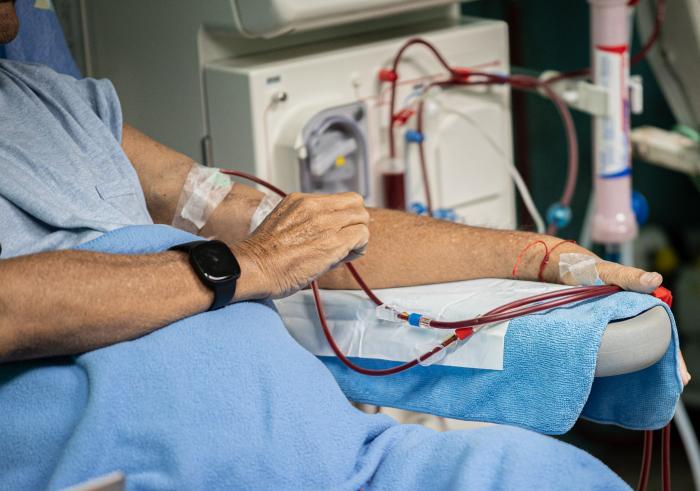
She extends her arm, they insert a catheter into the vein, the blood begins to flow: "We can't live without this."
She extends her arm, closes her eyes, and wishes the four or five hours she must be connected to the dialysis machine would pass quickly: "But I have to keep going. For myself and my family, I have to keep going."
And I think that, although we know little about the history of the sky, she seems to be an expert on the origin of the tenacity of that blue which, without delving too deeply, is surely the place where hope resides.
"I’ve been receiving treatment since 2020, because I had COVID-19. There comes a point when you get depressed, you cry because it’s a life change, something you don’t want. But with time you learn to love the machine. And like I said: I have to depend on it, and if there’s no fuel, nobody here could get hemodialysis," says Zurama, a hemodialysis patient.
***
It's after 9:00 a.m. Outside, the street is peaceful; people are going about their daily lives. Here, at the Dr. Abelardo Buch López Institute of Nephrology in Havana, the first shift for hemodialysis treatment has begun. It feels as if life has just started.
Julio César Candelaria Brito, head of the institute's hemodialysis service, knows a great deal about this simultaneous hustle and bustle. He says that to ensure the service functions properly, it must be viewed as a system, because it encompasses transportation, healthcare—"which is not just the dialysis treatment, but also
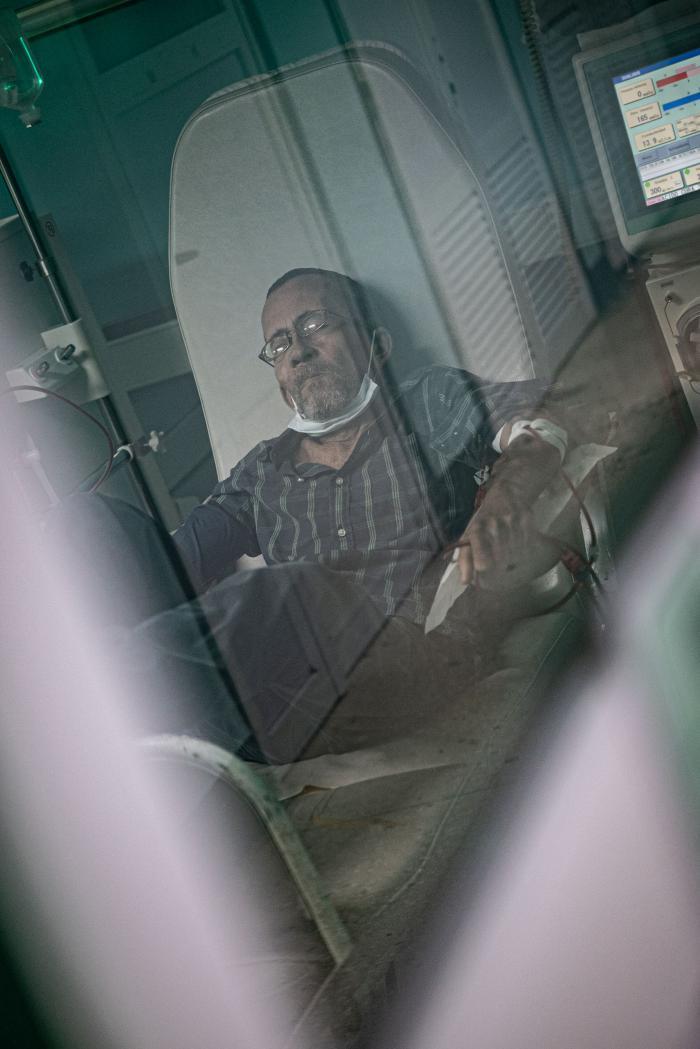
medications and supplies"—and spiritual support.
He believes that to work here, "you have to have a lot of empathy and put yourself in the other person's shoes. It's a treatment that constantly battles with death, and we do everything in our power."
There are 57 hemodialysis units in the country, serving more than 3,000 patients who require renal replacement therapy. Of these, 45 are treated at the institute in Havana. A taxi—arranged in advance with the Ministry of Transportation—is supposed to pick up all of them daily at their homes and take them to the center. But this seemingly simple process, as well as the movement of medical supplies and staff, is hampered in Cuba by fuel shortages.
One example is the frequency with which these dialysis supplies are delivered, which must be stockpiled in large quantities. While deliveries used to be almost daily, these days they are made in small batches. "We're waiting for the truck to arrive today to ensure we can start tomorrow's hemodialysis session," says Julio César.
And if we add to this the constant electricity needed to run the dialysis machines and the plants that must deionize the water—because it's necessary to remove elements that could cause infection—maintaining the service—like all the others—will be difficult if the oil blockade continues, if the effort to suffocate an entire population persists.
***
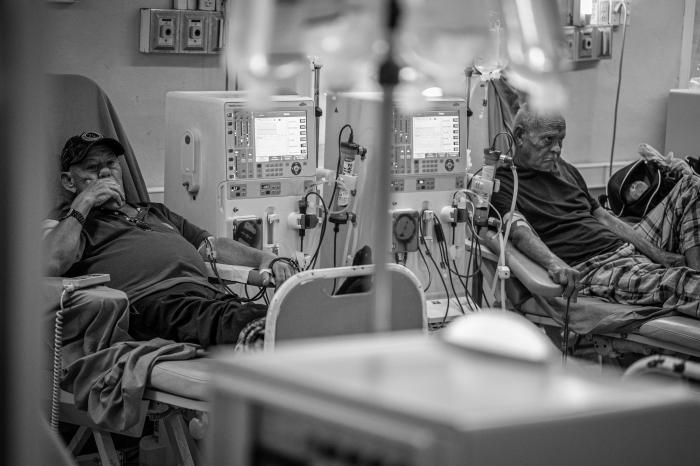
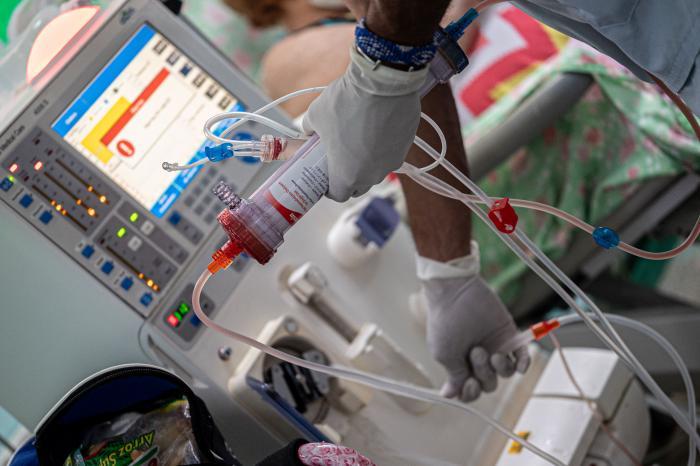
The machine constantly monitors the parameters: conductivity, blood flow, filtration rate, and the volume of water extracted.
A cylindrical filter containing a semipermeable acetate membrane facilitates the exchange. Blood enters at the top and flows downward, while the dialysis fluid rises. They circulate in opposite directions.
The head of the hemodialysis unit checks the time remaining for a patient. One hour and 36 minutes. "Not long now." Dairy Rodríguez Barreto, head nurse, approaches and tells me that these machines have batteries, "but they're old, the batteries don't last long, and it would be quite difficult to work without electricity." Without hemodialysis, the patients could die.
***
They say Armando is always present, "one way or another, he always gets to the Institute." On the days he's not driving patients, he's been a patient himself for the past four years. That's why he says, "This is all I do, no matter what time I leave."
"Now they've put me on standby like an emergency response team. If a car breaks down, they call me, and I'm always there on alert. Until recently, I was taking a patient to the Military Hospital, but with all the problems with gasoline, I don't do it anymore. It's too far away."
In that regard, the taxi company has limited the measure of combining several patients who live in adjacent areas into a single shift, depending on availability. However, there are many people with kidney disease who depend on companions because the treatment weakens them, "but that companion can no longer come in the car," says nurse José Carlos Castillo Curbeco.
In fact, there are patients who can't get here, and we've often had to admit them to the emergency room, because missing a single day puts their lives at risk. So, it's essential that they stay connected to that artificial kidney, explains José Carlos.
And as a precaution, beds have been made available for people who can't attend their dialysis treatment.
***
Yamilé García Villar, the Institute's director, has the kind of gaze that doesn't need words to explain what's happening.
I sometimes saw her walking through the hallways, overseeing the treatments. She explains that "we've experienced breakdowns in the water treatment system, which have delayed the start of hemodialysis sessions, which, of course, have set schedules. In those situations, the technical staff has been mobilized, and then the sessions restart at a later time, with hemodialysis finishing at 4:00 a.m."
However, she says, the program hasn't stopped at any point. "Although we've faced challenges, we always ensure that the necessary resources are available on time."
Furthermore, while dialysis machines are designed to last around five years, they require annual maintenance. However, the economic and financial limitations imposed by the United States have prevented this maintenance from being carried out effectively, and the hemodialysis machines are breaking down more frequently.
How can an island be sustained if not by the love of its people?
Yamilé knows this well, and although the answer doesn't come from her lips, just by observing her I know that if it weren't from that position, if it weren't from love, the weight of the Cuba we live in—and the one those in the North allow us to live in—would overwhelm us.
"All illnesses have a psychological component, and the certainty that treatment is guaranteed provides a certain well-being and confidence. When there are threats, especially in this way, which is real, which is palpable, the patient feels fearful.
"We are experiencing this. There is fear that there won't be continuity of treatment, even though we know of the political will that is developing, of the commitment of the staff, and I'm not referring only to doctors or nurses, but also to lab technicians, kitchen staff, drivers."
And here we are talking about lives: why are they being threatened?