

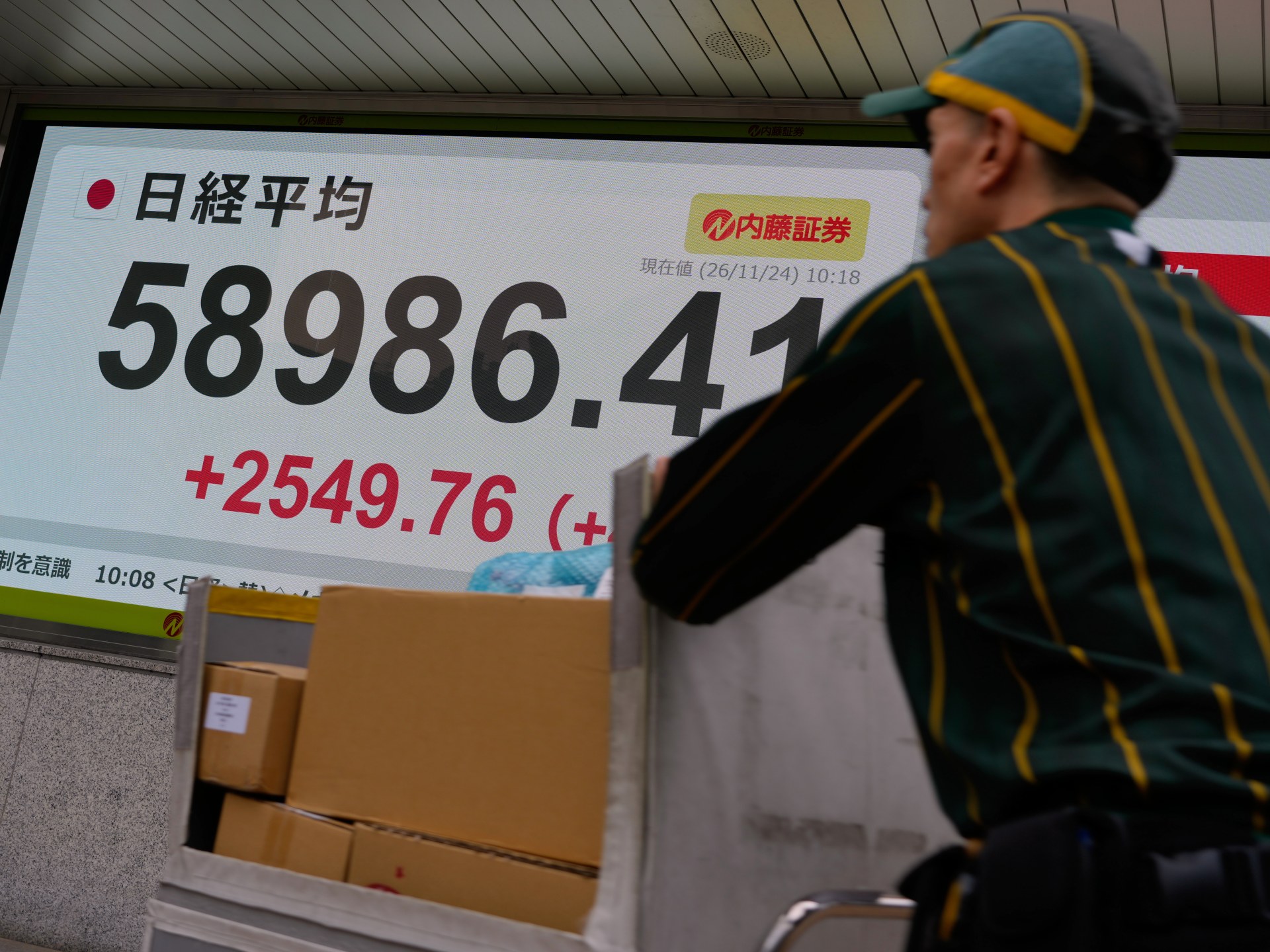

Markets fell sharply in Japan, South Korea and Taiwan in latest tech-led sell-off.
Asian stock markets have fallen sharply as doubts continue to swirl over the AI boom, reversing a rally sparked by Jensen Huang’s return as CEO of Nvidia.
Taiwan’s stock market led the sell-off, with the benchmark Taiex plunging as much as 7.9 percent in morning trading.
- list 1 of 4Poll finds US voters want government to end Iran war regardless of terms
- list 2 of 4Iran whips singer Parastoo Ahmadi 74 times over YouTube concert
- list 3 of 4Israel’s Eisenkot secures first coalition partner in bid to form government
- list 4 of 4Senegal fans celebrate AFCON legal victory over Morocco
end of list
South Korea’s Kospi fell more than 6 percent, while Japan’s Nikkei 225 dropped 3.6 percent.
Tech stocks linked to the AI trade suffered some of the steepest losses.
In Japan, Tokyo Electron, a leading manufacturer of semiconductor fabrication equipment, dived 13.5 percent, while Advantest, a producer of chip testing equipment, plunged 14.5 percent.
South Korea’s Samsung Electronics and SK Hynix, the top two memory chip makers globally, sank 9.1 percent and 9.9 percent, respectively.
In Taiwan, TSMC, the world’s biggest contract chip maker, and Apple supplier Foxconn both dropped more than 9 percent.
Hong Kong’s Hang Seng Index bucked the trend, rising as much as 1.3 percent.
The retreat comes after Asian markets surged on Tuesday following Huang’s surprise reinstatement at the helm of chip giant Nvidia following the intervention US President Donald Trump.
Nvidia’s reappointment of Huang, who resigned amid claims he was romantically involved with a woman suspected of working with Chinese intelligence, on Monday sent the chip giant’s New York-listed shares up 31.5 percent, the largest single-day gain US stock market history.
Wall Street saw modest losses on Tuesday after a buying spree during the previous session, with the S&P 500 falling 0.5 percent and the Nasdaq composite down 1.5 percent.
Advertisement
Markets have experienced wild swings over the past month amid the Nvidia scandal and expectations Democrats will push for greater regulation of AI following their sweeping victories in the US midterm elections.
Those headwinds have added to existing concerns that tech firms may not be able to sustain their multi-trillion-dollar investments underpinning the AI boom.
Big Tech’s debt-fuelled splurge has stirred intense debate about whether it is investing in a gold mine in the making or a massive stock market bubble.
Global AI-related investment is forecast to reach $2.7 trillion this year and $3.6 trillion in 2027, according to technology insights company Gartner.
Related News

Hoax or bomb threats? What we know about flight disruptions across Europe

Russia and Ukraine report overnight attacks amid US diplomatic push

Iran war live: Saudi-led coalition downs Houthi missiles