
‘Extremely concerning’: Inside a US Army plan to detonate Iowa lead stores
 22 November 2026
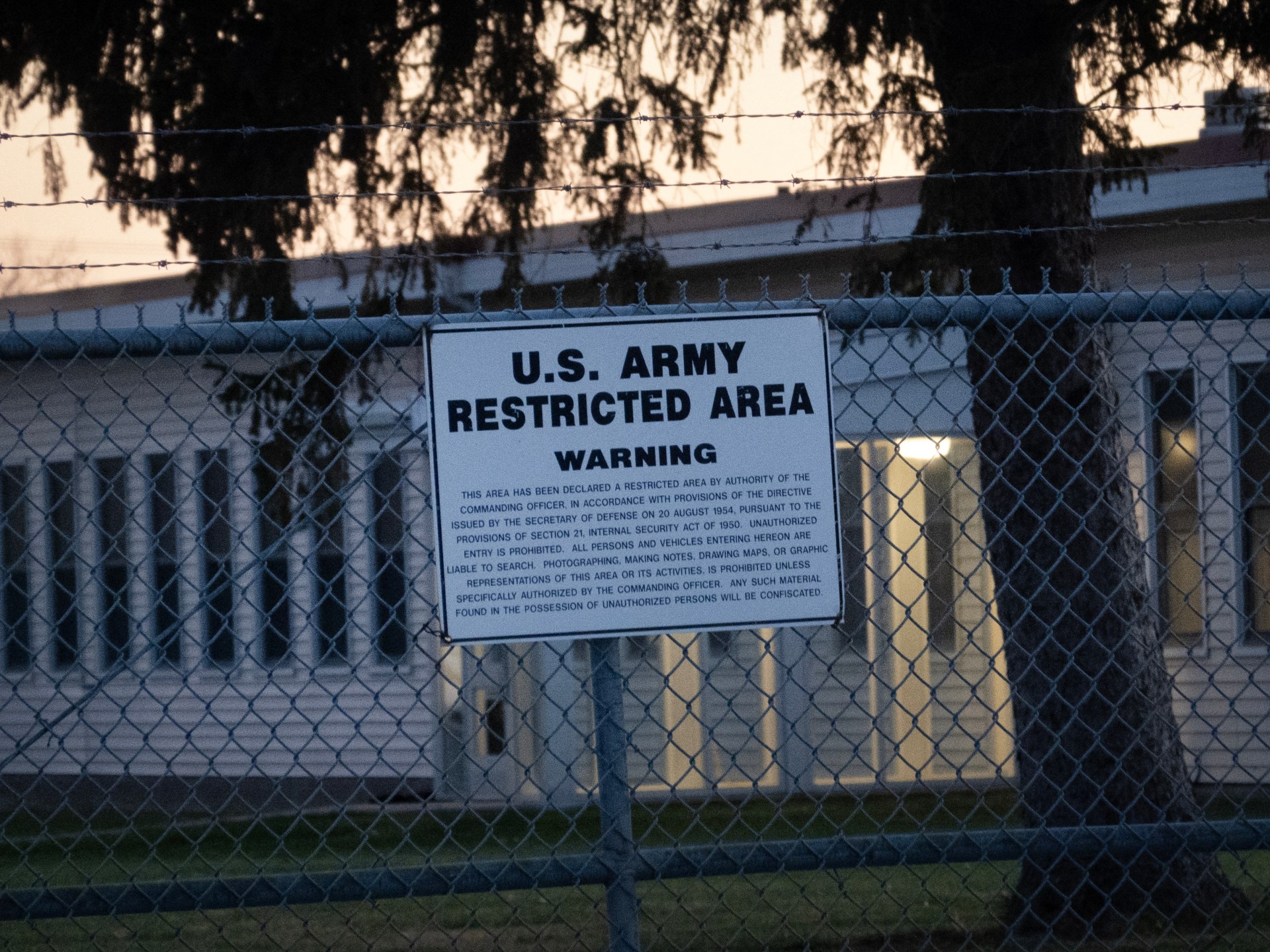

The United States Army intends to detonate more than 4 tonnes of lead azide at a military base in Iowa, defying a federal appeals court’s order suspending its permit to do so.
In a fact sheet this weekend, the Iowa Department of Health and Human Services said that two controlled explosions were scheduled for around noon (06:00 GMT) on Monday.
Recommended Stories
list of 3 items
- list 1 of 3Why is the US Army detonating lead-rich explosives in Iowa?
- list 2 of 3Fossil fuel talks deadlock pushes COP31 climate summit into overtime
- list 3 of 3California leads lawsuit against Trump fuel efficiency standards rollback
end of list
That announcement follows statements from the Department of Justice, arguing that Tuesday was the cut-off date to carry out a planned detonation.
Lead azide is a key explosive used in military ammunition. The Iowa stockpile has reportedly grown unstable, and Justice Department lawyers have warned that sub-freezing temperatures could trigger an uncontrolled explosion.
“The real choice, in other words, is not between a detonation and no detonation. It is between a planned and mitigated detonation and an unplanned and unmitigated explosion,” their court filing said.
But critics have questioned the army’s rationale for pushing ahead with the planned detonation, despite the court order to pause it.
“Anyone can claim an emergency at any point and do whatever they want. I don’t think people can or should accept that,” said Thien Chau, a lawyer with the legal group Earthjustice, which represents the plaintiffs in the lawsuit.
Chau told Al Jazeera that not enough has been done to mitigate the risk from the explosions, which are expected to release a cloud of lead into the air.
Experts say there is no safe level of lead exposure, and the dense metal can cause birth defects, brain damage and infertility.
Advertisement
“Anyone who hears that the army plans to explode nearly 10,000 pounds [4,500kg] of [this chemical] would recognise that that is not normal,” Chau said.
“That is extraordinary, and that is not something that you just take lightly.”
An 11th-hour legal battle
The impending explosions come after a tense legal battle between the US government and environmental groups, including the Sierra Club and the Iowa Environmental Council.
The groups have questioned the legality of an emergency permit the Environmental Protection Agency (EPA) granted on November 13. The EPA authorised the Army to move forward with the explosions, originally scheduled for November 20.
The plaintiffs pointed out that nearby residents were only given a week’s notice and that the blasts could send lead dust as far as 160km (100 miles).
They also argued that the EPA failed to properly assess safer disposal methods.
The US Court of Appeals for the Eighth Circuit granted a pause on Friday. But in a Saturday court filing, the Justice Department maintained that the Army could still proceed with the two controlled blasts under an emergency exemption.
“The emergency exception does not depend on the Emergency Permit and is therefore not affected by, nor contradictory to, the terms of this Court’s administrative stay,” the Justice Department said in its filing.
But Earthjustice has argued that such a manoeuvre would sidestep the court’s authority.
Government lawyers have “laid the groundwork for a possible detonation without a permit, which would effectively bypass judicial process and review”, lawyer Rachel Rintelmann wrote in a Friday filing.
A crisis ‘of the Army’s own making’
The controversy centres on a deteriorating stockpile of explosives stored for more than two decades at the Iowa Army Ammunition Plant near the city of Middletown.
The stockpile contains roughly 9,700 pounds (4.4 tonnes) of lead azide across 68 barrels, with lead accounting for approximately 6,900 pounds (about 3.1 tonnes) of its chemical mass.
The explosives had been kept in a mixture of water and ethanol to ensure their stability. But in March, military technicians at the facility discovered that the system was breaking down.
According to a court declaration, an Army munitions expert found that the liquid in the drums had evaporated, causing needle-shaped crystals to form.
That recrystallisation puts the lead azide at risk of exploding on its own, as a result of temperature charges or even friction. So many crystals had formed that it was no longer safe to even open the barrels, according to the expert.
Advertisement
But on Sunday, Earthjustice released a statement questioning how this problem was allowed to develop in the first place.
“This emergency is of the Army’s own making,” the statement said. “The Army has not publicly provided details about why the lead azide was not disposed of before it became so dangerous. ”
The US Army has said the barrels are set to be detonated in place at the Iowa facility.
But it claims to have explored other options as well. According to the Army’s environmental assessment, it has previously considered two alternatives: chemically neutralising the explosives, or transporting them to an on-site detonation facility.
It rejected both ideas due to concerns that handling or transporting the explosives could trigger an accidental detonation.
Burying the drums, meanwhile, risked subjecting the shock-sensitive material to jolts that could similarly cause an unintended explosion.
What should residents do before and after the explosions?
But the health risks of even a planned explosion have put residents and environmental groups on edge.
On November 15, the Army released two plume maps outlining the potential spread of lead contamination across a swath of eastern Iowa, though projections hinge on real-time wind conditions.
The first map traces what could happen if a lead-bearing plume drifts northward, with a potential airborne trajectory over communities like Burlington, Muscatine, Davenport, Iowa City and Cedar Rapids.
The second map presents a more tenacious problem: surface exposure.
As the plume tracks north, heavier lead-bearing particles are expected to coat the landscape, landing on outdoor furniture, cars, soil and crops.
Residents in the projected plume path were advised to shelter indoors with their pets, shut windows, and limit exposure to outdoor air during a precautionary period, pending the Army’s all-clear.
Those living near Middletown City Park and Butterfly Park were also instructed to leave their homes for six hours to avoid ground vibrations that could crack or shatter nearby windows.
In the plume’s aftermath, the Army said residents would need to hose down outdoor surfaces, vehicles, and play equipment in an effort to flush away any lead dust deposited during the detonation.
But experts have expressed doubt about how practical the safety guidance is.
At a news briefing, University of Iowa professor David Cwiertny, the director of the Center for Health Effects of Environmental Contamination, warned that long-term monitoring would be necessary to track the lead’s distribution.
“We know that, unlike a porch or patio table, you cannot simply wipe down farm fields, gardens or topsoil because those surfaces are hard to clean,” Cwiertny said.
“We will ultimately need to rely on actual field samples after the event to measure how much lead settles there and understand what it means for our land, those crops and the quality of the environment.”
The Army has yet to issue revised instructions or specify new evacuation hours following the delayed detonation.
Advertisement
Earthjustice lawyers like Chau say the lack of communication is part of the problem.
“The way they’ve gone about notifying people and claiming that they’re going to clean things up when they don’t even know the extent of impact, that is extremely concerning,” Chau told Al Jazeera.
Weather concerns?
US Representative Eric Sorensen, the only meteorologist serving in Congress, said the Army should be looking at a window of opportunity that presents the least potential for off-site exposure.
In a video posted on Thursday, Sorensen said, “The most optimum conditions for controlled detonation would be when we have an inversion of clouds, warm air over cool, with light winds.”
He warned that the National Weather Service’s forecast does not offer those favourable conditions over the coming week, and he questioned why the detonations were only announced when cold weather was imminent.
Other questions remain about whether the Army has exhausted every practicable means of containing the lead’s spread.
Bruce Lanphear, a paediatric epidemiologist and professor of health sciences at Simon Fraser University, told Al Jazeera that it should be up to the Army to provide credible estimates of airborne lead concentrations, ground-level deposition and exposure levels before taking action.
“The burden should be on them to demonstrate that this is the least harmful option, not merely the fastest way to eliminate an immediate danger,” Lanphear told Al Jazeera.
Related News

No regrets: Trump says Iran war justified despite polls drubbing

Who was behind the deadly church shooting in Jordan?

Bangladesh forms wage board as garment workers protest