
Trump says Israel, Gulf allies must repay Iran war cost: What does it mean?
 10 November 2026
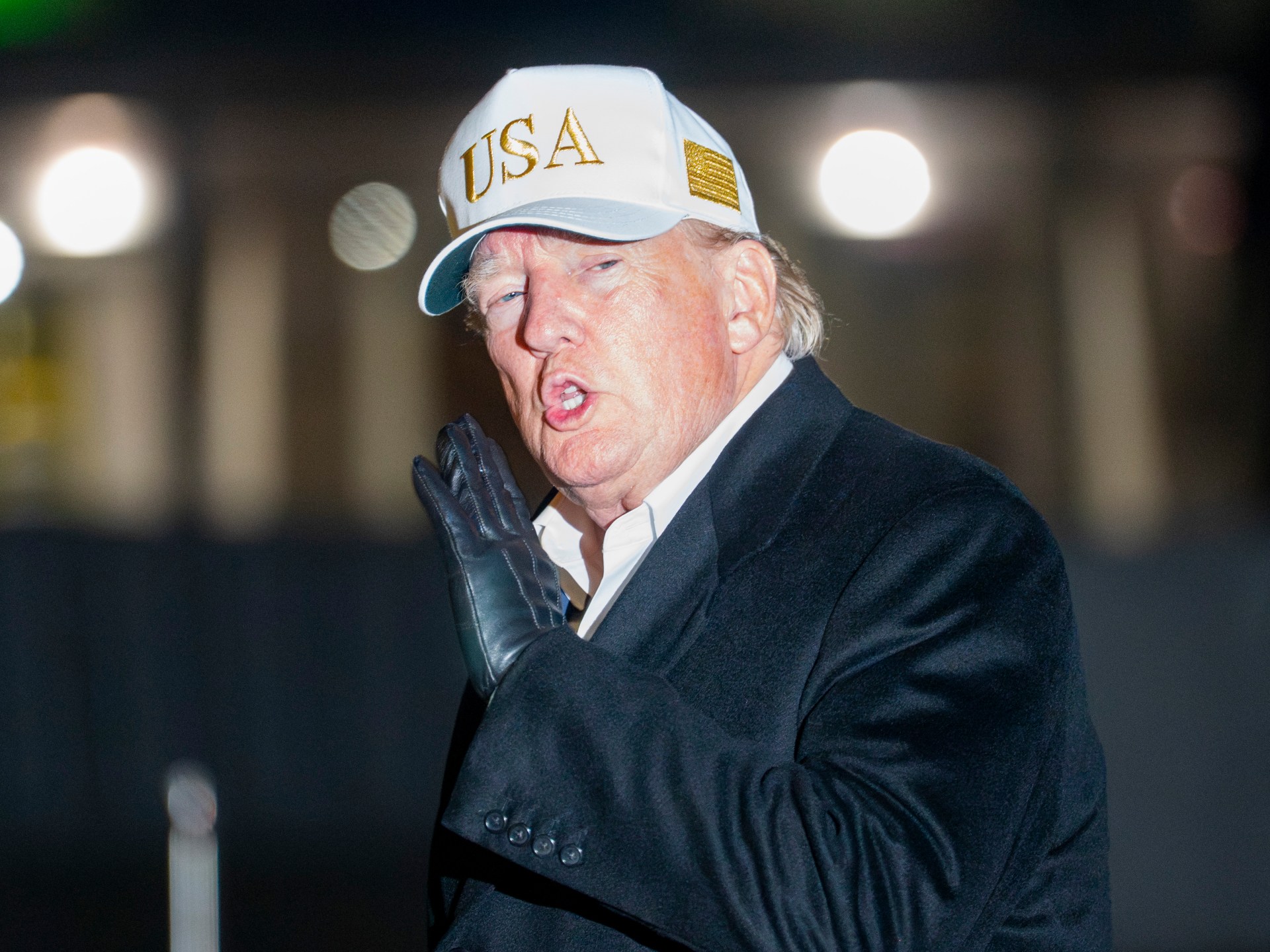

United States President Donald Trump has said the US plans to seek compensation from countries it “protected” during its war on Iran.
In an interview with CBS News correspondent Ross Douthat that aired Sunday, Trump said such countries would “pay us any and all costs we had for the war”.
- list 1 of 3Who are the seafarers caught in the US-Israeli war on Iran?
- list 2 of 3Iran stands by demands to end the war as US ramps up military pressure
- list 3 of 3The anti-Netanyahu: Can Gadi Eisenkot give the world a different Israel?
end of list
“We’re going to get all that money back,” Trump said. “They’re going to do it, 100 percent. Because without us, they wouldn’t exist.”
For the first time, Trump also explicitly spoke of compensation from Israel, which he said “wouldn’t exist” without US military intervention.
The reimbursement demand comes after Trump and his Republican party took a drubbing in midterm elections, which the president has conceded was partly due to public discontent over the Iran war.
The US president has since declared the war “effectively over” militarily, while defending his decision to start the conflict as “a very good decision”.
Here’s what to know about Trump’s demand for repayment, and what it could mean for the US and its allies:
Which countries does Trump want compensation from?
Trump — for the first time — singled out Israel, which was a direct participant in the war against Iran from the outset.
“We decapitated their [Iran’s] nuclear arsenal,” he said. “If I didn’t do that, there would be no Israel right now. Israel would be gone.”
Previously, Trump has said he would seek repayment from Gulf countries that benefit from the US military presence around the embattled Strait of Hormuz, where US forces have been escorting vessels.
Advertisement
“We’re protecting a very rich portion of the world, we’re spending money, and so what we’ve done is we’re going to be reimbursed for protection,” Trump said during a press briefing in July.
He named Saudi Arabia, the UAE, Qatar, Bahrain and Kuwait as countries that should pay.
But while Israel jointly launched the war on Iran with the US, Gulf countries have said that they were not even informed about Washington’s plans, and have since borne the brunt of Iran’s retaliatory attacks. As members of the Gulf Cooperation Council (GCC), they have called for a diplomatic resolution to the conflict.
How much has the Iran war cost the US?
$47.1bn as of mid-October, according to the US military.
But the full cost is likely to be even higher, as that figure excludes the cost of repairing damage to US military bases across the Middle East.
The Congressional Budget Office in September estimated the conflict would carry an additional cost of $2bn-$3bn for each month it continues.
Will Trump actually seek repayment from allies?
Probably not directly, analysts say.
Neil Quilliam, an associate fellow at Chatham House’s Middle East and North Africa Programme, told Al Jazeera that Trump’s comments are “best understood as political signalling rather than a serious policy proposal.”
Gulf states in particular are likely to take Trump’s comments “with a grain of salt,” added Bader al-Saif, an assistant professor of history at Kuwait University and associate fellow at Chatham House’s Middle East and North Africa programme.
“I think what [Trump] stated on an American news channel was for domestic consumption, and I think that’s how most of the Gulf states will take it,” said al-Saif.
Stefan Lukas, an analyst specialising in Middle East and North Africa security and foreign policy, also pointed to Trump’s domestic political considerations, saying the US president has been “looking for someone to blame … and has been doing everything in his power to divert attention from the midterm election results”.
Lukas told Al Jazeera it is unlikely that Washington’s Arab allies in the region will face large compensation payments “or anything similar”.
However, he suggested that Trump could be more serious about seeking economic concessions from Israel, particularly after announcing that the country would no longer receive US aid after the end of this year.
That is partly because, from Trump’s perspective, “Israel pushed him into a disastrous war with Iran”, Lukas said.
What would compensation look like?
Al-Saif said Trump could be “very innovative” in defining what constitutes repayment for the war, potentially pointing to existing trade agreements or investment from the Gulf.
Advertisement
“There’s many agreements for him to go back to and to claim,” said Al-Saif. “There have been a lot of [Gulf] pledges for investment in the US.”
Farid Boussaid, an assistant professor in Middle East politics at the University of Amsterdam, said Washington could push for further Gulf investment and present it as compensation.
“This will most likely be indirect and take the form of commercial investments in the US, buying of US weapons systems – on top of what has already been ordered – and investments into close associates of Trump’s financial dealings,” said Boussaid.
Trump has repeatedly made misleading claims about foreign investment and trade agreements in the past, portraying them as payments or gifts to the US.
After a July 2025 trade deal with the European Union, Trump claimed the bloc had given the US a $600bn “gift” that could be invested in “anything we want”. However, the framework agreement referred only to an expectation that European companies would invest $600bn across strategic sectors in the US through 2028.
The same month, Trump described a $550bn investment pledge from Japan, under a new US-Japan trade agreement, as being “like a signing bonus that a baseball player would get”.
During Trump’s first term, he repeatedly claimed that Mexico would pay for a border wall – which was never completed and which Mexico did not pay for. Trump later qualified his claim to say that Mexico would reimburse the US for the wall or pay for a “piece” of it, which also never happened. Trump at one point claimed that the benefits of a trade pact he negotiated with Mexico would cover the cost of the wall.
How will US allies react to Trump’s demands?
Having already suffered extensive financial losses during the war, the US’s Gulf allies will not take well to being asked to pay more for a war they did not start, say analysts.
Quilliam said Gulf leaders would likely respond to any demand for direct repayment with “quiet resistance”, arguing that they “already contribute significantly to the cost of regional security through defence cooperation, investment and economic partnerships with the US”.
Gulf states also pay for the maintenance of several large bases that the US uses for military operations in the region.
Boussaid said Gulf states will be particularly averse to such a demand as “the US-Israeli war led to considerable damage to their [civilian] and military infrastructure when Iran struck back”.
Al-Saif added that Trump’s “condescending language does not bode well for partners long invested in the relationship with the US”.
As for Israel, it looks unlikely to “reverse its longstanding role as a recipient rather than a provider of support in its relationship with the US”, according to Marzieh Kouhi Esfahani, assistant professor of politics and international relations of the Middle East at Durham University.
“While Israel and the United States continue to share intelligence and coordinate on regional security issues, any request for Israel to shoulder a meaningful share of the financial burden would run against established practice and Israel’s present resource constraints,” she said.
Related News

Israel’s Shin Bet finds no evidence of foreign election meddling: Report
Security officer killed in stabbing attack in Jordan’s capital
Michigan Senate debate: Key takeaways from El-Sayed, Rogers clash