‘One less gang leader’: Haiti’s prime minister celebrates police operation
 07 November 2026
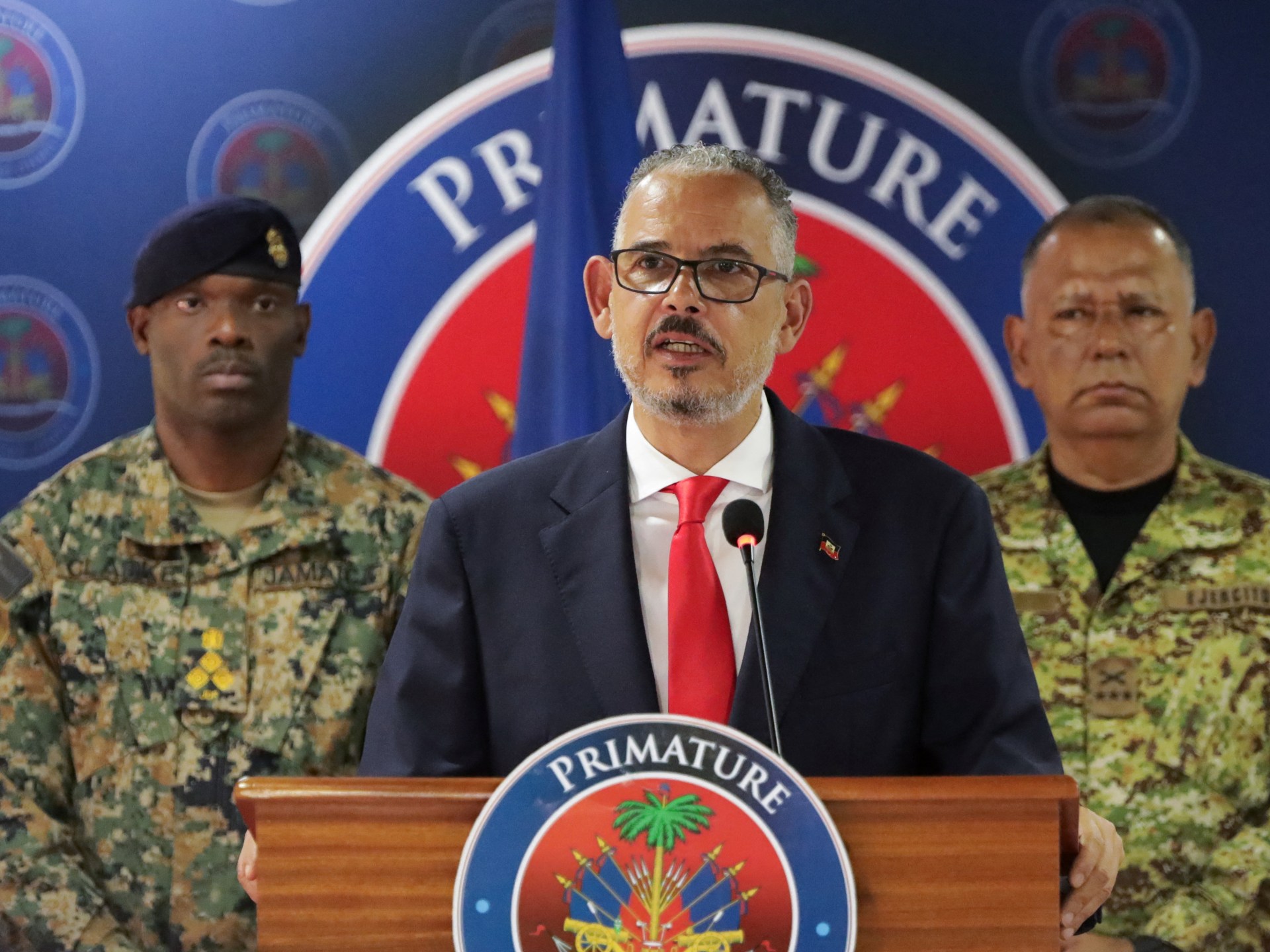

Haiti’s National Police (PNH) has confirmed that a gang leader known as Mathias Saintil was “neutralised” as part of a recent law enforcement operation.
In a social media post shared on Friday, officials described Saintil as the leader of the Boston gang, named for a neighbourhood in Cite Soleil, an impoverished part of the capital, Port-au-Prince.
- list 1 of 3El Salvador’s Bukele threatens Haitian gangs over abducted soldiers
- list 2 of 3El Salvador pledges more than 2,000 soldiers as Haiti delays elections
- list 3 of 3El Salvador’s Bukele touts military intervention in Haiti
end of list
Saintil was reportedly struck by “multiple bullets” during a law enforcement operation, and a police source said he died later in the hospital.
Prime Minister Alix Didier Fils-Aime celebrated the news with a social media post of his own.
“One less gang leader,” he wrote in a mix of French and Haitian Creole. “The battle to liberate the country from the grip of bandits continues with determination. The gangs won’t be able to sleep!”
Haiti has struggled with a surge in gang violence for years, most notably after the assassination of then-President Jovenel Moise in 2021.
The assassination left the country in crisis, and no national elections have been held in the years since. Amid the political turmoil, organised crime in Haiti sought to expand its influence, claiming large swaths of territory.
As much as 90 percent of Port-au-Prince has fallen under gang control, including key roadways and maritime ports. At least 26 gangs operate in the area in and around the capital, according to the United Nations.
Haiti has long struggled with political instability, economic decline and successive natural disasters. It has been ranked as the poorest country in the Western Hemisphere.
Advertisement
The country’s gangs often recruit young people with the promise of food, income and protection. The UN estimates that half of the country’s gang members are children and teens under the age of 18.
The violence, however, has led to a spiralling humanitarian crisis. At least 1.4 million people have been displaced from their homes, particularly in the capital area.
Some 1,123 Haitians were killed in the violence between July and October of this year, according to the UN. Another 440 people were injured during that time period, and rates of sexual violence remain high: Between July and August, there were 689 cases of gang-involved rape.
The crisis has prompted widespread outcry. In April, members of a new international Gang Suppression Force (GSF) began arriving in Haiti, with a mission to “neutralise, isolate and deter gangs”.
Its 12-month mandate was renewed in September, with the UN Security Council granting an extension until March 2027.
But the GSF has encountered many of the same setbacks that faced its predecessor, the Kenyan-led Multinational Security Support (MSS) — namely, insufficient resources and staffing.
Proponents of the GSF have called on the international community to fulfil its commitments by funding the force to the fullest extent.
Members of the GSF have also come under attack as part of their clashes with Haiti’s gangs. On October 18, for instance, four Salvadoran aviation technicians involved in the GSF were kidnapped.
El Salvador has responded by surging as many as 2,000 troops to Haiti. Salvadoran President Nayib Bukele described the deployment as a rescue mission.
“We have one single objective: to ensure our four compatriots return home alive and unharmed,” Bukele wrote on October 21, sharing a video of armoured vehicles patrolling Haitian streets, some firing guns.
“But I want you — the gang leaders — to understand one thing very clearly,” Bukele added. “Today’s attack is nothing compared to what is coming if you do not return all four hostages alive.”
He has since called on Haitians to “rise up” and “reclaim control of your communities”. He also insisted that his forces are not “invaders”.
Human rights watchdogs have criticised Bukele for his heavy-handed approach to gang violence in El Salvador, which he has addressed in part through mass arrests and mass trials.
Bukele has warned he is “capable” of deploying the same tactics against Haiti’s gangs. In his latest post on Friday, Bukele interacted with a social media user who suggested they had identified the residence of a prominent Haitian gang leader.
Advertisement
“Where is this house located?” Bukele asked. “Give us the exact address, and we will destroy it.”
Related News
Qatari officials in Iran in bid to revive ceasefire deal with US

How Iran messaging highlights cost of war ahead of US midterm elections

Conservative Party suspends ex-candidate filmed in Al Jazeera investigation