

The head of the United Kingdom’s domestic spy agency has said Iran is ramping up attempts to strike sensitive military targets after a series of incidents at airbases in Britain, even as Tehran has denied any involvement.
In his annual speech, M15 Director-General Ken McCallum on Tuesday said there had been a major shift in Tehran’s calculus this year and that “Iranian ambitions to come at harder targets, like military sites”.
- list 1 of 3UK PM says RAF base incidents ‘likely coordinated’ by Iran
- list 2 of 3UK blames Iran for airbase plot, sanctions two Iranian nationals
- list 3 of 3Iran sees ‘false flag’ operations after UK blames IRGC for airbase incident
end of list
McCallum’s warning came after UK Prime Minister Andy Burnham said Iran’s Islamic Revolutionary Guard Corps (IRGC) was “almost certainly” behind a suspected plot against Royal Air Force (RAF) Fairford, an airbase used by US bombers to carry out strikes on Iran. The incident prompted the United States to withdraw its military jets from the facility over security concerns earlier this month.

UK airbase incidents
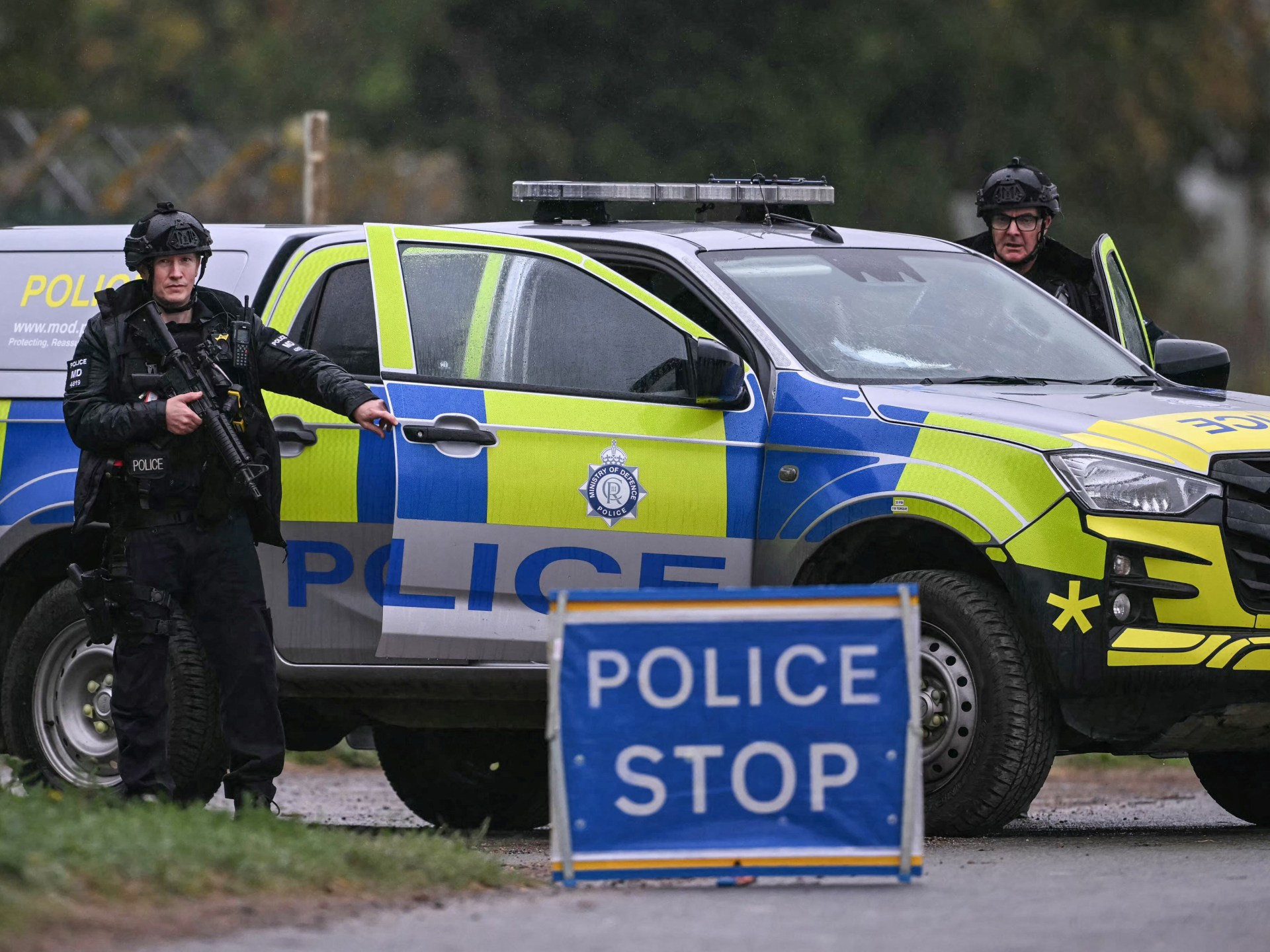
British police declared a major incident after three “suspicious” vans drove close to the RAF Fairford airbase in Gloucestershire on September 27. Five British men in their 20s were arrested “on suspicion of committing offences under the Explosives Act”, but all were released on bail.
Police said they found a supply of petrol in three vans linked to the suspects, but no explosives. The men were later released without charge on police bail “under stringent conditions”.
Advertisement
Two others were arrested later, including a British-Iranian national, but were later released. None of the men have been charged.
Two Latvian men were arrested for trespassing at RAF Molesworth, which is used by the US military and NATO for intelligence operations, on Friday. The men were also released on bail.
UK Foreign Secretary Ed Miliband said on Monday that the government was sanctioning two Iranians for their “role in facilitating or engaging in hostile activity on behalf of the Iranian regime”.
One is Ruhollah Bazghandi, the head of IRGC counterespionage operations, and the other is Shahram Ali Reza Tamarzadeh Jakki, whom British officials described as a facilitator for Iran’s Zindashti criminal network.
‘Not unique’
McCallum said he could not speak about the recent incident at RAF Fairford because it was an ongoing investigation, but added, “The RAF Fairford incident … is not unique. There have been other examples, not just in the UK but around the world.”
The spy chief said UK authorities had carried out 50 arrests over the past year to disrupt Iran-linked operations.
However, he said he doubted Iran’s ability to launch complex attacks, perhaps using explosive drones, due to the limited sophistication of operatives Tehran used in the UK.
“Given what we’ve actually seen in practice in the UK in recent years, that has not been anywhere near [that] level of capability,” McCallum said.
“That said, clearly it is the case that in countries closer to its own homeland, the IRGC has quite deep experience of using more conventional and hybrid technology in a more aggressive and sophisticated way,” the MI5 boss added.
Tehran has rejected accusations of involvement in the Fairford incident or any other accusations of harmful activity in Britain.
Related News
India summons Pakistani diplomat after incident in Arabian Sea
Ilhan Omar attacker sentenced to more than a year in prison
Rubio warns of Iraq ‘Balkanisation’: Is that a real threat?