

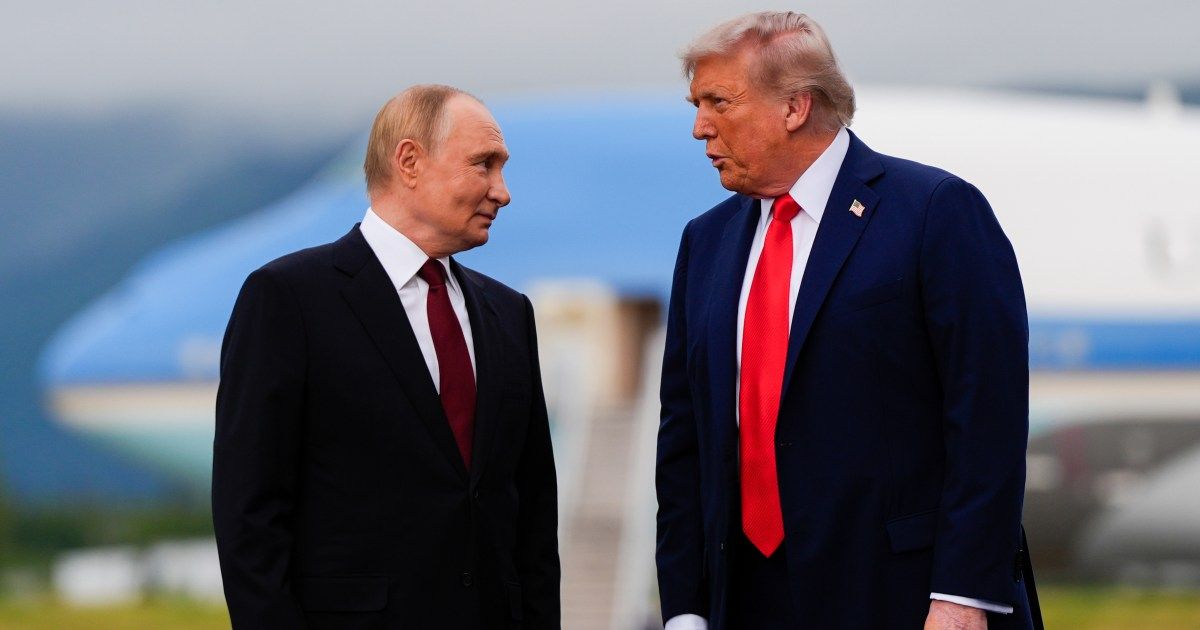

United States President Donald Trump says he has agreed a deal to release stocks of diesel fuel from Russia to try to ease high fuel costs in the US before November’s midterm elections.
However analysts told Al Jazeera that the deal will likely have little effect on easing the global energy crisis while European countries could refuse to buy from Russia altogether.
- list 1 of 3US stocks slide as oil prices fluctuate over renewed Iran war fears
- list 2 of 3Putin tells Trump peace talks are unlikely, cites Ukraine drone attacks
- list 3 of 3Russia kills 15 in Ukraine as US hosts ‘productive’ talks to end war
end of list
The agreement comes despite years of sanctions on Russia over its war on Ukraine, the latest of which were announced last month by the US and specifically targeted buyers of Russian oil.
Here’s what we know:
What has Trump agreed with Putin?
On Friday night, Trump announced on social media that after a “highly successful discussion” with Russian President Vladimir Putin, it had been agreed that Russia would “immediately” supply more than 300,000 tonnes of diesel fuel to the US and global marketplace.
Another 500,000 tonnes would be released in November, and a further 1 million tonnes sometime after that, Trump said. He added that, based on the current condition of its diesel refineries, Russia would then deliver another 3 million tonnes of diesel.
Trump claimed that this move, along with what he described as “total control” by the US of the Strait of Hormuz, would bring down diesel prices in the US and the rest of the world.
“Lower prices for Americans, especially our Great Farmers, Ranchers, and Truckers, is my Greatest Priority,” he wrote in a post on his Truth Social platform.
Trump later thanked Putin for the deal, telling reporters outside the White House on Friday: “To be honest, we have massive amounts of oil coming into our country, and it’s diesel which is what we want.”
Advertisement
Putin said in a statement on Friday that Russia “confirmed its willingness to supply oil and petroleum products to the US market and global markets at large”.
Why is there a global diesel crisis?
Global fuel prices have surged as a result of both the US-Israel war on Iran and Russia’s war on Ukraine. Tehran has largely closed off the Strait of Hormuz, through which 20 percent of the world’s oil and gas supplies had been shipped in peacetime, since the US and Israel first launched strikes on Iran in February.
The recent attack on Saudi Arabia’s East-West Pipeline, another key oil export route from the Gulf, as well as attacks by Yemen’s Houthis around the Red Sea and the Bab al-Mandeb strait have compounded supply disruptions.
Meanwhile, oil refineries and energy and port facilities have come under heavy attack in both Russia and Ukraine.
Global fuel inventories have plummeted, and diesel prices reached record highs in both the US and Europe in September.
Last week, the Group of Seven countries agreed to release 100 million barrels of emergency reserves of diesel and crude oil after a US pressure campaign on the European Union in which the Trump administration threatened a US ban on its diesel exports.
Hamad Hussain, a climate and commodities economist at Capital Economics, told Al Jazeera last week that the impact of the G7 release “would be short-lived given that this is just a temporary solution to the supply crunch”.
![[Al Jazeera]](https://www.aljazeera.com/wp-content/uploads/2026/09/INTERACTIVE-MIDDLE-EAST-iran-hormuz-shipping-aug-27-2026-1787815800-1788488337.webp?w=770&resize=770%2C962&quality=80)
How has the diesel crisis affected the US?
Surging diesel prices in the US saw the national average rise to a record $6.52 a gallon (3.79 litres) in September, more than twice the price from a year earlier. The national average is currently $6.20, according to the American Automobile Association (AAA).
The US is the world’s largest diesel exporter. Its inventories have fallen sharply since the Iran war began and remain below normal levels despite refiners increasing their output.
In September, US lawmakers and Trump floated restricting diesel exports in a bid to lower consumer costs. Trump also called on Ukrainian President Volodymyr Zelenskyy to halt attacks on diesel fuel targets, accusing him of causing a shortage after Ukraine ramped up its strikes on Russia’s oil industry this year, aiming to disrupt its energy industry, which it uses to fund its war effort. Trump did not single Russia out for similar treatment over its attacks on Ukraine’s energy infrastructure.
Trump is particularly concerned about bringing down the price of diesel before the US midterm elections. The Iran war is already deeply unpopular and many small-business owners in his MAGA (Make America Great Again) support base rely on diesel being affordable.
Advertisement
Consumers are feeling the effects of rising prices as diesel is used by truckers to transport food and products and by farmers operating machinery. The latest Pew Research Center polling indicated that the economy is the most important issue for 84 percent of registered voters.
States that voted for Trump and typically support candidates from his Republican Party, like Iowa and Kansas, are now seen as battlegrounds in the November 3 elections, putting Trump under pressure to avoid a Republican defeat.
What does this mean for US sanctions on Russian oil?
The US banned imports of Russian oil and gas in 2022 under the Biden administration in response to the invasion of Ukraine in February that year.
A sweeping Russian sanctions law passed in Congress last month and signed by Trump also targets countries that buy Russian oil and gas. The Lindsey O Graham Sanctioning Russia and Iran Act of 2026 expanded existing sanctions and aimed to pressure Putin by targeting officials, banks and shadow tankers that facilitate the Russian energy trade.
It also gave Trump the power to impose 100 percent tariffs on the top five importers of Russian oil and natural gas.
After Trump’s announcement on Friday, the US Department of the Treasury said the Office of Foreign Assets Control was “immediately issuing a temporary general license to allow the supply of Russian diesel to the global market”.
Isn’t Russia having a fuel crisis of its own?
Yes, it is, giving analysts reason to doubt that Russia will be able to release as much diesel as Trump is promising.
Neil Atkinson, former head of the International Energy Agency’s oil industry and markets division, told Al Jazeera that he is sceptical about Russia being able to do this.
“In the very short term, it’s very hard to see how Russia can deliver the volumes that are talked about in the deal other than at the expense of its domestic market,” he said.
Russia was previously the world’s second-largest diesel exporter after the US. But Russian diesel and gas exports in the third quarter of this year were at 190,000 barrels per day compared with 690,000 barrels per day in the second quarter and 850,000 barrels per day in the first quarter, explained Michelle Wiese Bockmann, a maritime intelligence analyst with the shipping analytics company Windward, citing data from the commodities tracker Vortexa.
Russia, therefore, banned diesel exports in July in a bid to meet domestic demand and in late September expanded the ban until the end of October.
Ukraine’s attacks on Russian energy facilities have also contributed to the fuel crisis in Russia. Putin has admitted that 1 percent of Russia’s gross domestic product has been affected by Ukrainian attacks.
Ukraine’s Ministry of Defence said its air strikes have destroyed more than half of Russia’s oil refining capacity. In July, it also struck hundreds of Russian shadow fleet tankers in the Sea of Azov and the Black Sea, affecting the delivery of gas to Crimea, which Russia annexed in 2014.
Advertisement
Bockmann told Al Jazeera that Russian domestic shortages were “so acute that over the third quarter for the first time we saw Russia import gasoline and diesel and gas oil”.
She added that “as recently as this week”, a ship carrying diesel and gas oil arrived in the port of Vysotsk.
Last week, Russia said it would consider a partial lifting of diesel export restrictions in the case of overproduction. Deputy Prime Minister Alexander Novak told the Russian parliament that the domestic market was balanced and “if diesel production exceeds domestic demand, we will consider partially reopening exports.”
Russia typically produces double the diesel needed to meet its domestic needs, according to the International Energy Agency. It has different standards of diesel suitable for different temperatures. Its summer-grade diesel for temperatures over 0 degrees Celsius (32 degrees Fahrenheit) may be released to make way for the winter and Arctic grades needed domestically in the coming months.
How has Ukraine reacted?
Trump’s announcement came as US envoys Steve Witkoff and Jared Kushner, Trump’s son-in-law, were meeting with Ukrainian officials and European negotiators in Miami, Florida, to discuss ending the Russia-Ukraine war, now in its fifth year.
Zelenskyy reacted to the announcement, saying it was “a weak decision by strong partners”.
He said the deal “plays into Russia’s hands,- allowing it to kill more, wage war for longer”.
Can Russian diesel ease the pressure on global prices?
On Friday, Putin said he was “convinced [the agreement] will have a positive impact on the entire global economy”.
The Russian president also noted that “an agreement was reaffirmed to maintain personal contacts between the presidents of the two countries and to continue cooperation across their respective administrations, security services and agencies.”
Analysts said the agreement will do little to address the global energy crisis, however.
Chris Beauchamp, chief market analyst at IG Group, told Al Jazeera that the Trump-Putin deal to release Russian diesel is a short-term solution and “another classic Trump deal”.
“Announce an ‘agreement’ with an unpleasant dictator with impressive headline numbers and no certainty that any of the objectives will be achieved,” he said. “Even if some of the diesel does make it out of Russia, it is only a short-term solution given the globe’s daily consumption of diesel is around 30 million barrels,” which is roughly the total amount that could be released under the outlines of the deal that Trump announced.
Bockmann also told Al Jazeera that it is unclear how much impact releasing Russian diesel will have on reducing prices and global shortages.
“I’m not sure how effective the issuing of the general licence will be in allowing volumes to be imported at levels that are going to impact the domestic price of diesel in the US,” she said.
Atkinson said the volumes announced by Trump – even if Russia could manage to provide them – “don’t really move the needle very much” on prices because the US uses about 3.7 million barrels of diesel a day.
There are also indications that European countries may not even buy diesel from Russia.
“It’s very hard to see how a European government could, in all morality, buy oil from Russia when the whole point of the last four years is that Europe has been trying to wean itself off Russian oil and gas supplies as soon as practical,” Atkinson said.
Related News

‘I want the truth’: NY governor appoints prosecutor in Cornell rape case

Trump says Europe agrees to release ‘massive amount’ diesel stockpile

Geneva talks put Rwanda-DRC peace deal to the test
