
Amid protests, Kosovo’s political deadlock raises prospect of new elections
 06 October 2026
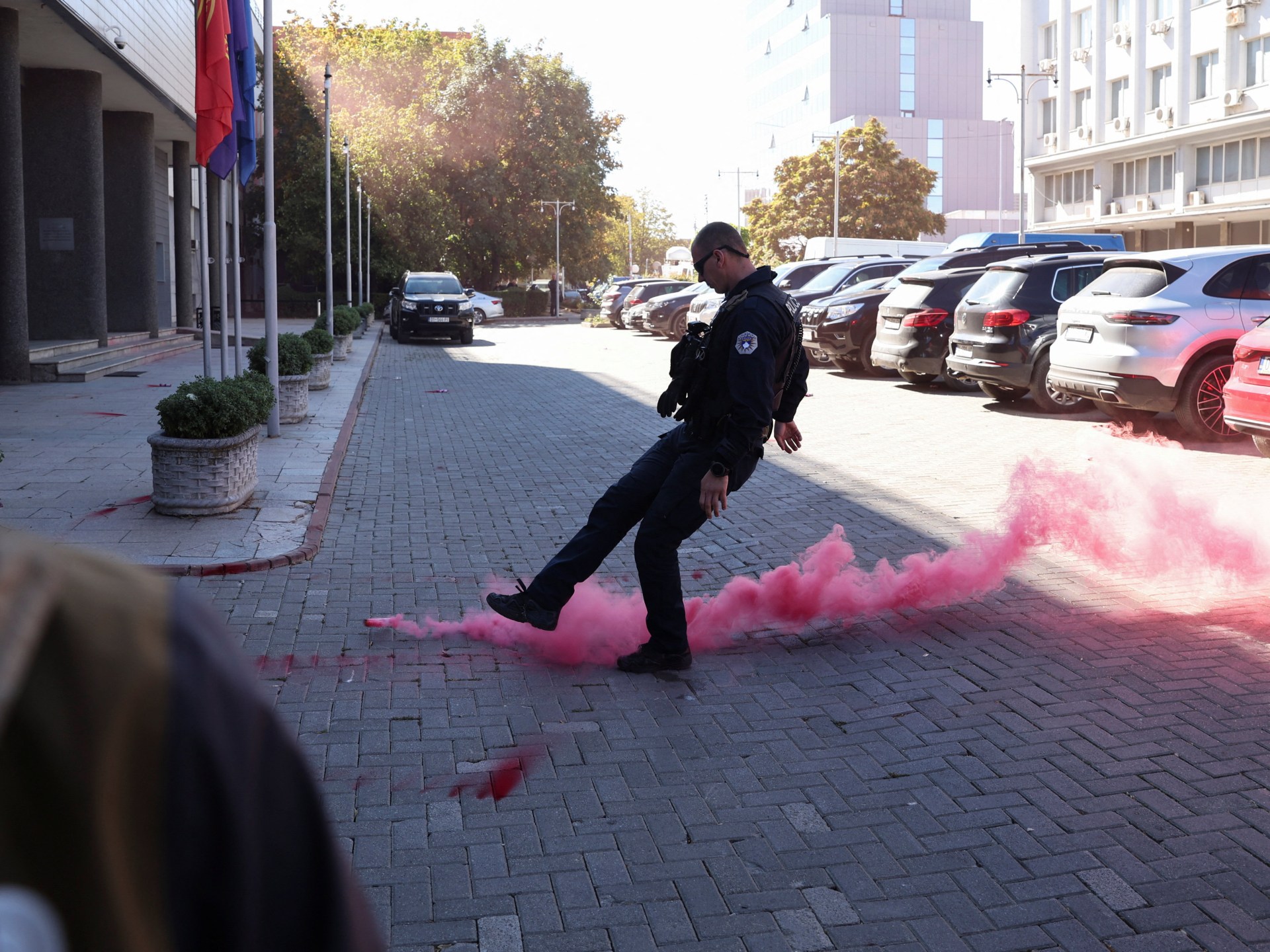

Kosovo faces the risk of turmoil as protests against the convictions of former Kosovo Liberation Army (KLA) leaders coincide with a midnight deadline to elect a president.
Demonstrators have called for changes to the law governing the Hague-based Kosovo Specialist Chambers, including measures affecting prison terms and where convicted people serve their sentences. The protests follow the September 16 convictions of former KLA leaders, including former President Hashim Thaci.
- list 1 of 4Former Kosovo President Hashim Thaci faces verdict for alleged war crimes
- list 2 of 4Former Kosovo President Hashim Thaci sentenced to 25 years for war crimes
- list 3 of 4Kosovo’s former president guilty of war crimes
- list 4 of 4Police clash with Kosovo protesters over bid to curb Hague war crimes court
end of list
The protesters’ demands have become entangled with negotiations over the presidency, raising the prospect of new elections if lawmakers fail to reach an agreement. November 15 has emerged as a likely date for a new vote.
“New elections do not, in themselves, promise anything particularly positive,” political analyst Artan Muhaxhiri told Al Jazeera. “The chances of a radical political change are slim.”
He said that if a president is not elected by midnight, a new vote will take place in a tense political climate.
Anger over the verdicts will become a central campaign issue, he said, “overshadowing fundamental questions of socioeconomic development, and deepening the country’s downward spiral of systemic instability”.
How did Kosovo get here?
In 2015, the Specialist Chambers were established under Kosovo law following international investigations into alleged war crimes committed by KLA members during and after the 1998-99 conflict. Although formally part of Kosovo’s judicial system, the court sits in The Hague. It remains contentious in Kosovo because the KLA is widely revered for having fought against Serbian rule.
Advertisement
In September, protests erupted after the court sentenced Thaci to 25 years in prison.
Later, the opposition Democratic Party of Kosovo (PDK) – formerly led by Thaci – proposed amendments aimed at curbing the tribunal. The plan included capping prison sentences at 15 years, allowing convicts to serve their sentences in Kosovo, enabling appeals before Kosovo’s Supreme Court, granting presidential pardons and narrowing the court’s temporal jurisdiction.
On October 2, 2026, Prime Minister Albi Kurti’s government concluded that there were no legal obstacles to the PDK initiative and forwarded its assessment to the parliament, the Assembly of Kosovo. Days later, Kosovo’s parliament approved the initiative at first reading with 91 votes in favour, although it has not been finally adopted.
Meanwhile, Kosovo has been mired in a political impasse after the expiration of President Vjosa Osmani’s term in April, as the National Assembly has been unable to select a new president.
Now, internal power struggles within the PDK following the September sentencing have left the party fragmented, rendering the largest opposition party incapable of negotiating a cross-party presidential compromise, according to Nexhmedin Spahiu, a Pristina-based professor of political science.
On Monday, as lawmakers failed to secure a quorum to elect a president, police deployed tear gas and water cannon outside the Assembly, following confrontations involving fireworks and bottles. The use of force prompted criticism from observers.
Tensions rise
Pristina-based journalist Gezim Baxhaku believes special police units overstepped their legal authority.
“There was an overuse of force,” Baxhaku told Al Jazeera. He said that while protesters threw firecrackers, police “exceeded their legal powers and acted entirely contrary to the situation on the ground”.
Among the hundreds of protesters were KLA veterans.
Pristina had witnessed nearly three weeks of largely peaceful gatherings before Monday’s escalation.
“Citizens were routinely bringing food, water, and coffee to the officers on duty,” Baxhaku said. “There was absolutely no reason for this to happen. For the first time since the late 2000s, police acted in such an uncalled-for manner – reacting upon orders to escalate a situation.”
Spahiu, the political science professor, said the protests should not be understood as a sign that people in Kosovo broadly reject the verdicts.
“A large majority of citizens in Kosovo are satisfied with the decision of the Specialist Chambers in The Hague,” said Spahiu.
Advertisement
He told Al Jazeera that the court’s rejection of Serbian claims of systematic crimes against humanity by the KLA “validated the liberation struggle”.
“Furthermore, people are relieved that individuals are finally being held accountable for crimes committed against political rivals within the Albanian community itself,” he said.
The political deadlock and Kurti’s ‘transactional’ approach
The Assembly remains deadlocked over the election of a head of state, as the PDK and other opposition parties boycott the voting session, denying the legislature its constitutionally required 80-MP quorum.
Muhaxhiri blamed Kurti for the crisis, criticising his decision to link the presidential vote to the Hague court amendments.
“Tensions escalated further when Kurti presented a plan based on a transactional approach to two fundamentally distinct issues: linking the draft law amending the Law on the Specialist Chambers to the election of the new president,” said Muhaxhiri.
“In effect, this amounted to a quid pro quo. By doing so, he appeared to be placing the historical, national, and identity-related significance of the liberation war on the same political bargaining table as the immediate objective of electing a president who would serve his political interests.”
Related News
How Palestinian reporters defied Israel’s genocide to redefine journalism
Rubio heads to Ecuador, Colombia, Peru after right-wing victories in region
FBI’s Kash Patel defends hiring policy change on bestiality, prostitution