
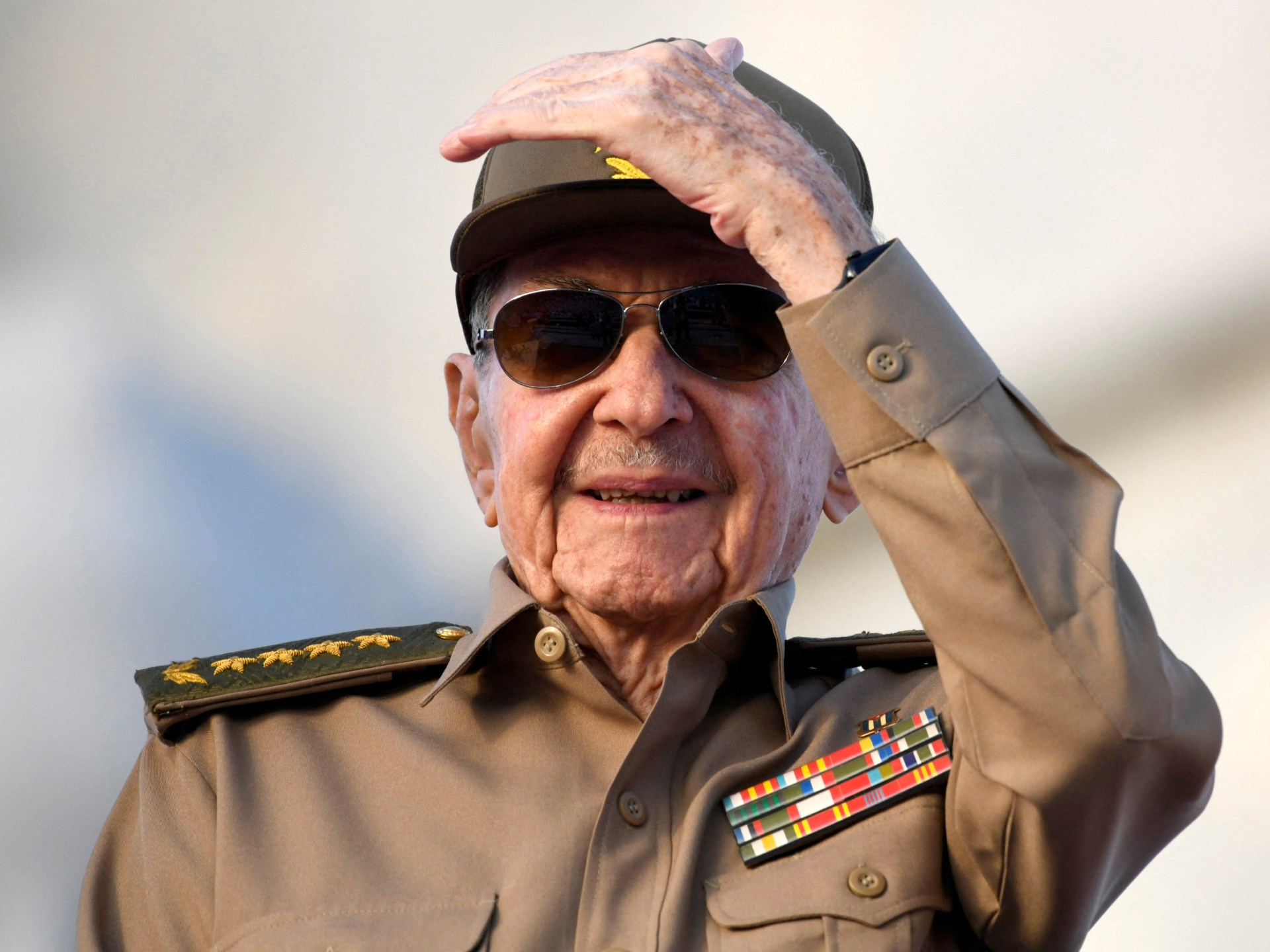

United States federal prosecutors have indicted Cuba’s former President Raul Castro in connection with the 1996 downing of planes operated by the Miami-based exile group Brothers to the Rescue.
The indictment, unsealed on Wednesday, marks one of the sharpest escalations in tensions between Washington and Havana in years.
- list 1 of 3Photos: Cuba holds May Day celebrations amid US threats
- list 2 of 3US seeks indictment of former Cuban leader Raul Castro
- list 3 of 3Cuba’s Diaz-Canel open to US aid amid worsening fuel crisis, blackouts
end of list
The US Justice Department alleges that Castro, Cuba’s defence minister at the time, played a leading role in the decision to have Cuban fighter jets to shoot down two civilian aircraft on February 24, 1996.
It has charged Castro with one count of conspiracy to kill US nationals, four counts of murder and two counts of destroying an aircraft.
Four people were killed in the 1996 attack, which triggered international condemnation and deepened the strains between the US and Cuba.
Kash Patel, the director of the Federal Bureau of Investigation, called the indictment “a major step toward accountability”.
Brothers to the Rescue began operating in 1991 during a wave of Cuban migration to the United States. Founded by Cuban exile Jose Basulto, the group aimed to help Cuban refugees crossing the Florida Straits by locating rafters at sea and alerting the US Coast Guard.
US officials and international investigators said the planes were attacked over international waters, while Cuba maintained the aircraft had violated or approached Cuban airspace.
Then-President Fidel Castro later denied that he or Raul Castro gave a direct order to shoot down the planes.
Orlando Perez, a political science professor at the University of North Texas at Dallas, told Al Jazeera that the timing of the indictment appears linked to a broader US pressure campaign against Havana.
Advertisement
“I think it’s important to look at the sequence of recent events,” Perez said.
He pointed to a visit last week from the director of the US Central Intelligence Agency (CIA), John Ratcliffe, to Havana.
That meeting came as part of ongoing negotiations between the island’s communist government and the administration of US President Donald Trump, which has pushed for leadership change in Cuba.
There were also reports this month alleging Cuba had explored drone and asymmetric warfare capabilities, as Trump increases his pressure campaign against the island.
According to the reports, Havana had considered possible drone attacks targeting the US naval base at Guantanamo Bay, US military vessels and the nearby island of Key West, Florida, which sits roughly 140 kilometres (90 miles) from the Cuban coast.
“Washington appears to be running two simultaneous tracks: a backchannel with the Castro family network, and a public pressure campaign,” Perez said. “A Raul Castro indictment fits within that architecture.”
Perez added that the move to indict Castro could backfire, stirring support among Cuba’s communist base rather than weakening it.
“An indictment of Raul Castro strengthens those hardliners and hands them the siege narrative they’ve always relied on,” he said.
“The Castro clan is not going to turn over Raul Castro. Raul Castro is the legitimacy anchor for the regime.”
But Perez indicated that the Trump administration might have another motive for unveiling the indictment now.
Trump’s Republican Party is facing a heated midterm election in November, and Trump’s approval ratings continue to tumble.
A poll from the news agency Reuters and the research firm Ipsos, published this month showed Trump’s support at its lowest level since he returned to office. Only 34 percent of respondents approved of his job performance.
Perez explained that Trump’s polling has suffered from public backlash to the US-Israeli war in Iran and other issues.
If Wednesday’s indictment pushes Cuba’s government to some sort of compromise, the Trump administration could frame that outcome as a victory.
“Under the circumstances that he is suffering now — in terms of his own approval ratings, which are very low, and the prospects of losing seats in the midterm elections, and the situation in Iran, which is still critical and unresolved — I think the pressure campaign is there and they’re hoping that it will lead to some sort of acceptable deal,” Perez said.
But Perez added that such an outcome is likely a long shot. “I don’t know that that is possible.”
Advertisement
Castro, 94, succeeded his brother Fidel Castro as Cuba’s president in 2008. Although he formally stepped down from Cuba’s Communist Party leadership in 2021, he is still widely seen as an influential figure within the country’s political system.
The Cuban government did not immediately comment on the indictment.
Separately, the White House also issued a statement on Wednesday marking the establishment of the Cuban republic on May 20, 1902. It called the island’s current communist leadership a “direct betrayal of the nation their founding patriots bled and died for”.
Cuba’s Foreign Minister Bruno Rodriguez Parrilla responded on social media that the message was “superficial and ill-informed”.
The Trump administration’s statement, he wrote, “is an affront to the people of #Cuba and a reflection of the neocolonial nostalgia that persists among influential elements within that government”.
Deputy Foreign Minister Carlos de Cossio also accused the Trump administration of catering to Cuban exiles in South Florida with its actions.
“The anti-Cuban fascist minority entrenched in Florida has finally found a government it can ride, pressure and attempt to bend to its will by blackmailing it with their votes,” he posted online.
Related News
Trump-Xi meeting: Could China, US form a ‘G2’?
Africa sees winners and losers as Iran war pushes up oil prices
Russia tells diplomats to leave Kyiv in case Moscow launches mass strikes