


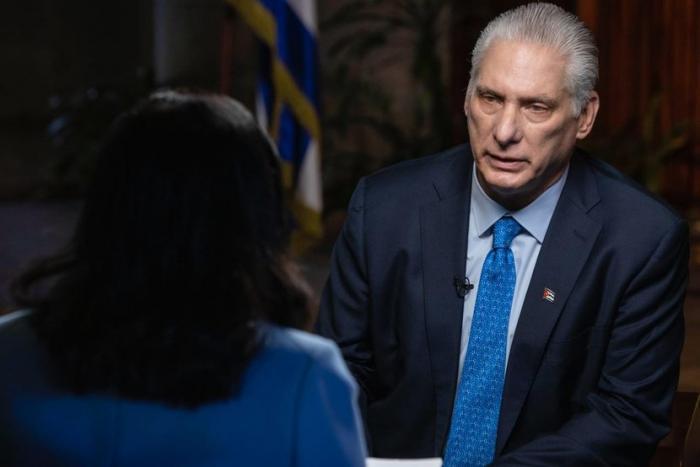
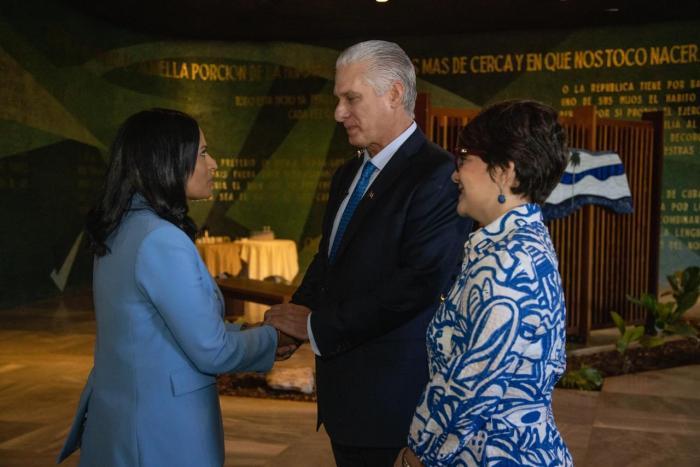
Kristen Welker: President Díaz-Canel, welcome to Meet the Press.
Miguel M. Díaz-Canel: Thank you very much. Thank you for this opportunity, and thank you for being in Cuba.
Kristen Welker: Thank you for inviting us to your beautiful country; it is an honor.
Miguel M. Díaz-Canel: It is a pleasure for us to have you here.
Kristen Welker: Thank you, thank you very much.
I’d like to start with President Trump. He said he has plans to take over Cuba in some way. He said, “I think I can do whatever I want with Cuba.” Do you take Trump’s threats seriously?
Miguel M. Díaz-Canel: I believe that in recent days, many things have been said—not only by the President but also by other U.S. government officials—that truly reflect aggressive language and rhetoric toward Cuba.
One must understand our country’s history. Our country is one whose identity is deeply rooted in the values of sovereignty and independence. For 150 years, Cuba fought, first to free itself from colonial rule and then from neocolonialism. And with the Cuban Revolution, with its triumph in January 1959, a whole range of dependencies was eradicated, along with subjugation and subordination to a foreign power, bringing a host of beneficial consequences for the country—consequences that the Cuban people are not willing to give up.
One of the most brilliant generals of our wars of independence, Antonio Maceo, once said: “Whoever attempts to seize Cuba will only gather the dust of its blood-soaked soil, if they do not perish in the struggle.”
We are a country of peace. We do not promote war; we do not like war; we foster solidarity and cooperation among peoples, but we are prepared to defend the peace we desire; therefore, we are not intimidated, and we do not want to be caught off guard or defeated. That is one interpretation of this threat and Cuba’s position.
The other interpretation that can be given is when they say that Cuba will collapse on its own, and they try to label us a failed state or a country that is going to collapse, which is contradicted by reality: how a country like this has withstood all kinds of pressures and aggressions over 67 years, including, for more than sixty years, the longest-running blockade in history, which is a criminal, genocidal blockade. There is much to be said on these topics, but I do tell you that the Cuban people and the Cuban Revolution are ready to defend themselves.
Kristen Welker: Let’s move on to the next question.
President Trump wants to deal with Cuba the same way he has with President Maduro in Venezuela, and the same way he has in Iran, where he has killed the Supreme Leader. Do you think you could be arrested or assassinated by the U.S. government?
Miguel M. Díaz-Canel.—That’s a very interesting question. I never like it when people draw parallels between Cuba and other nations, because we have our own history, we operate under our own circumstances, and it also shows a lack of understanding of our history, the strength of our unity, and the strength of our institutions.
Those of us who have assumed responsibilities within the Revolution are committed to the Revolution, above all to our heroic people. And that sense of responsibility includes the conviction that we are willing to give our lives for the Revolution, for the cause we defend. Therefore, for me, that is not a concern.
If the time comes, I do not believe there is any justification for the United States to provoke an attack on Cuba or for the United States to attempt a surgical strike or the kidnapping of a president in Cuba. If that were to happen, there would be combat, there would be a fight. We will defend ourselves, and if we must die, we will die, because as our National Anthem says: “To die for the Fatherland is to live.”
But there is a misunderstanding here, and that is that the leadership of the Cuban Revolution is always personalized with a single individual. At one time it was personified by the Commander-in-Chief, at another time by the Army General; now they are trying to personify it with me. The fact is that we have a collective leadership in which there is unity, cohesion, ideological unity as well, and revolutionary discipline. Therefore, eliminating one person from the leadership structure of the Revolution does not solve any problem; on the contrary, there are hundreds of people who are capable of assuming that responsibility and making decisions collectively. And we are prepared to face any kind of situation.
Kristen Welker: What you say is very powerful, but are you afraid for yourself, for your family? Are you prepared, as you say, to make the ultimate sacrifice if you were attacked?
Miguel M. Díaz-Canel: I am not afraid; I am willing to give my life for the Revolution. Of course, I would not want that to be the attitude of the United States government. I don’t believe the American people—who are a sensitive people—would allow or approve of their country, their government, invading a small island that poses no national security concern for the U.S. government; an island that wants peace, an island that wants dialogue, an island where its people want to have a direct relationship with the American people—I don’t think they would approve of that.
Furthermore, what would be the justification for doing that? But, moreover, an attack on Cuba would have costs; it would have costs for both countries in terms of unnecessary loss of human life, which can be avoided; it would have material costs; it would affect the security and stability of the United States, of Cuba, and of the region.
I believe we must approach matters with great responsibility when making a decision of such magnitude. And, above all, before making that decision—which is totally illogical and irrational—there is a more just approach: that of engaging in dialogue, discussion, and debate, and of striving to reach agreements that steer us away from confrontation.
Kristen Welker: Is Cuba actively preparing for the possibility of an attack by the United States?
Miguel M. Díaz-Canel: Look, as I have always stated in other meetings, in other interviews, and also when we speak to the Cuban people, it is evident that there is a threat; it is present in the rhetoric of the U.S. government. Cuba has done nothing to offend the United States. Cuba has never proposed attacking the United States, nor interfering in the internal affairs of the United States. However, there are constant claims that Cuba is next, that Cuba will be attacked, that there are plans for Cuba, that they are going to take over Cuba. Therefore, from the standpoint of responsibility in leading the country, this is a warning, and we must responsibly protect our people, protect our project, and protect our country. So, yes, we are preparing for defense.
Now, what is the concept behind our defense preparations? We have a defense doctrine that is entirely defensive; it is not aggressive, it poses no danger to anyone—it is simply a doctrine known as the War of the Entire People, which has been built collectively through the experience of our history, and was fully conceived and structured precisely during a very difficult period in our history when we were also under serious threat from the United States government. And it is based on popular participation: every Cuban man and woman has a mission, a purpose, a goal to defend, a place and a position to occupy in the defense. And it is based on popular participation, voluntary participation, and, of course, it encompasses the preparation for the defense of all levels and all links that make up our territorial defense; but it is a wholly defensive and non-aggressive concept. And, furthermore, because we also start from a fact: that preparing to defend ourselves is the best way to avoid war and the best way to preserve peace.
I would go further: I believe that what both the American people and the Cuban people deserve in their relationship is neither aggression nor the language of war. What the American people and the Cuban people deserve is peace—a peace that allows us to have an atmosphere of trust, cooperation, collaboration, solidarity, and, of course, understanding.
Kristen Welker: Do you think the Cuban military could succeed in a confrontation with the United States if one were to occur?
Miguel M. Díaz-Canel: When we speak of Cuba’s defense, we speak of our glorious Revolutionary Armed Forces, but also of our people, who are organized into different links of that territorial defense. Yes, we would succeed; yes, we can succeed. There is no enemy that cannot be defeated.
Kristen Welker: But against the United States, the world’s greatest power?
Miguel M. Díaz-Canel: The United States has a concept of waging war. Our concept of territorial defense is based on irregular, asymmetric warfare, where they might achieve success at a certain moment; but it would become unsustainable for them to invade and occupy Cuban soil, because there is a decision—and that decision, that conviction, I refer once again to Maceo’s phrase: “You will only gather the dust of your blood-soaked soil, if you do not perish in the struggle.” And it’s not a slogan, it’s not a catchphrase. If you go out on the street right now and mention or show the first part of that phrase to a child, an elderly person, a Cuban, or a young person, they’ll finish it immediately, because that’s how we’ve been raised, and it’s in our hearts.
I repeat, that’s not what we want. We do not want a war; we do not want a confrontation. It would come at a great cost to everyone.
Kristen Welker: Well, I’m going to ask you about this extraordinary moment.
The United States has suspended fuel supplies to Cuba; but Russia has resumed them. Do you think the Russians have obtained permission to help Cuba? How has this worked?
Miguel M. Díaz-Canel: I believe that never before has such a common occurrence—such as trade between two countries—been followed so closely by the media and the public, in different parts of the world, as the arrival of the Russian ship carrying fuel, which came as a humanitarian aid effort. In other words, it was not a commercial transaction.
I believe that Cuba has the right, like any other country, to import oil. And all countries also have the right to export oil to Cuba. Therefore, this energy blockade—which further intensifies the U.S. blockade against Cuba—is deeply unjust. In other words, the imposition of the energy blockade on Cuba demonstrates once again that there is a full-scale, multidimensional aggression by the U.S. government against Cuba. With an economic war that has lasted 67 years, with a blockade that has lasted more than 60 years, with a blockade that intensified in 2019 under the first Trump administration, which was maintained by the Biden administration even amid the COVID-19 pandemic, and which now, once again, is being enforced with maximum pressure, causing devastating harm to the Cuban people through this energy blockade.
The Russian Federation was able to send that ship as humanitarian aid. The United States has persisted in maintaining the energy blockade; therefore, we have no certainty as to when another oil tanker might enter Cuba, even though we have the right to ensure that happens. And we should not have false expectations regarding this ship that has arrived, although it is an important aid at a time like this, which we acknowledge, but it only covers one-third of Cuba’s monthly fuel demand. In other words, we cannot believe that this has already saved the situation.
Now we have crude oil that we must refine, that we must distribute throughout the country, and a significant portion of which we will dedicate to utilizing an electricity generation capacity of over 1,200 megawatts that has been idle for four months and could improve our energy supply situation, as well as support certain economic activities.
Kristen Welker: How long can you survive until the next shipment of oil from Russia arrives?
Miguel M. Díaz-Canel: That is an extremely interesting question, and it must be answered at a very difficult time. No country in the world can develop a thriving, prosperous economy without fuel. That is why I tell you that there is an element of perversity, of malice, when a power that plays the role of an aggressor subjects a small nation that is constantly under attack to a situation like this.
But we have not stood idly by. What have we committed to? We have a comprehensive strategy and program to revitalize the country’s energy sector: first, to rely more on domestic crude oil rather than on imports. In Cuba, we have oil fields; they are not enough to cover all our needs; but we can—and in fact are—increasing oil production; we are exploring more fields; we are open to foreign investment in Cuba for oil well drilling and exploration. In fact, it would be an opportunity for U.S. businesspeople who could also participate in Cuba in investments in the energy sector. The problem is that the blockade is what prevents this, but Cuba would welcome U.S. companies that wish to participate in the energy sector in Cuba, without any prejudice. That is one approach.
On the other hand, we have turned to science and innovation. Our scientists have discovered and developed technologies so that this Cuban crude oil—which is very heavy due to its high sulfur content—can be refined. Therefore, if we increase production, we could achieve a certain level of availability—which would not meet all our demands, but a certain level of availability that we do not have today—with products derived from the refining of that Cuban crude oil.
On the other hand, we have developed a comprehensive energy transition strategy that relies more heavily on renewable energy sources and, of course, includes an energy efficiency strategy as well. All of this combined is leading us—or is already leading us—toward a different situation. It’s still complex and takes time, but we will be able to hold out.
Kristen Welker: But what can be said about the strength of the Cuban regime at a time when it needs Russia’s support to survive?
Miguel M. Díaz-Canel: We rely, above all, on our own people and our own capabilities. I believe the first thing to highlight is the creativity with which our people have faced the adversities imposed by the blockade—the intensified blockade—and now the energy blockade.
I always describe the attitude of our people—of whom I am utterly proud—because they are constantly teaching lessons in resistance, demonstrating a spirit of creative resistance. The Cuban people do not resist by merely enduring, suffering, and submitting in humiliation. On the contrary, they resist and rise to the occasion; they are capable of innovating, capable of creating, and through that, they can overcome adversity. Therefore, it is the people, and our strength lies in our people and in the unity we have with them.
Now, for us, we welcome the help from Russia, the help from China, the help from Vietnam, the help from Mexico, and the help from other countries. The United States could also adopt a different approach toward Cuba—one that isn’t based on confrontation, aggression, and the blockade—and could also help Cuba.
Does that hinder Cuba’s development?
Kristen Welker: President Trump says this is a country on the brink of collapse.
Miguel M. Díaz-Canel: It’s very curious, because in relations between Cuba and the United States, especially during times of tension, there is a heavy reliance on media narratives and the perpetuation of stereotypes, and even for global public opinion, certain perspectives are almost imposed. And in this case, it’s the narrative of collapse.
I would ask, what country in the world would be capable, as Cuba has been, as the Cuban people have been, of withstanding 67 years of sustained aggression from the world’s most powerful nation—with more than 60 years of a blockade, the last six or seven years of an intensified blockade, and now an energy blockade—and not collapse? We have not collapsed; we maintain an organized country, a country in harmony.
In 67 years of Revolution, we have achieved many social gains; and while we are sometimes criticized for our economic performance, the fact is that we have had to face a war economy, and in the midst of that war economy, our economy has been able to withstand the pressure and move forward with social projects. We have more than 32 social projects to address vulnerabilities and inequalities. Sixty-seven years of the Revolution have prevented the country from collapsing—and it will not collapse!—and the country has achieved great things.
We have a universal healthcare system that provides free healthcare to the entire population. We have an education system—from general education through university—that is inclusive and also free. We have achieved success in culture and sports; we are one of the countries with the highest ratio of Olympic medals per capita. We have developed our human resources and possess a skilled workforce and a pool of scientists. We have advanced science and innovation. The progress made in Cuban biotechnology and the biopharmaceutical industry is well known. We have achieved equity, justice, and equality.
We have a society where peace of mind prevails, a safe society; a society that does not tolerate corruption, drug trafficking, or organized crime; a society capable of offering solidarity to other peoples based on its own potential. And that cannot be seen as a collapse.
They try to impose the narrative of collapse on us when, through an aggressive policy—a genocidal blockade policy—they force us to live in a complex situation. We are living in a complex situation; our people face very difficult circumstances every day, which exist on a national level, but we can also see them on a family level. But our country has not collapsed.
Kristen Welker: No one would dispute that the blockade or embargo has had an impact, but let’s discuss the situation here in Cuba.
The Cuban people are suffering; there are shortages of energy and food. Do you bear any responsibility for the suffering the people are experiencing right now? As President, don’t you feel responsible for it?
Miguel M. Díaz-Canel: Well, the Cuban people are suffering. And that suffering, as I was saying, can be seen in two spheres: the national sphere and the family sphere, because it’s all part of daily life.
Now, what is the fundamental cause of that suffering? Is it the mistakes I may have made, or, as I said, a collective leadership?
Kristen Welker: Or the government?
Miguel M. Díaz-Canel: Or the government.
Or is that suffering due above all to the intensified blockade policy, maintained and sustained by the United States? I believe the answer—and the people, the majority of our people, can provide it—lies in that policy of permanent hostility by the United States government.
Look, on a national level: we are a country that, after 2019—when the blockade was tightened, when the U.S. administration imposed 240 measures that intensified that blockade and also included us on a spurious list accusing Cuba of allegedly supporting terrorism—had all our sources of external financing cut off.
We do not receive loans from any bank. There is financial and energy persecution. Anyone who comes to conduct a commercial, financial, or banking transaction with Cuba is subjected to coercive measures and pressure. They do the same to shipping companies and oil agencies.
They exerted pressure and took measures to cut off tourism to Cuba. For example, a European citizen holds a visa called an ESTA visa to visit the United States; if that European citizen comes to visit Cuba as a tourist, the United States automatically revokes their ESTA visa. In other words, these are a whole series of situations that do not apply to any other country in the world.
We lack the funding to purchase food; to acquire supplies for our main production and services; to obtain the medicines we need; and to make the repairs we need to our national power grid and our industrial infrastructure. Now, how is that playing out right now? On our people.
Kristen Welker: And yet the people of Cuba say you can’t just blame the United States, because the economy has been in decline for the past ten years. Thousands of people have left the country.
Miguel M. Díaz-Canel: So, as I was saying, how does that play out in family life today? There are food shortages, there are medicine shortages; early mornings become grueling because, when you’ve gone 20 hours without electricity due to a blockade—not because of a government’s incompetence—that’s when you have to do the household chores.
Kristen Welker: But this was before the blockade; people were suffering even before the blockade.
Miguel M. Díaz-Canel: No, no, no, let me explain. There’s a misunderstanding here—there’s a misunderstanding!
We were already living under the conditions of the blockade, but the blockade intensified and took on a different character in the second half of 2019 with these 240 measures and with Cuba’s inclusion on a list of countries that supposedly support terrorism. Therefore, everything intensified.
So here we have the cumulative effect of the blockade, plus the effect of the intensified blockade, plus the effect that this energy blockade is now adding to and amplifying. I’m telling you this in all seriousness: it’s not the Cuban government’s fault. It’s not the Cuban government’s fault!
It has also caused discontent, because living through the last 10 years under those conditions—which are extreme compared to other times… The Cuban people feel frustrated, the Cuban people feel resentful, and the Cuban people are facing very complex situations; but most Cubans do not blame the government for this. There has also been a great deal of manipulation in the media; the aim is to ignore the effects that the blockade has had over all these years.
And I’m going to give you some concrete examples so you can see the brutality of that blockade and what it has meant for the Cuban people, and yet, what the response has been from that government that you supposedly want to condemn as the culprit. And I’m going to refer to the COVID-19 period.
When COVID-19 entered our country, we realized early on that we would not have access to the global vaccine market, which was dominated by large transnational corporations. Consequently, given the economic restrictions we were already suffering due to the intensified impact of the blockade, we did not have the necessary funds to purchase those vaccines. Therefore, the acquisition of vaccines was denied to us. We had to turn to Cuban science.
This government, condemned by some, dedicated all its efforts to protecting the lives of Cubans. We turned to our scientists, and in a short time, they were able to develop Cuban vaccines that allowed us to achieve one of the highest levels of effectiveness in combating COVID-19.
Our indicators for combating COVID-19, in terms of effectiveness, are better than those of the United States, which is a power that is not subject to any blockade.
Later, we faced a crisis due to a breakdown at the medical oxygen production plant. At that time, the U.S. government refused to allow companies to sell us oxygen, which is a completely criminal act, but through international solidarity and a well-organized effort, we managed to overcome that crisis.
And when we had to expand our intensive care units, the U.S. government banned the sale of ventilators to Cuba. We turned to young scientists, and those scientists developed the ventilators.
Now, you know that to make a ventilator, you need U.S.-made parts and components. The blockade prevents any equipment containing more than 10% U.S. components from being sold to Cuba. So, we had to go to different places to buy a small part, to buy a cable, to buy a servomotor to get those things. No one else in the world has had these things imposed on them.
The blockade is very aggressive, it is very genocidal, so it is unjust; it is unjust to blame a government whose sole purpose is to serve its people, to dedicate itself to its people, to seek social justice, to find solutions—and in complex situations, we do find them—to blame it for these evils.
I believe the U.S. government should reflect on how cruel it has been toward Cuba and the Cuban people. And it shouldn’t come presenting itself as the savior of the Cuban situation—it has no right to do so, no right at all, nor does it have the moral authority!
Kristen Welker: But in terms of what the Cuban people are experiencing—we saw it with our own eyes—there are people suffering on the streets of Havana, the capital city. Isn’t it time for Cuba to take responsibility, to look in the mirror, and to change Cuba’s economic system in favor of the people who are suffering?
Miguel M. Díaz-Canel: We always conduct very self-critical analyses of our realities, and we are constantly striving to transform and revolutionize what we do in order to improve, but this has nothing to do with the political system.
Our political system is not the one that prevents us from moving forward. I repeat that the blame lies with the blockade imposed by the United States government. That very same people who are suffering these conditions today—and a significant portion of whom understand who the real culprit is—are the people who have approved, through various popular consultations and referendums, the political system we defend.
Our political system is designed for the people; it is designed for social justice; it is designed so that we can all move forward. And it seems to bother others in the world because of what it might represent, because it is a system for us—not one we wish to impose on anyone—and so they block it in this way; because, you see, we are not just talking about a blockade; we are talking about a blockade that is unusual—it has been the longest in human history, the most severe.
A blockade that, moreover, is not only against the Cuban people, but also against the American people, and has, furthermore, become internationalized. American businesspeople cannot invest in Cuba—why? American citizens cannot freely visit Cuba—why? Citizens of other countries, businesspeople from other countries, are also subject to sanctions.
Kristen Welker: But you can trade with other countries.
Miguel M. Díaz-Canel: We can trade, with many limitations—many limitations!—because the laws of the blockade have been internationalized through the application of Title III of the Helms-Burton Act.
You have to do a lot of research, you have to look into it thoroughly, because the narrative in the media and the narratives on social media that promote hatred and confusion are not realistic. I think we also need to take a critical look at that. And we in our government, together with our people, remain committed to transforming it and moving forward, including overcoming these situations.
Kristen Welker: Let’s talk about the future.
China and Vietnam have embraced the one-party system and have made changes. Why couldn’t Cuba do the same?
Miguel M. Díaz-Canel: China and Vietnam are countries building socialism, just like Cuba.
It must be said that China and Vietnam—I have studied the reforms in China and Vietnam extensively, and we have taken them as a reference for Cuba—at one point also faced the consequences of coercive measures and sanctions by the United States and were subject to blockades, blockades that lasted a shorter time, approximately a decade. Once they emerged from those blockades, they had every opportunity to develop their capacity for socialist construction. They implemented a series of reforms, and through those reforms they have demonstrated that socialism, led by a single party, is viable and capable of achieving significant economic, social, and technological progress. Today, China is a major global power.
We maintain constant communication; we are sister nations, our parties share a deep inter-party relationship, and we are constantly exchanging views on our respective processes. The thing is, Cuba also has its own unique circumstances.
Cuba is an island nation, located just 90 miles from the United States. Cuba has been a country under attack, and the blockade has not been lifted—it has been in place for over sixty years, as I was telling you; therefore, we have not been able to build what we have dreamed of or what we have wanted to be. We have many unfinished tasks because the blockade has prevented them, even though there are people who do not understand this.
I’d like to tell you something else: I really appreciated this during our last trip to China and Vietnam. When you look at the periods of reform and the times when China and Vietnam were able to strengthen themselves, they started from a less favorable situation in terms of infrastructure and development than perhaps what Cuba has today. So we should tell the U.S. government: Lift the blockade and let’s see how we fare, lift the blockade and let’s see how we fare! Let’s see if Cuba, with all the potential it possesses—if, even under the blockade, it has been able to achieve victories—what it wouldn’t do if it weren’t under the blockade; because we’ve even been able to show solidarity while under the blockade.
Why does the United States have to spend millions? If we are so incapable, if we are as foolish as they want to portray us, if we are so closed-minded, if we are so uninnovative, why then have they insisted for so many years on spending millions—money contributed by taxpayers, that is, the American people—on subversive schemes, on blockades, on crushing the Cuban Revolution? Why don’t they let us fall on our own, if that is what they believe? Or why wouldn’t they be willing to acknowledge that a Cuba without a blockade would be capable of achieving levels of economic and social development with a far-reaching impact and demonstrating that other solutions are possible in the world, that other models are possible in the world?
Kristen Welker: Let’s talk about the future.
There have been talks between Cuba and the United States. Do you think it is possible to reach an agreement with U.S. President Trump?
Miguel M. Díaz-Canel: Here I believe we can take an approach that starts with what is possible and what is difficult.
I believe that dialogue and agreements with the U.S. government are possible, but they are difficult.
Where does the possibility lie? Throughout the years of the Revolution, Cuba has always been willing—it has historically held the position—to have a civilized relationship with the United States as neighbors, one that allows us to cooperate, exchange, and maintain normal relations in a wide range of areas. And what we have always asked is that this relationship be built from a position of respect, from a position of equality, without imposing, without conditions; because imposing conditions does not lead to dialogue, and imposing does not lead to negotiation.
For there to be a conversation, for there to be a dialogue, for a negotiated agreement to be reached, there must be a willingness, there must be a capacity to dialogue and listen on both sides, there must be respect, there must be decency, and there must be recognition.
Therefore, all the conditions and possibilities exist, if both sides agree, to have that dialogue. What are the factors that make that dialogue difficult? First of all, over the past 67 years, U.S. policy toward Cuba has been a totally hostile one. The United States, as a major power, has always assumed the position of aggressor, and Cuba, as a small island, has had to assume the position of the victim.
On several occasions—and this is another factor that makes dialogue possible—agreements have been reached, discussions have taken place with various U.S. administrations, and compromises have been made. Cuba has always honored its commitments. The United States has failed to honor many of those commitments.
The United States, for example, has recently been in talks with other countries and then, in the middle of those talks, has attacked them. So, all of this creates a great deal of mistrust.
And we know that in the United States there are forces that, constantly, whenever they see an opportunity for conversation or dialogue, try to sabotage those negotiations. But, I insist, I am confident that we can talk with respect and decency; that we can find, through dialogue, a solution to our bilateral differences; that we can find areas of cooperation in which we can develop projects.
There are many issues we can work on, including the fight against drug trafficking, terrorism, migration issues, and the fight against transnational crime. We can make progress in negotiations; we can have investment and business ventures by American entrepreneurs in Cuba.
There is a Cuban community residing in the United States to which we must also provide opportunities both in the United States and in our country; there are American citizens who could visit Cuba. We can have cultural, sports, and health exchanges. All of this would then allow us to build spaces for understanding, moving us away from confrontation and ensuring peace and security not only for Cuba and the United States, but also for the Latin American and Caribbean region. That is the future to which we aspire: to have a relationship of good neighbors, a civilized relationship, regardless of our ideological differences. I believe it would be an opportunity; it is what our peoples deserve.
I’m going to tell you a story.
Kristen Welker: I’m told we’re running out of time.
Miguel M. Díaz-Canel: That’s a shame, it’s a shame!
Kristen Welker: Please, let us finish with the questions.
Miguel M. Díaz-Canel: It’s a shame we’re running out of time, because we have a lot to discuss. So, I suggest we talk again at another time.
But look, I’m going to tell you two stories.
Kristen Welker: But that’s fine. We have many more questions. I wanted to give you the time and the opportunity to respond so that the people of Cuba and the United States can hear your answer.
Miguel M. Díaz-Canel: I agree.
Kristen Welker: All right.
Miguel M. Díaz-Canel: For example, two anecdotes that give you an idea of how much both our peoples could benefit if we could reach agreements and achieve results, creating opportunities that make all of this possible.
A Cuban science, technology, and pharmaceutical biotechnology organization has been conducting a clinical trial for years in collaboration with a prestigious cancer research institution in the United States. This clinical trial involves a Cuban vaccine against lung cancer. And this clinical trial has been underway for nearly a decade. It must be said that the results of this clinical trial are extremely encouraging. Both the U.S. and Cuban sides have tremendous confidence in the success of this clinical trial and in what it could mean for public health in the United States and in Cuba.
Recently, I have been meeting with Cuban scientists every week as we seek to address the country’s problems through science and innovation, and they presented me with the results of a clinical trial involving a highly innovative Cuban medication to combat Alzheimer’s disease. This clinical trial involves a collaboration with a clinic in Colorado, in the United States, from which American patients come to receive treatment in Cuba, then return to the United States to continue their treatment.
You have to hear the terms in which the director of that clinic in Colorado speaks about how his patients have improved and achieved results superior to any of the other medications. Therefore, we cannot allow a blockade policy—which serves only minorities and elites—to undermine the relationship that our two peoples could have. And that is what I urge: that there be understanding, that there be sensitivity, that we see opportunities in our relationship, and that we do not encourage confrontation, war, and aggression.
Kristen Welker: I’d like to continue discussing the future of the negotiations. Are you confident that President Trump will reach an agreement?
Miguel M. Díaz-Canel: Well, the reason we’re in these talks is because we hope to reach an agreement. And as I was saying, reaching an agreement depends on the willingness of both parties to identify those areas of collaboration and cooperation; to build those spaces of understanding; and to approach this with sensitivity, responsibility, and also with great seriousness.
Kristen Welker: Mr. President, are you in direct talks with Secretary of State Marco Rubio? Do you have confidence in him?
Miguel M. Díaz-Canel: We were in talks and will continue to be in talks, provided the United States is willing, with the representative of the U.S. government designated by that country to hold talks with us.
The negotiation process is a complex one. It involves first establishing channels of dialogue; then we must build agendas that allow for discussion and the reconciliation of common interests.
Kristen Welker: But have you spoken with Secretary Rubio?
Miguel M. Díaz-Canel: No, I have not spoken with Secretary Rubio; I do not know Secretary Rubio.
After establishing agendas and debating, if there is a willingness, agreements can be reached. But these are processes that must be conducted with great sensitivity, great responsibility, great decency, and great discretion, so as not to create false expectations, so that information is not manipulated, and so that intentions are not manipulated. Therefore, I prefer not to give details on these matters.
Kristen Welker: Let’s talk about some of the United States’ key demands: recognition of a free press, the release of political prisoners, and the holding of fair elections.
Miguel M. Díaz-Canel: At this time, no one has made those demands of us, and we have made it clear that internal order, the Cuban constitutional order, and respect for our political system are issues that are not up for negotiation or discussion with the United States.
And I think we need to move past, Kristen, all the hype that has surrounded concepts regarding issues about Cuba—about democracy, human rights, whether we are a tyranny or a dictatorship or not, freedom of expression, the existence of unions—in which there is a lot of manipulation and a lot of prejudice that I believe we have to overcome. It would take—we don’t have the time now—a long time, but we have all the arguments to demonstrate how democratic we are; how the electoral system in Cuba works, which is a system that comes from the grassroots; how we exercise power with the people, how we are indeed defenders of human rights, how we are not a dictatorship—I would have to explain that in much more detail, and I ask that we discuss those things at another time. But there is a lot of prejudice that needs to be overcome and eliminated.
Kristen Welker: Two more questions.
There are still more than 1,200 political prisoners in Cuba. Maykel Osorbo, who is in prison and has won two Latin Grammys.
Miguel M. Díaz-Canel: This is another issue where those prejudices also exist. People talk about political prisoners in Cuba. In Cuba, just as you said, the people are going through a difficult situation; not everyone in Cuba supports the Revolution. There are people who do not embrace the Revolution, who demonstrate against it every day in different ways, and they are not in prison. That narrative they’ve created—that image that in Cuba we imprison anyone who speaks out against the Revolution and label them a political prisoner—is a lie, it’s slander, and it’s part of a fabrication designed to discredit, to unsettle, to demonize, and to destroy the reputation of the Cuban Revolution.
Now, what happens? In Cuba, for example, there are protests, especially during long power outages or when there are supply issues. When people protest, what do they do? They go to our government institutions, to state institutions, and there they speak with leaders who attend to them, explain the situation, and either resolve the problems or provide explanations. That is a fully democratic exercise, and no one goes to prison for doing that.
Now, people with a certain aversion or discontent are often misled and encouraged to commit acts of vandalism or acts that disrupt our constitutional order, or that also disrupt internal order, or threaten public peace—often financed by terrorist organizations; often funded by programs of U.S. government agencies that encourage subversion against Cuba; often even directed by the U.S. Embassy in Cuba. And those people, then, are not in prison for protesting; they are in prison—as they would be anywhere in the world that respects its Constitution and its legal processes—for committing acts of vandalism and acts that are reprehensible anywhere in the world. There are no political prisoners in Cuba, I assure you.
Kristen Welker: I have to wrap up the interview now. I have to ask you this last question.
Would you be willing to resign in order to save Cuba, the people of Cuba?
Miguel M. Díaz-Canel: You, who are an important, renowned journalist, have you asked that question of any other president in the world?
Kristen Welker: If the United States asked him to, because that is one of the conditions the United States is imposing.
Miguel M. Díaz-Canel: I’ll ask you again: would you have asked that question of any other president in the world? Have you asked it of any other president?
Could you ask it of Trump?
Kristen Welker: I ask President Trump very difficult questions.
Miguel M. Díaz-Canel: Is this your own question, or is it a question from the State Department or the U.S. government?
Kristen Welker: My question is, because it’s one of the things we’ve heard from the U.S. government. If they were to ask.
Miguel M. Díaz-Canel: Given your sincerity, I’m going to assume you’re asking precisely because of those things.
First, in Cuba, the people who lead and hold government responsibilities are not chosen by the U.S. government nor appointed by the U.S. government. We are a sovereign, free state. We have self-determination, we have independence, and we do not submit to any dictates of the U.S. government.
Furthermore, Cuban leaders do not rise to power because we represent a ruling elite. You could look into my background—where I was born, the family I was born into, and what I have done in life. It is the people who elect us, although there is a narrative that tries to ignore that.
Any one of us, to hold a position of responsibility, must be elected at the grassroots level, in an electoral district, by thousands of Cubans, and then the Cubans who represent those others in the National Assembly of People’s Power elect those officials through an indirect vote, just as it is in other countries around the world, just as it is in other countries around the world! We also have an electoral system that is entirely based on popular participation.
Therefore, when we assume a position of responsibility, we do so neither out of personal ambition, nor corporate ambition, nor even for a party position, because our Party is not an electoral party. We do so by mandate of the people, and surrender is not part of the revolutionary concept.
If the Cuban people believe that I am incapable, that I am not up to the task, that I do not represent them, then it is up to them to decide whether I should remain in the leadership or hold the office of President or not.
Furthermore, it should be remembered that the leadership of the country, the leadership of the Revolution, and the continuity of the Revolution cannot be concentrated in a single person. Here, we have a collegial leadership, and it is a collegial leadership that has deep ties to the people. But it is not the United States that can impose changes on us or demand them of us.
The U.S. government, which has pursued that hostile policy against Cuba, has no moral standing to demand anything of Cuba. It has no moral standing, including to claim that they are concerned about the situation of the Cuban people and that the Cuban government is the one that has led Cuba into this situation, when they bear all that responsibility.
I believe the most important thing is for them to take a critical stance, a sincere stance, to see how much their policies have cost the Cuban people in suffering and hardship; how much they have deprived the American people of a normal relationship with Cuba; and to be willing, as we have asked, as we have requested, and as is in our interest, to engage in dialogue, to debate any issue, without conditions, without demanding changes to our system—just as we would not demand changes to the U.S. system, about which we have endless doubts and endless criticisms—and focus on what can unite us, on what can create spaces for understanding, and once again, I repeat, to avoid confrontation and ensure a future for both peoples marked by mutual benefit, relationship, friendship, and solidarity.
Kristen Welker: President Díaz-Canel, thank you.
Miguel M. Díaz-Canel: Thank you very much, and thank you for giving us this opportunity to speak to the American people.
And you are always welcome to come and discuss other topics in greater depth.
Kristen Welker: Thank you.
Miguel M. Díaz-Canel:Thank you.
Kristen Welker: I hope we can have more interviews to continue the discussion.
Miguel M. Díaz-Canel: That’s right, that’s right.
Kristen Welker: It’s an honor.
Miguel M. Díaz-Canel: Thank you.
Related News

Energy and data: International project boosts university resilience in Cuba
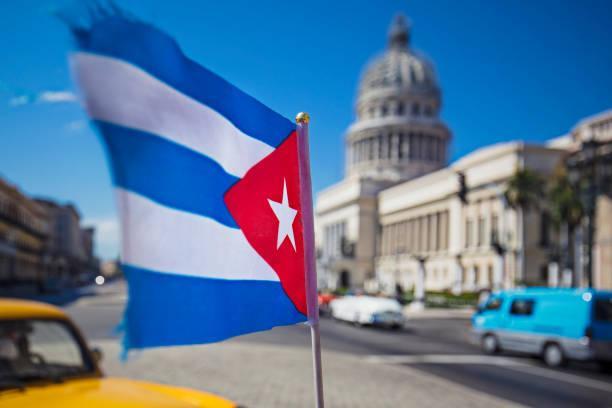
What is the blockade against Cuba, if not punitive?
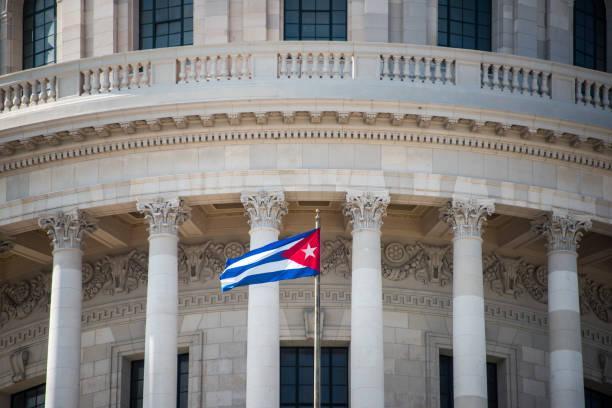
The blockade limits the full performance of the Cuban economy