
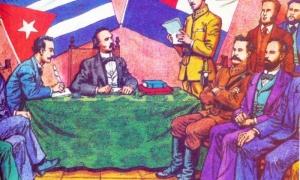

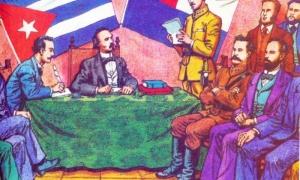
Imagine the April dust rising in that village in Camagüey. The news from the front was not encouraging: only six months had passed since we had lit the fuse at La Demajagua, and Bayamo had already fallen back into Spanish hands. The military initiative had slowed. And most seriously, there was not a single government speaking on behalf of the nascent Republic.
There were three. Three governments, two flags, one single urgency: unity or death.
That was the scene on April 10th, 1869. Many were missing, differences abounded; and yet, the impossible happened. The Mambises not only agreed on a unified command: they gave birth to the first Constitution of the Republic of Cuba in Arms. That fundamental law, with a mere 29 articles, was much more than a piece of paper signed amidst the hail of gunfire. It was the founding document of the sovereign Cuban nation, with a separation of powers, a separation of military and civilian command, and above all, with a revolutionary principle that still resonates with us: the abolition of slavery.
Imperfect? Like all human endeavors. But it was ours. Cubans didn't wait for permission from any metropolis to enact their own laws. With that Magna Carta, Cuba, through its own efforts, inscribed itself among the world's republican nations in the heart of the 19th century, confronting the Spanish empire.
Thus was born, from that Constituent Assembly, the first legitimate government of the nation, with Carlos Manuel de Céspedes as president and Manuel de Quesada as Commander-in-Chief. Thus was also born the constitutional tradition that, more than a century and a half later, remains the soul of our Republic.
These were also part of the essence that inspired our National Hero, José Martí, to found, on the same date in April but in 1892, the Cuban Revolutionary Party—which, as the Apostle said in Patria newspaper, is the people—with the mission of organizing the war that would make possible independence and the establishment of a sovereign republic, "with all and for the good of all." On these foundations were built the first Communist Party of Cuba, and its successor, as the vanguard organization of the Revolution.
Today, when the North tries to sell us the idea that a country without sovereignty can be free, it's worth remembering Guáimaro. There, our founding fathers didn't debate whether it was wise to have their own state. They took it for granted that independence isn't begged for, it's built with laws and rifles. And that certainty, that faith in the legality of the struggle, runs like an underground river through several of our subsequent constitutions, from the 1940 Constitution to the one the people ratified in 2019.
So, when you see the mercenaries of the algorithm and the spokesmen of annexationism selling the stinging idea of surrendering, remember Guáimaro’s dust. There, in the plain in Camagüey, a handful of men with machetes and dreams bequeathed to us the most powerful tool that a people who is set free can have: the reason for their sword, converted into a constitution. And that inheritance is not negotiated, auctioned, or handed over. It is defended, always.