


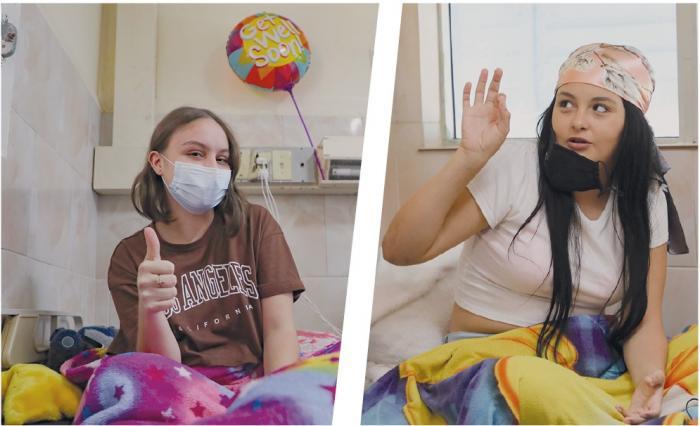
The “Good morning” needle prick has become routine for Lisnatali and Anyeli. They are 17 and 16 years old, respectively, and although they’ve known each other for only a short time, they’re united by a “horribly painful” experience that they nevertheless endure with as much courage as joy. And those are, without a doubt, their most effective treatments.
The older sister was the first to be admitted. Just a month ago—after visiting several hospitals—she was diagnosed with nodular sclerosis Hodgkin’s lymphoma at the Juan Manuel Márquez Pediatric Teaching Hospital. “Since she arrived here, they’ve done everything to her: X-rays, CT scans, biopsies, bone marrow scans—all in less than 15 days. “The care is special—in the General Ward, in the Surgery Ward, and here,” her mother says, hope shining in her eyes.
The younger one has a hydatidiform mole—a pregnancy disorder accompanied by a form of cancer. After finding out, the first thing she asked was if her hair would fall out from the chemotherapy. “When I heard ‘yes,’ I broke down. I couldn’t hold back the tears; I was really scared. Before I went in, my mom shaved my head.” She and her grandmother also cut their hair. She thought the treatments would affect her psychologically, but the doctors and nurses don’t give her time to “get down” and do everything in their power to prevent any pain.
One of them wants to study psychology—for herself, to understand herself, to help herself. And yes, it’s clear that, in true Cuban fashion, “it comes naturally” to her. She’s been able to cheer up her roommate when her hair—like hers—started falling out. “It’s something exotic,” she tells her. The other is studying nursing. “When I came in, I already knew what they had to do to me. And once they figured it out here, they kept me in the loop about everything.” Her resolve in the face of what she’s facing today, her determination to live, stems in large part from that love for the profession she’s eager to finish studying. “As soon as I’m out of here, I’ll go back to school, to working shifts, to helping,” she says with a firmness that no one can deny.
FROM THE OTHER SIDE OF THE WHITE COAT
It is also their “calling” that, at this time—when it is extremely difficult to strike a balance between personal and professional challenges—keeps Cuban healthcare specialists at their posts. This is a conviction held by Dr. Andy Hernández Álvarez, a specialist in pediatric clinical oncology and head of that department at the Juan Manuel Márquez Hospital.
“The professional who stands firm deserves respect. We choose to stay. I think the easiest thing is to focus on the problems affecting us, but those of us who love what we do and feel it in our bones cannot leave patients behind. Doing so is very difficult: getting to work, transportation, physical and psychological exhaustion, the hours of poor sleep.”
Postponing surgeries, extending waiting lists, and fragmenting medical services because specialists cannot get there are just some of the measures that have had to be taken at that institution following the intensification of the blockade and the oil embargo that is putting pressure on the country.
“What do we do when we have to carry a patient up to the seventh floor in the middle of a National Electric System blackout? We carry them in our arms and walk up the stairs. That’s the part the news on the other side doesn’t show,” asks Hernández Álvarez.
That hospital is a national referral center for services such as neurosurgery, oncohematology, psychiatry, therapy, and neonatology. It is the only pediatric unit that treats burn patients, has the largest oncohematology ward in the country, and the largest intensive care unit in the capital. “We are a pillar of pediatrics.”
Although oncology is viewed with fear from the outside, for him it is not a difficult subject. “There are other specialties that are more complicated,” he asserts. “Every professional sees things from their own perspective.” To understand this, he says, “you have to keep in mind that I was a pediatric cancer patient at age 13. I know what it’s like to be on the other side of the white coat. And that’s what no doctor can ever forget: empathy.”
His calling came from his own experiences. “I always wanted to be a doctor; ever since I was a child, I wanted to be a veterinarian. Then I became aware of illnesses and all their complications, and I knew I wanted to be a doctor—precisely to help those who were in the same situation I was in at that time.”
COMMITMENTS
It is that sense of belonging that, when aid breaks through in times of desperation, makes “relief” the only word that describes what the hospital staff feel. Because “there is nothing more satisfying than having the medicine. The relief comes from knowing that you can treat, that you can continue, that you can fight, and, above all, that you can keep your patient alive.”
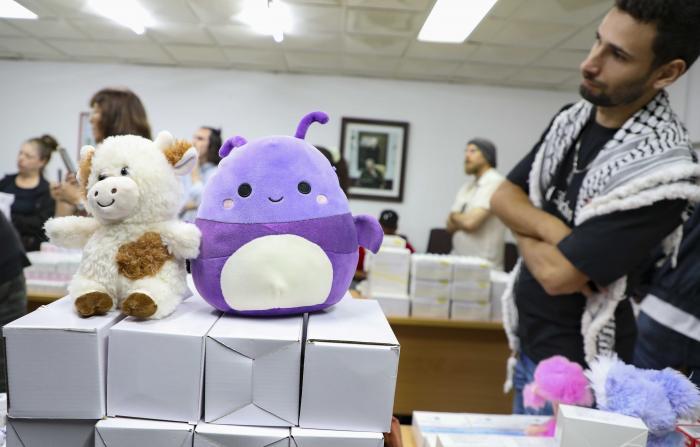
That is how they felt when the Hatuey project (Health Advocates in Truth, Unity, and Empathy) brought a special donation to that institution.
As a metaphor for protecting the tenderness of childhood in the face of life’s transience, cytostatic drugs, antibiotics, antiemetics, and consumables—topped off with toys—filled the tables.
Meanwhile, Dr. Andy explained—as if it were his own life that the donations would save—the importance of the arrival of these supplies, born of the good wishes and sacrifice of many who love Cuba from different parts of the world.
“It’s a reality that hits us hard. We’re still operating. We haven’t stopped providing services, but do you know what it’s like to spend a year vomiting nonstop from chemotherapy and not have the medications to stop the adverse reactions? We’re not just talking about saving lives, but also about treating patients and maintaining their quality of life. A patient who can tolerate adverse reactions endures more treatments and stays in good spirits.”
“I don’t want you to keep this information to yourselves; I want you to share it,” she told them. “This isn’t just an act of solidarity; it’s an act of humanity. You are embodying what humanity should be.”
In response to his words, Miami-based Dr. Nadia Marsh, a member of the Hatuey project, replied: “You thank us, but I want to thank the healthcare workers of Cuba—you are an inspiration to us. We are here because you serve as an example to the world.”
“Before coming, I spoke with my colleagues at the hospital, and they told me they would cover my responsibilities. They aren’t activists; they’re regular doctors, but most people in the U.S. are against the blockade and the stranglehold imposed by the empire.”
“My colleagues know what you’ve done on an international level. It’s the work of heroes. That gives us strength to fight. We are seeing that even with the blockade and the lack of resources, what a people can do when they truly think of the people.”
Solidarity with Cuba may seem like something new, but it is not a recent phenomenon. It has been sprouting for some years now, with its cultivators knowing full well that the imperial siege is not a recent measure either.
David Paul, a nurse in San Francisco, California, will take with him, upon his return, “a commitment”—that of “not only providing the new material aid they deserve and need, but also of educating the people about it.” And he reflected: “What will people in our countries say when we explain that the blockade prevents what is needed for our families’ lives from entering? We are committed to continuing the struggle,” he assured.
Dr. Andy thanks and bids farewell to his friends from the Hatuey project. He glances at his watch. He climbs the stairs to the seventh floor. He’s sweating. He walks through the hallways with their faded cartoon murals. The hospital isn’t 100% structurally sound. There are other priorities. “We’re not a building; we’re a living, beating heart,” he knows.
He continues his journey through the maze of hallways and rooms. He checks in on his patients at the Outpatient Chemotherapy Unit. He keeps going. He enters the first inpatient ward; Lisnatali and Anyeli are smiling alongside their mothers—they’ve been given a Parcheesi set, just like the other children who can’t leave. He takes a breath, opens the door: his “Good morning” feels like an invitation to life.
Related News

There are many lessons to be learned in this country during these difficult times
To create spaces for understanding and cooperation, Cuban officials have recently held tal...

For Cuba, "Humanity Made Solidarity"
