


In their hands, they carried what their bodies allowed them to carry. In their words—sometimes overwhelmed by emotions and language barriers—they expressed everything that can be said with words. In their hearts, the world beat—for Cuba.
It seemed as if they had arrived at a temple, as if they were discovering a relic as ancient as it was precious. Nothing vibrates with such youthful energy as a hospital from the beginning of the last century where the miracle of life still occurs—one after another. And, as if that weren't enough, the cases treated there are as unique as those of pregnant women with diabetes, heart conditions, or cancer, and newborns.
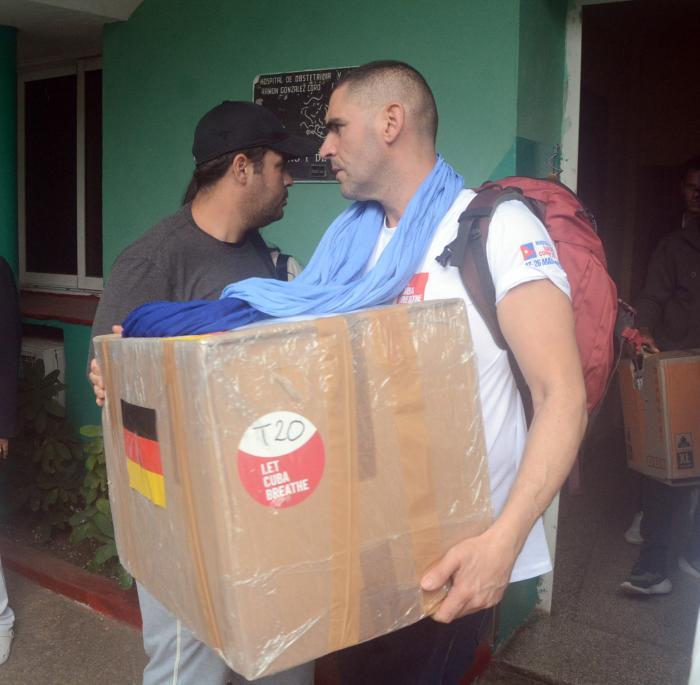
A delegation from the European segment of the Solidarity Convoy, which arrived in the country on March 17th with about five tons of medical supplies, medicines and basic necessities, arrived at the Ramón González Coro Gynecological and Obstetrical Hospital in Havana.
THE MARVELOUS REAL OF CUBAN MEDICINE
The surprise on their faces was evident. They had been told about a country with serious needs. They had seen it. They had shared it. How could they work knowing that the situation at home was also difficult? Where did they get or where did they keep so much hope? The questions came in droves.
"A child doesn't ask for permission or wait to be born." You have to be there for him and for his mother. "Saving two lives at once" is a task that requires a joint effort, even more so when it comes to pregnant women with complex health conditions, emphasized Liudmila Rodríguez, head of the anesthesiology service.
Although it might seem that the beautiful chaos of childbirth is the only experience of the workers in this—and other institutions in Cuba—nothing could be further from the truth. Overcoming everything from transportation limitations to the most basic household activities affected by an attempt to suffocate an entire country are feats that the island's specialists are no strangers to.
The anecdotes continue. They seem straight out of science fiction. It's the will, the marvelous real of a people who refuse to give up.
Two young, recently graduated engineers, whom we "won over to stay," repaired a previously donated anesthesia machine that couldn't be used because the donors had been unable to send the software needed to get it up and running. The equipment is now an unusual trophy: it doesn't just decorate the space uselessly, it saves lives.
As a doctor, Dr. Otto Rafael Recio, the institution's director, summed it up in his own way: "At this center, we treat cases of fetuses with intrauterine growth restriction. In such situations, the developing organism itself provides the brain, heart, and kidneys until it is born. That's what our country is doing today. Prioritizing vital and essential functions within healthcare facilities," he affirmed.
Thus, at the González Coro Hospital, surgical activity, patient care, and the internal life of the center have been reorganized, adopting strategies to ensure that the population continues to receive services.
Andrea Santor, a member of the solidarity organization Cuba Va, asks to speak. His mind recalls the events in Italian, even though he wants to speak in Spanish. Images from 2020 flash before his eyes as if he were watching a film. Then, he said it aloud. When COVID-19 struck, while hundreds of citizens were losing their lives in Turin and there seemed to be no way to resolve the crisis, "a small island, on the other side of the world, with fewer resources than capitalist countries, extended a helping hand."
He, who served as a translator at that time, didn't hesitate to join this solidarity campaign. "Let's embrace this people who helped us when we needed it," he said. "It's just a drop in the bucket, but it's a direct message to the consciences of the world."
Raiza Ruiz, an oncologist, explains that they provide care with an "absolute minimum for everything." It's "wartime medicine." For the pathologies she treats, most medications and treatments are imported, "and we are prevented from purchasing them, even though the Ministry of Public Health (MINSAP) has a budget allocated for priority programs, such as PAMI (Maternal and Child Health Program)."
The limitations in terms of supplies, infrastructure, and medications affect every aspect of patient follow-up. "We can't provide all the treatments, nor the most up-to-date ones." However, we look for solutions, which often amaze the residents of other countries who come to the center, she emphasized.
CUBAN-STYLE
Someone in the audience raises their hand. A young man, brimming with curiosity for more "Cuban-style" solutions, asks the Director if they have ever faced extreme situations.
"We have experienced tense moments," says Dr. Otto Rafael Recio. "Our generator has failed, and we have had to finish surgeries using emergency lamps. Life is the most important thing." At the González Coro Hospital, they have newborns on mechanical ventilation, for which they use German-made Dragger ventilators. The batteries for these ventilators need to be replaced, and this cannot be guaranteed today due to the blockade. Every time the generator has failed—which is not a situation that can be resolved quickly—"we have had to resort to manual ventilation."
That systematic stress and exhaustion in trying to prevent maternal and neonatal deaths "weighs on our conscience," he acknowledged. And that, too, is a form of war, a Cold War, he insisted.
"My greatest fear as a doctor is working with a patient, knowing they need something, and not having it. We will be with them until the very end, but it's painful to know we can save them, yet we lack the resources because they have been denied to us from the outside."
Silence filled the room. Death and children should never share a prayer. Not even a thought.
As if many voices spoke through him, the young man could only manage to say: "Thank you for the effort you make despite the difficulties, for the example of resilience you are."
Certainties, heartbeats, hopes… Maureen Echevarría Peña knows these shortages all too well. At 25, she has only a few days left—less than a week—before the doctors and nurses who have cared for her daily at the González Coro Hospital for the past three months induce labor. Whether or not there's a blood pressure monitor or a glucometer, or whether they'll have to use more invasive or less precise methods due to the lack of resources, isn't her most pressing concern. She receives the specialists' constant monitoring with a smile; she trusts them. She suffers from hypertension and diabetes. That's why she's spent the last trimester of her pregnancy hospitalized. However, she says her mind is more focused on her inexperience—she's a first-time mother—and on being able to hold the heartbeat she's felt through the ultrasound, in her arms, close to her own.
The situation in the country is something that concerns her, of course. Other worries will occupy her when she returns home after this extended stay, during which "the hospital has gone to great lengths" to ensure she "lacks nothing." Today she is confident that, as on so many other occasions, and although this time it will be more complex, in true Cuban fashion and with the help of those arriving from other parts of the world, "we will get through this."