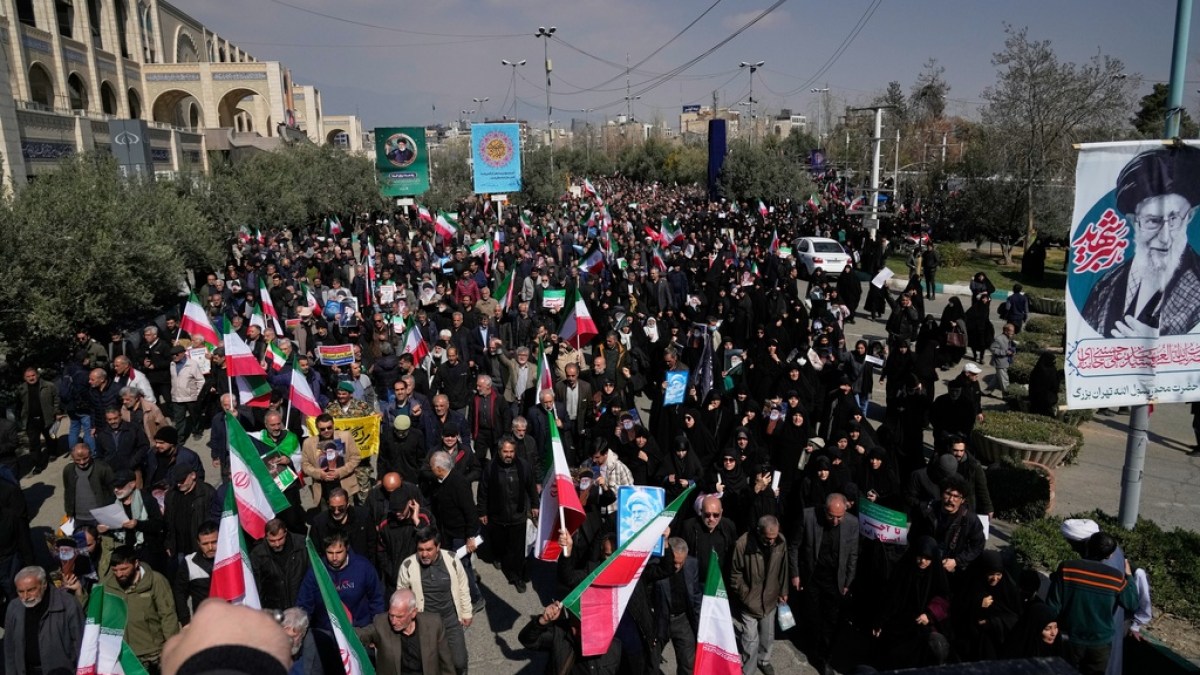

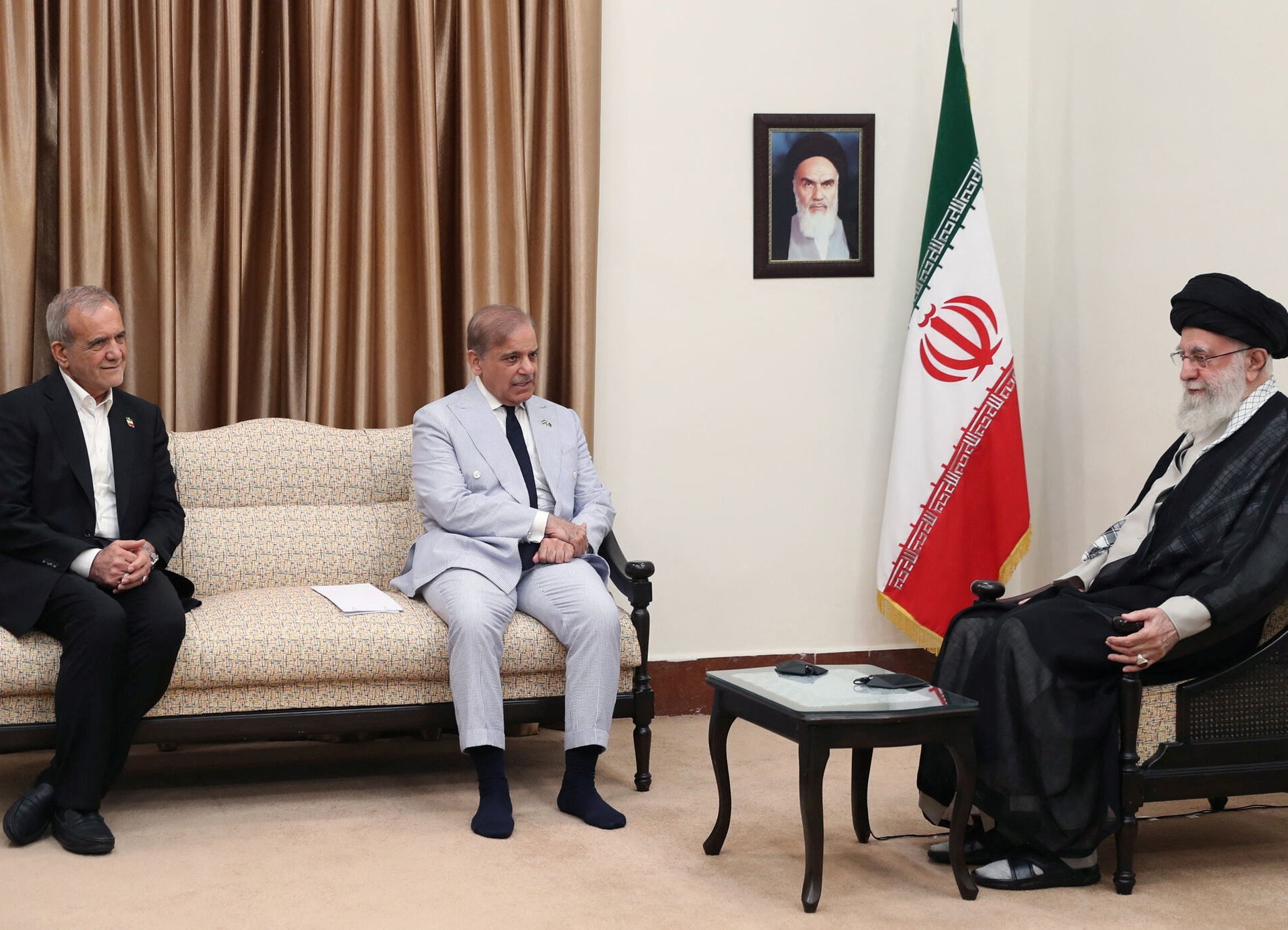

Islamabad, Pakistan – The reverberations of a war in which US-Israel attacks have killed more than a thousand people in Iran, including the country’s supreme leader Ali Khamenei, and Iranian missiles and drones have fallen on Israel in retaliation, are being felt deeply in Pakistan.
Six Gulf countries have also come under Iranian missile and drone attacks, putting Pakistan in a tough position.
- list 1 of 4‘We were just praying’: Pakistani students recount escape from war-hit Iran
- list 2 of 4Ten killed in pro-Iran protest at US consulate in Pakistan’s Karachi
- list 3 of 4Anger on Pakistan streets, 20 dead, after US-Israel strike kills Khamenei
- list 4 of 4World reacts to killing of Iran’s Khamenei by US, Israel forces
end of list
The country shares a 900-kilometre (559 miles) border with Iran in its southwest, and millions of its workers are residents in Saudi Arabia and other Gulf nations.
Since September last year, Islamabad has also reinforced its decades-long ties with Riyadh by signing a formal mutual defence agreement that commits each side to treat aggression against the other as aggression against both.
As Iranian drones and ballistic missiles continue to target Gulf states, the question being asked with increasing urgency in Pakistan is what Islamabad will do next if it finds itself pulled into the war.
Islamabad’s answer so far has been to work the phones furiously, engaging regional leaders, including Iran and Saudi Arabia.
When US-Israeli strikes killed Supreme Leader Ayatollah Ali Khamenei on February 28, Pakistan condemned the attacks as “unwarranted”. Within hours, it also condemned Iran’s retaliatory strikes on Gulf states as “blatant violations of sovereignty”.
Deputy Prime Minister and Foreign Minister Ishaq Dar, who was attending an Organisation of Islamic Cooperation meeting in Riyadh when the conflict began last week, launched what he later described as “shuttle communication” between Tehran and Riyadh.
Advertisement
Speaking in the Senate on March 3, and at a news conference later the same day, Dar disclosed that he had personally reminded Iranian Foreign Minister Abbas Araghchi of Pakistan’s defence obligations to Saudi Arabia.
“We have a defence pact with Saudi Arabia, and the whole world knows about it,” Dar said. “I told the Iranian leadership to take care of our pact with Saudi Arabia.”
Araghchi, he said, asked for guarantees that Saudi soil would not be used to attack Iran. Dar said he obtained those assurances from Riyadh and credited the back-channel exchange with limiting the scale of Iranian strikes on the kingdom.
On March 5, Iran’s ambassador to Saudi Arabia, Alireza Enayati, said his country welcomed Saudi Arabia’s pledge not to allow its airspace or territory to be used during the ongoing war with the US and Israel.
“We appreciate what we have repeatedly heard from Saudi Arabia – that it does not allow its airspace, waters, or territory to be used against the Islamic Republic of Iran,” he said in an interview.
But only a day later, during early hours of March 6, Saudi Arabia’s defence ministry confirmed it intercepted three ballistic missiles targeting the kingdom’s Prince Sultan Air Base. And hours later, Pakistan’s Field Marshal Asim Munir was in Riyadh, meeting Saudi Defence Minister Prince Khalid bin Salman, where they “discussed Iranian attacks on the Kingdom and the measures needed to halt them within the framework” of their mutual defence pact, the Saudi minister said in a post on X.
As the war escalates, analysts say that Pakistan’s tightrope walk between two close partners could become harder and harder.
A defence pact under pressure
![A month after Iranian president's visit to Islamabad, Pakistani PM Shehbaz Sharif met Saudi Crown Prince Mohammed bin Salman in Riyadh in September 2025 to sign a defence agreement. [File: Handout/Saudi Press Agency via Reuters]](https://www.aljazeera.com/wp-content/uploads/2026/03/2025-09-17T193003Z_2033872192_RC2VTGAIIE3P_RTRMADP_3_SAUDI-PAKISTAN-DEFENCE-1772753571.jpg?w=770&resize=770%2C700&quality=80)
The Strategic Mutual Defence Agreement, signed on September 17, 2025, in Riyadh by Crown Prince Mohammed bin Salman and Prime Minister Shehbaz Sharif alongside army chief Asim Munir, was the most significant formal defence commitment Pakistan had entered into in decades.
Its central clause states that any aggression against either country shall be considered aggression against both. The wording was modelled on collective defence principles similar to NATO’s Article 5, though analysts have cautioned against interpreting it as an automatic trigger for military intervention.
The agreement followed Israel’s September 2025 strikes on Hamas officials in Doha, an event that shook confidence in US security guarantees across the six Gulf Cooperation Council states: Bahrain, Kuwait, Oman, Qatar, Saudi Arabia and the United Arab Emirates.
Advertisement
Nuclear-armed Pakistan has maintained a military relationship with Saudi Arabia for decades, according to which an estimated 1,500 to 2,000 Pakistani troops remain stationed in the kingdom.
Now the pact is being tested under conditions neither side anticipated.
Umer Karim, an associate fellow at the Riyadh-based King Faisal Center for Research and Islamic Studies, called Pakistan’s current predicament the outcome of a miscalculation.
Islamabad, he argued, likely never expected to find itself caught between Tehran and Riyadh, particularly after the China-brokered rapprochement between Saudi Arabia and Iran in 2023.
“Pakistani leaders were always careful not to take an official plunge vis-a-vis Saudi defence. It was done for the first time by the current army chief, and though the potential dividends are big, so are the costs,” Karim told Al Jazeera.
“Perhaps this is the last time the Saudis will test Pakistan, and if Pakistan doesn’t fulfil its commitments now, the relationship will be irreversibly damaged,” he added.
In 2015, it declined a direct Saudi request to join the military coalition fighting in Yemen, following a parliamentary resolution that the country must remain neutral.
Aziz Alghashian, senior non-resident fellow at the Gulf International Forum in Riyadh, pointed to that episode. “The limitation of the Saudi-Pakistan treaty is clear. Treaties are only as strong as the political calculations and political will behind them,” Alghashian told Al Jazeera.
But Ilhan Niaz, a professor of history at Islamabad’s Quaid-e-Azam University, said that if Saudi Arabia feels sufficiently threatened by Iran to formally request Pakistani military assistance, “Pakistan will come to Saudi Arabia’s aid.”
“To do otherwise would undermine Pakistan’s credibility,” he told Al Jazeera.
The Iran constraint
The complicating factor for Pakistan is that it cannot afford to treat Iran simply as an adversary if Riyadh calls for military assistance.
The two countries share a long and porous border, maintain significant trade ties, and have recently stepped up diplomatic engagement. Iranian President Masoud Pezeshkian visited Islamabad in August 2025, and the two governments maintain a range of formal and backchannel contacts.
Niaz acknowledged that Tehran has also been “a difficult neighbour”, pointing to the January 2024 exchange of cross-border strikes initiated by Iran as evidence of the relationship’s unpredictability.
Even so, he said Pakistan had “vital national interests” in ensuring Iran’s stability and territorial integrity.
“The collapse of Iran into civil war, its fragmentation into warring states, and the extension of Israeli influence to Pakistan’s western borders are all developments that greatly, and rightly, worry Islamabad,” he said.
The domestic fallout from the US-Israel strikes and Iran’s response has already been immediate.
The army was deployed and a three-day curfew imposed in Gilgit-Baltistan after at least 23 people were killed in protests across Pakistan following Khamenei’s assassination. The protests were driven largely by Pakistan’s Shia community, estimated to make up between 15 and 20 percent of the 250 million population, which has historically mobilised around developments involving Iran.
Advertisement
Pakistan’s violent sectarian history adds another layer of risk.
The Zainabiyoun Brigade, a Pakistan-origin Shia militia trained, funded and commanded by Iran’s Islamic Revolutionary Guard Corps, has recruited thousands of fighters from Pakistan over the past decade. While many fought in Syria against ISIL (ISIS), many Syrians activists accuse them of committing sectarian violence.
Two years ago, Pakistan’s northwestern Kurram district, the Zainabiyoun’s primary recruitment ground, saw more than 130 people killed in sectarian clashes in the final weeks of 2024 alone.
Pakistan formally banned the group in 2024, but many believe the designation has done little to dismantle its networks.
Analysts warn that fighters hardened in Syria’s civil war could, if Iran’s conflict with Pakistan’s Gulf partners deepens, shift from a defensive to an offensive posture on Pakistani soil.
“Iran has significant influence over Shia organisations in Pakistan,” Islamabad-based security analyst Amir Rana, executive director of the Pak Institute of Peace Studies, told Al Jazeera. “And then you have Balochistan, which is already a highly volatile area. If there is any confrontation, the fallout for Pakistan would be severe.”
Pakistan’s Balochistan province borders Iran, and has been ground-zero for a decades-long separatist movement. “That reality cannot be ignored,” Muhammad Khatibi, a political analyst based in Tehran, said, pointing out that geography itself constrains Islamabad’s choices.
“Any perception that Islamabad is siding militarily against Tehran could inflame domestic sectarian divisions in ways that a full-scale regional war would make very difficult to contain,” Khatibi told Al Jazeera.
![Violence erupted in Pakistan following news of US and Israeli strikes on Iran that killed Iran's Supreme Leader Ayatollah Ali Khamenei on February 28. At least 23 people were killed in violence across country, with at least 10 people killed in Karachi during a protest outside the US Consulate General. [Akhtar Soomro/Reuters]](https://www.aljazeera.com/wp-content/uploads/2026/03/2026-03-01T152518Z_797272407_RC2NVJALJ3YW_RTRMADP_3_IRAN-CRISIS-PAKISTAN-PROTESTS-1772753695.jpg?w=770&resize=770%2C513&quality=80)
What are Pakistan’s options?
Analysts say direct offensive military action against Iran, such as deploying combat aircraft or conducting strikes on Iranian territory, is not a realistic option for Pakistan, given its domestic constraints.
Rana describes Islamabad’s current posture as an attempt to placate both sides.
“Iran’s primary threat is through air strikes using drones and missiles, and that is an area where Pakistan can help and provide assistance to Saudi Arabia. But that would mean Pakistan becoming a party to the war, and that is a major question mark,” he said.
He added that the most viable option for Pakistan could be to provide covert operational support to Saudi Arabia while maintaining diplomatic engagement with Iran.
Alghashian also agreed; he identified air defence cooperation as the most concrete role Pakistan could play — it would be both “militarily meaningful and politically defensible”
“They could help create more air defence capacity,” he said. “This is tangible, it is defensive, and it is in Pakistan’s interest that Saudi Arabia becomes more stable and prosperous.”
Karim, however, warned that the window for Pakistan’s balancing act may be closing faster than Islamabad realises.
“As the situation reaches a tipping point and as Saudi energy installations and infrastructure are hit, it is only a matter of time that Saudi Arabia will ask Pakistan to contribute towards its defence,” he said.
He added that if Pakistan deploys air defence assets to Saudi Arabia, doing so could leave its own air defences dangerously exposed, while deeper involvement could carry political costs at home.
Advertisement
For now, Islamabad’s strongest card remains diplomacy, using its access to both Riyadh and Tehran and the trust it has accumulated. Khatibi said Pakistan should protect that position “at all costs”.
“Pakistan’s most realistic positioning is as a mediator and leveraging its relationships with both sides. It is highly unlikely that Pakistan deploys forces into an anti-Iran coalition. The risks would outweigh the benefits,” he said.
The stakes for Pakistan
The scenario least favourable to Islamabad would be a collective Gulf Cooperation Council decision to enter the war directly, and the warning signs are mounting.
Saudi Arabia and the United Arab Emirates have both declared that Iranian attacks “crossed a red line”.
A joint statement issued on March 1 by the United States, Bahrain, Jordan, Kuwait, Qatar, Saudi Arabia and the UAE said they “reaffirm the right to self-defense in the face of these attacks.”
For Pakistan, such an escalation could carry serious consequences.
Economically, with millions of Pakistani workers living and earning their wages in Gulf states, remittances from the region provide crucial foreign exchange for an economy still recovering from a balance of payments crisis.
Khatibi said any prolonged regional war that disrupts Gulf economies would directly affect Pakistan’s financial position.
“Energy prices could also spike, adding further strain,” he said, noting Pakistan’s heavy dependence on Gulf states for its energy needs.
Pakistan is also simultaneously managing its own military confrontation with the Afghan Taliban which began two days before the US-Israel strikes.
Karim warned that deeper involvement in the regional conflict could trigger internal instability.
“Sectarian conflict,” he said, “can reignite, taking the country back to the bloody 1990s. The government already has lean political legitimacy, and such an occurrence will make it even more unpopular.”
Alghashian also highlighted Pakistan’s reluctance to be drawn into the conflict.
“Saudi Arabia does not want to be in this war and is getting dragged into it. Pakistan will also certainly not want to be dragged into somebody else’s war that they didn’t want to be dragged into. It just wouldn’t make any sense,” he says.
But Niaz said that if the crisis eventually forces Islamabad to choose, the calculus may become unavoidable.
“If Tehran forces Pakistan to choose between Iran and Saudi Arabia, the choice would unquestionably be in favour of the Saudis.”
Related News
Blood tech: UK’s use of Israeli spyware that helps underpin a genocide
Three US fighter jets ‘mistakenly’ shot down over Kuwait

Twelve Palestine Action activists granted bail