

The day after one of Mexico’s most wanted drug lords, known as “El Mencho”, was killed in a dawn raid last week, Defence Minister Ricardo Trevilla Trejo told reporters that 80 percent of weapons seized from cartels have been smuggled across the border from the United States.
With the aid of US intelligence, Mexican security forces tracked El Mencho, whose real name is Nemesio Oseguera Cervantes and was also wanted in the US, to a property in the mountain town of Tapalpa in west-central Mexico. He was the head of the Jalisco New Generation Cartel (CJNG), which is known for its military-style arsenal of weapons and amassing large amounts of power in just a couple of decades.
So do the majority of these weapons really originate in the US? And if so, what is President Donald Trump’s administration doing about it?
What are the main drug cartels operating in Mexico, and how well armed are they?
Mexico’s main drug cartels include the Gulf Cartel, the Sinaloa Cartel and the CJNG.
They are all heavily armed with military-grade rifles, high-capacity magazines and in some cases explosives.
The CJNG, in particular, is notorious for its firepower, having shot down Mexican military helicopters in 2015.
Both the Mexican authorities and the US government have rewards out for several cartel leaders, including Ismael Zambada Sicairos, known as “El Mayito Flaco”, of the La Mayiza faction of the Sinaloa Cartel; Ivan Archivaldo Guzman Salazar, or “El Chapito”, a senior Sinaloa Cartel leader; Fausto Isidro Meza Flores – “El Chapo Isidro” – who was added to the FBI’s 10 most wanted fugitives in February; and Juan Reyes Mejia-Gonzalez, “R-1” or “Kiki”, of the Gulf Cartel’s Los Rojos faction with a $15m US reward.
Advertisement
After the raid that killed El Mencho on February 22, armed cartel members launched coordinated attacks on highways, police stations and rival territories across multiple states, resulting in several deaths and widespread disruptions.
What are the gun purchase laws in Mexico?
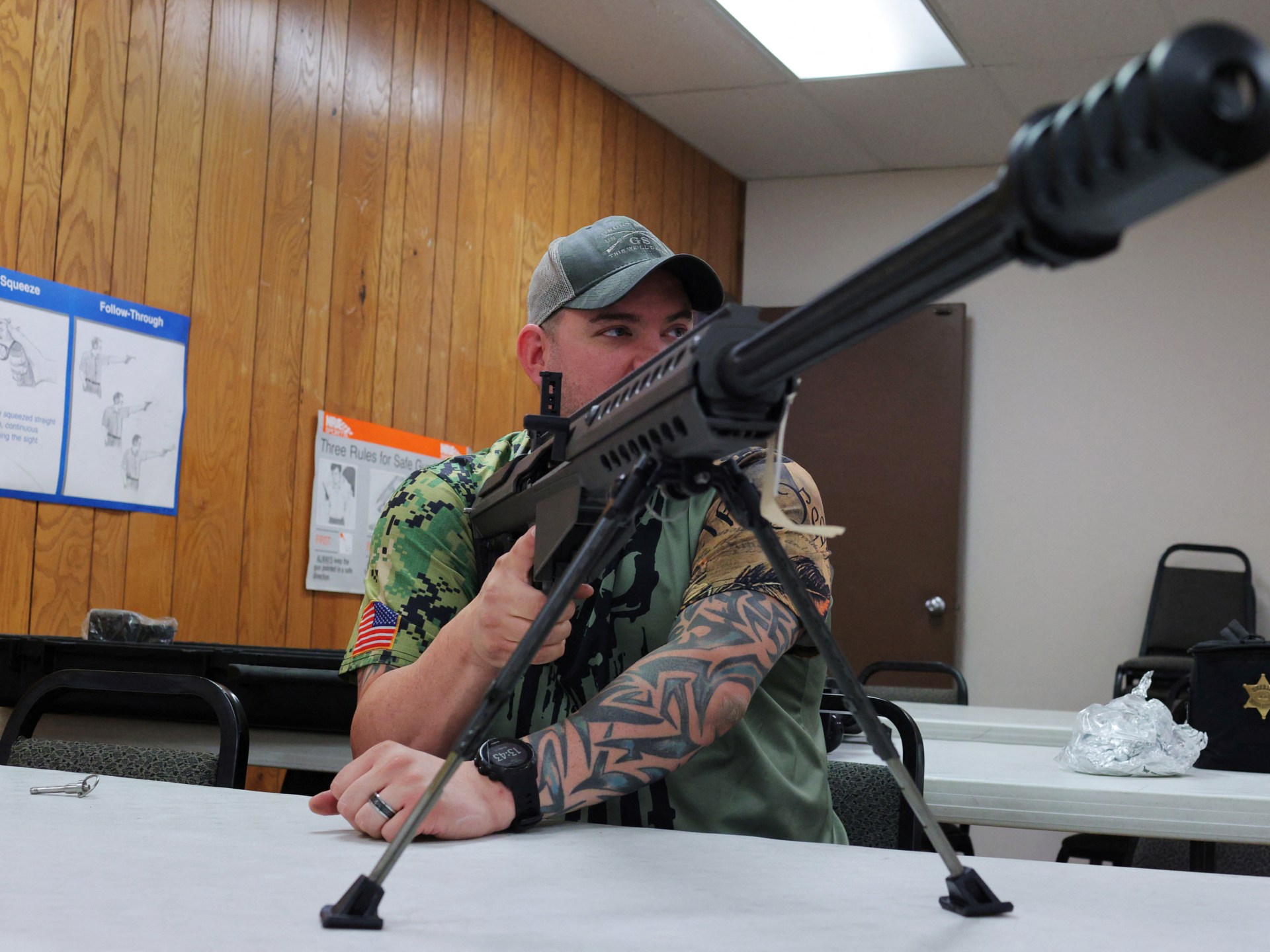
Under Mexico’s Federal Law on Firearms and Explosives, civilians may legally buy limited firearms – such as small handguns, .22-calibre rifles and certain shotguns – and only through two military-run stores: DCAM in Mexico City and OTCA in Apodaca, Nuevo Leon. Buyers must undergo multiple government approvals and background checks. Military-grade rifles are reserved for the armed forces only.
According to Benjamin Smith, a professor of Latin American history at the University of Warwick in the United Kingdom, cartels bypass these restrictions by sourcing most weapons illicitly, primarily from the US, where higher-calibre rifles and high-capacity magazines are widely available.
Some weapons are obtained through theft or corruption within Mexican security forces, but US-sourced trafficking is central.
Smith said strict controls in one country can spur illicit flows in another, just as US drug prohibition fuels Mexican trafficking and Mexico’s gun restrictions drive cross-border arms smuggling.
Authorities estimated that 200,000 to 500,000 firearms are trafficked from the US into Mexico each year to supply cartels.
This trade is illegal because US federal law prohibits the export of firearms to non-US residents without authorisation from the Bureau of Alcohol, Tobacco, Firearms and Explosives (ATF) while Mexico’s Federal Law on Firearms and Explosives forbids importing weapons without government approval. Violators face severe criminal penalties.
By smuggling guns across the border, cartels break both US export law and Mexican import law, essentially creating a criminal network that operates outside both legal systems.
Where do Mexican cartels get their weapons from?
According to Annette Idler, associate professor of global security at the University of Oxford, cartels typically acquire weapons through a combination of straw purchasers, unlicensed resellers, theft and specialised brokers who source firearms and ammunition from US commercial markets.
Straw purchasing happens when someone legally eligible to buy a gun purchases it on behalf of someone who cannot legally do so to circumvent background checks. In the US, this is explicitly prohibited under the Gun Control Act of 1968, which makes it illegal to provide false information to a federally licensed firearms dealer or buy a gun for someone who is prohibited from owning one.
Advertisement
The weapons are typically transported by land, often in small, concealed shipments of disassembled guns to reduce detection, Idler told Al Jazeera.
In February, Mexico’s Ministry of Defence said it had seized 137,000 .50-calibre rounds from cartels since 2012. These high-powered bullets, capable of penetrating vehicles and body armour, are designed for heavy rifles and machineguns, and almost half were traced to the Lake City Army Ammunition Plant in Missouri, the largest military small-arms manufacturer in the US.
In 2021, the Mexican government filed a $10bn lawsuit in US federal court in Massachusetts against several major US gun manufacturers, including Smith & Wesson, Beretta USA, Colt and Glock, arguing that their business practices facilitate the illegal flow of firearms to Mexican drug cartels and exacerbate violence in Mexico.
The case ultimately reached the US Supreme Court, which, on June 5, unanimously ruled that the Protection of Lawful Commerce in Arms Act, a 2005 US federal law that shields gun manufacturers from being sued for crimes committed with their firearms, barred Mexico’s claim against the manufacturers because the government failed to show they “aided and abetted” illegal arms sales to traffickers.
Mexico has pursued similar action against individual dealers. In October 2022, the government sued five Arizona gun shops – Diamondback Shooting Sports, SNG Tactical, Loan Prairie (The Hub Target Sports), Ammo A-Z and Sprague’s Sports – alleging they routinely enabled straw purchases and weapons trafficking to criminal organisations. That case is pending.

What has the US done to address this problem?
US authorities have tried to tackle the flow of guns to Mexico.
From 2018 to 2021, the ATF conducted Project Thor, a multiagency intelligence programme targeting US-based gun-trafficking networks supplying Mexican cartels.
It brought dozens of trafficking cases and mapped supply chains moving weapons south. The initiative was defunded in 2022 by President Joe Biden’s administration athough neither the Department of Justice nor the ATF publicly explained why.
The US has also tried other avenues.
From 2009 to 2011, the ATF ran Operation Fast and Furious, under which more than 2,000 firearms were allowed to be purchased illegally in the US and trafficked to Mexican cartels. The aim was to track the weapons to senior members of the cartels.
Instead, many were lost because the ATF significantly underestimated the difficulty of tracking the guns once they entered the illicit market. Many ended up being used in violent crimes, including in the killing of US Border Patrol agent Brian Terry in 2010. This sparked severe criticism of the operation.
In 2011, Humberto Benítez Trevino, then head of the justice committee in Mexico’s Chamber of Deputies, said at least 150 injuries and homicides had been linked to weapons smuggled under the US operation. Mexican lawmakers called it a violation of Mexico’s sovereignty.
Advertisement
The controversy deepened in 2011 when Jesus Vicente Zambada-Niebla of the Sinaloa Cartel claimed in filed pleadings in US federal court in Chicago, Illinois, that his cartel had received preferential treatment from US authorities aimed at undermining its rivals.
US officials denied the allegation, but Smith noted that US counternarcotics operations have historically involved setting cartels against each other.

Could the US really be tactically arming some Mexican cartels?
According to Smith, the US is unlikely to be deliberately or tactically arming cartels like Jalisco. He explained that while “it is possible that in order to get information on the Sinaloa Cartel, [authorities] turned a blind eye to arms trafficking by their rival, the CJNG,” there is no explicit plan to arm them.
Past outcomes, such as high-calibre weapons reaching criminal groups during Operation Fast and Furious, were unintended consequences of enforcement strategies, not deliberate policy, he said.
Smith added that while the US could easily stop such smuggling through stricter regulation, failing to do so is a political choice influenced by domestic pressure and “the political expediency of blaming Latin Americans rather than Americans for cartel violence”.
According to Idler, Mexican cartels’ current access to US military-grade ammunition, including ammunition from the Lake City Army Ammunition Plant, is better explained by “market diversion and regulatory gaps” rather than intentional US support.
What will it take to counter gun trafficking to Mexican cartels?
To effectively counter gun trafficking requires a major shift in US policy and priorities, Idler said.
She explained that a credible strategy “requires Washington to treat southbound firearms trafficking with the same urgency as northbound flows of drugs and people – tightening oversight, investing in tracing and investigations, and framing cross-border security as a genuinely mutual obligation rather than a one-directional problem”.
Addressing the flow of weapons will rely on continued oversight and coordinated action and cooperation between the US and Mexico, she said.
Related News

How four years of Ukraine war have changed Russia
Second US drone laser incident this month prompts Texas airspace closure
Photos: The aftermath of Pakistan’s air strikes in Afghanistan