

Iran appeared determined to avenge the killing of Supreme Leader Ayatollah Ali Khamenei and other senior Iranian officials following the start of the US-Israeli assault on Saturday, as Tehran continued to strike back at Israel and United States military assets across the Gulf on Monday.
After Khamenei’s death was confirmed by Iranian state media on Sunday, the Islamic Revolutionary Guard Corps (IRGC) vowed revenge and launched what it called “the heaviest offensive operations in the history of the armed forces of the Islamic Republic against occupied lands [a reference to Israel] and the bases of American terrorists”.
- list 1 of 3Explosions across Qatar, UAE, Kuwait as Iran’s retaliatory strikes continue
- list 2 of 3What we know on day three of US-Israeli attacks on Iran
- list 3 of 3Oil prices rise sharply after US, Israeli attacks on Iran
end of list
Iran’s army chief, Amir Hatami, also pledged to continue defending the country, as the army claimed its fighter jets had bombed US bases across the Gulf region on Sunday.
This is not the first time Iran has targeted Israel and US military bases in the Gulf region in retaliatory strikes. Last June, during Iran’s 12-day war with Israel, Tehran launched a wave of ballistic missiles targeting Israel and the Al Udeid airbase in Qatar, which hosts US troops. Most of these missiles were intercepted and destroyed, and the strike on Al Udeid was pre-warned and largely seen as a face-saving exercise.
This year, defence analysts say Iran has revised its military strategy to a more aggressive one focused on the Islamic Republic’s survival.
What does Iran’s military structure look like?
Iran’s military power is often described as opaque and complex.
The nation operates parallel armies, multiple intelligence services and layered command structures, all of which answer directly to the supreme leader, who serves as the commander in chief of all the armed forces.
Advertisement
The parallel armies comprise the Artesh – or Iran’s regular army, which is responsible for territorial defence, airspace and conventional warfare – and the IRGC, whose role goes beyond defence and includes protecting Iran’s political structure.
The IRGC also controls Iran’s airspace and drone arsenal, which has become the backbone of Iran’s deterrence strategy against attacks from Israel and the US.
Defence analysts told Al Jazeera that such a complex military structure is a deliberate strategy to safeguard the country from both external and internal threats, such as coups.
“Iran’s military strategy is derived from its political structure. Their political aim is to safeguard their own territorial integrity and stop foreign intervention targeted at overthrowing their rule,” a military specialist and former military official, who requested anonymity, told Al Jazeera.

How has Iran responded to strikes?
Following the US and Israel’s coordinated strikes on Iran on Saturday, Tehran has retaliated against Israel and US military bases across the Gulf region, using Shahed drones – Iranian unmanned combat aerial vehicles (UCAVs) – and high-speed ballistic missiles.
While Israel, the US and Gulf countries have intercepted most of these missiles, some have struck military assets and civilian infrastructure. Debris from those intercepted has also fallen on some civilian areas.
On Saturday, Iran fired 137 missiles and 209 drones across the United Arab Emirates (the UAE, where US military bases are present), its Ministry of Defence said, with fires and smoke reaching the Dubai landmarks of Palm Jumeirah and Burj Al Arab.
At Abu Dhabi’s airport, at least one person was killed and seven wounded during what the facility’s authority called an “incident”. Dubai’s airport, the world’s busiest for international traffic, and Kuwait’s airport were also hit.
At least nine people were also killed and more than 20 injured in Iran’s missile strike on the Israeli town of Beit Shemesh on Sunday.

What is Iran’s strategy here?
John Phillips, a British safety, security and risk adviser and a former military chief instructor, told Al Jazeera that Iran’s current military strategy is to survive intense Israeli‑US pressure, rebuild its core capabilities, and restore deterrence by calibrated asymmetric escalation through missiles, drones and proxies.
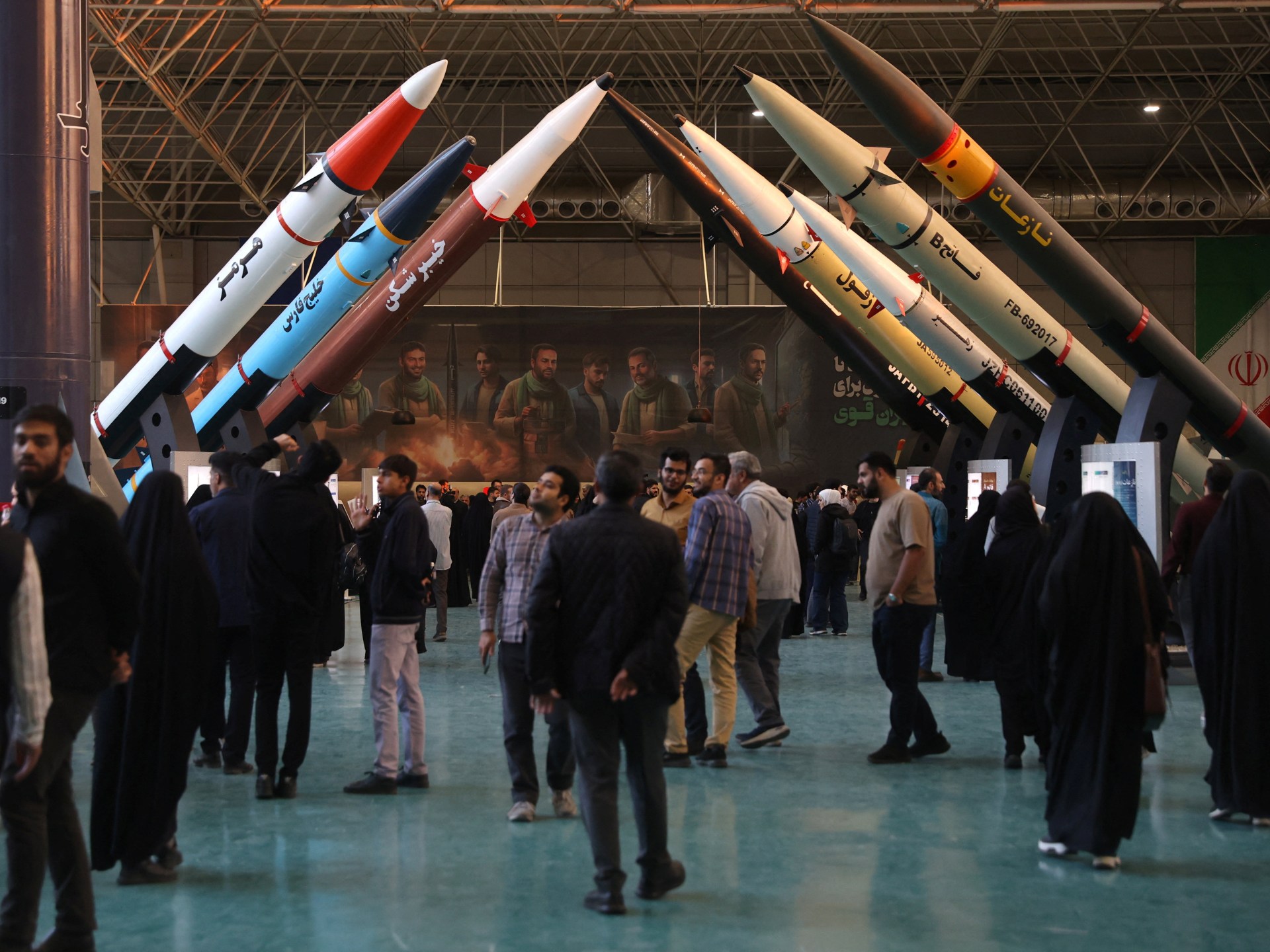
He said the military strategy firstly focuses on “asymmetric endurance, which is a case of hardening ‘missile cities’, dispersing command structures, and accepting initial damage in order to preserve a second‑strike capability rather than trying to prevent all strikes”. Missile cities are defensive infrastructure used by Iran to safeguard its ballistic and cruise missiles from any aerial attacks
Advertisement
Phillips explained that regional saturation and proxy warfare are also part of the strategy whereby Iran is using “large salvos of ballistic missiles and loitering munitions, alongside actions by Hezbollah and remaining partner militias across the Middle East, to stretch Israeli and US missile defences and impose costs region‑wide”.
Early on Monday, Hezbollah fired a barrage of rockets at northern Israel, to avenge the killing of Khamenei.
Phillips added that Iran has also threatened to close the Strait of Hormuz as part of its military strategy to raise the global economic stakes of the war and pressure Western and Gulf governments.
About 20-30 percent of global oil and gas supplies are shipped through the Strait of Hormuz. Instability in this important maritime route could rattle economic stability worldwide. So far, Iran has not officially closed the strait. But shipping data from Sunday showed that at least 150 tankers, including crude oil and liquified natural gas vessels, had dropped anchor in open Gulf waters beyond the strait.

How is this strategy different from last June?
In June last year, Iran and Israel, which was supported by the US, engaged in a 12-day war.
It erupted on June 13, 2025, when Israel launched air strikes on Iranian military and nuclear sites, killing key nuclear scientists and military commanders.
Iran retaliated with hundreds of ballistic missiles targeting Israeli cities. In the days that followed, Israel and Iran traded missiles as casualties mounted on both sides. While casualties were high in Iran, they were minimal in Israel. However, some missiles did breach Israel’s much-lauded Iron Dome.
The US entered the military clash on June 22 with bunker-buster strikes on Iran’s Natanz, Fordow and Isfahan nuclear facilities. Afterwards, US President Donald Trump claimed that Iran’s nuclear capabilities had been neutralised.
A fragile ceasefire was eventually brokered by the US on June 24, hours after Iran had fired missiles at the largest airbase hosting US troops in the Middle East – Al Udeid in Qatar.
Phillips said that since then, Tehran has shifted its military doctrine from a primarily defensive containment to an explicitly offensive asymmetric posture.
“The June 2025 war marked a major inflection from largely proxy‑based confrontation to direct, high‑intensity exchanges between Iran and Israel, with US involvement,” he said.
“Compared to June 2025, Iran today appears more structurally aggressive in doctrine where it is formally embracing earlier and more extensive use of regional missiles, drones, cyberattacks and energy coercion (when energy resources and infrastructure are targeted or cut off), but is operationally constrained by battle damage, sanctions and internal instability,” he added.
Phillips also noted that Iran has become more risk‑accepting and escalatory in nature since June last year.
“But its degraded capabilities and fear of triggering an outright regime‑ending campaign push it toward calibrated, episodic bursts of aggression rather than permanent high‑intensity warfare,” he said.
Advertisement
“Their immediate response is likely to be similar to that post the killing of [Qassem] Soleimani,” he said.
In January 2020, after Trump’s administration killed IRGC military commander Qassem Soleimani, along with six others in an air raid on Baghdad’s international airport in Iraq, Iran fired more than a dozen missiles at two Iraqi bases hosting US forces. There were no casualties.
Phillips added that Iran will likely resort to “excessive proxy attacks … for the period of mourning to avenge the killing of the ayatollah. There is highly likely to be another large-scale ICBM [intercontinental ballistic missile] attack on Israel to prove a point and to fight back.”
Is Iran’s current military strategy working?
Defence analysts say it is too early to tell whether the recalibrated strategy is working.
“Iran has a strong army, but there are currently no boots on the ground, and it is an aerial war. Iran is in a disadvantageous position with its air defence compared to the US and Israel. Tehran has increased its stockpile of aerial missiles, but only time will tell if it can hold its own,” the military expert and former official said.
Phillips compared Iran to a “wounded animal” and said that in narrow deterrence terms, Tehran’s military strategy is working to the extent that it has demonstrated it can still launch meaningful missile and drone attacks after the 2025 strikes. It has also forced Israel and the US into a “sustained, resource‑intensive defensive and offensive campaign rather than a clean, one‑off disarmament”, he added.
“However, Iran’s nuclear and missile infrastructure has been heavily damaged, its economy further weakened, and it lost Ayatollah Khamenei in the strike on Tehran, leaving the regime more vulnerable and internally strained, which indicates that its strategy has not prevented severe strategic setbacks,” he said.
How long can Iran hold out?
Even before the Israeli and US attacks on Iran on Saturday, Iranian officials had warned that any attack from Washington or Tel Aviv on Iran would be treated as the start of a wider war, not a contained operation.
After Khamenei’s killing, this stance by Iranian officials has continued.
“You have crossed our red line and must pay the price,” Iran’s parliamentary speaker, Mohammad Bagher Ghalibaf, said in a televised address, referring to the US and Israel.
“We will deliver such devastating blows that you yourselves will be driven to beg.”
While Iran, the US and Israel have traded air strikes since Saturday, it remains unclear how long the conflict will continue.
Phillips said that militarily, Iran can likely sustain “intermittent missile, drone, proxy, and cyber operations for years because these systems are relatively cheap and can be produced and deployed from dispersed, hardened facilities, even under sanctions”.
“Politically and economically, however, prolonged high‑intensity conflict that invites repeated large US‑Israeli strikes risks severe economic contraction, internal unrest, and further erosion of regime legitimacy,” he said.
“So Tehran has strong incentives to oscillate between escalation and tacit pauses rather than sustain continuous full‑scale war,” Phillips added.
How long can the US and Israel hold out?
US President Trump has repeatedly warned Iran against retaliation and threatened that the US could strike Iran “with a force that has never been seen before” in the face of retaliation. But he has also sent mixed messages about how long the war could continue.
Since early February, the US has amassed a vast array of military assets in the Middle East, amid escalating tensions with Iran.
Advertisement
According to open-source intelligence analysts and military flight-tracking data, since early February, the US appears to have deployed more than 120 aircraft to the region – the largest surge in US airpower in the Middle East since the 2003 Iraq war.
The reported deployments include E-3 Sentry Airborne Warning and Control System (AWACS) aircraft, F-35 stealth strike fighters and F-22 air superiority jets, alongside F-15s and F-16s. Flight-tracking data shows many departing bases in the US and Europe, supported by cargo aircraft and aerial refuelling tankers, a sign of sustained operational planning rather than routine rotations.
But after attacking Iran, Trump has been unclear about how long the conflict could last.
On March 1, he told the New York Times that the war could last for four to five weeks. He told ABC News that after the killing of Khamenei, the US was not thinking of targeting anyone else. He also told The Atlantic magazine that Iran’s new leadership had agreed to talk to him, signalling a potential end to the ongoing conflict.
Christopher Featherstone, associate lecturer in the department of politics at the University of York, said that for the US and Israel, international condemnation and domestic opposition could be a limiting factor.
“The US can continue to deploy assets in the region, but any increase in attack would require a huge political effort and significant resources. Trump ran on being an ‘at home’ president, but is increasingly aggressive abroad. However, he is still wary of sustained foreign engagement,” Featherstone told Al Jazeera.
Phillips said that militarily, Israel retains qualitative superiority, an active missile‑defence network, and robust US security support, allowing it to sustain repeated air and missile campaigns and defensive operations for an extended period.
“Its main constraints are domestic resilience (civilian disruption, reserve mobilisation fatigue) and the cumulative diplomatic and economic costs of prolonged regional conflict, which suggest it can sustain a grinding campaign for years, in military terms, but will come under growing pressure – internal and external – to stabilise the situation well before that,” Phillips said, adding that support from European and United Kingdom defence contractors could also dictate, to a degree, how long Israel can sustain this conflict.
‘The US can sustain the current tempo of strikes, air and naval deployments, and missile‑defence support far longer than either regional actor in purely material terms, given its global force posture and industrial base,” he said.
“The binding constraint is domestic political will and strategic prioritisation,” he noted.
“The Iran-Israel theatre is testing Washington’s ability to align its National Defense Strategy with limited public appetite for another open‑ended Middle Eastern conflict,” Phillips said. “So the US is likely to aim for a contained, deterrence‑focused campaign rather than an indefinite high‑intensity war. Their catalyst for stopping will be the political will of allies and how much sway they can hold over the next supreme leader.”
Related News
New Trump tariffs take effect days after Supreme Court decision
Trump says preference is to solve Iran tensions through diplomacy
Who are Mexico’s top cartel bosses killed or arrested in recent years?