



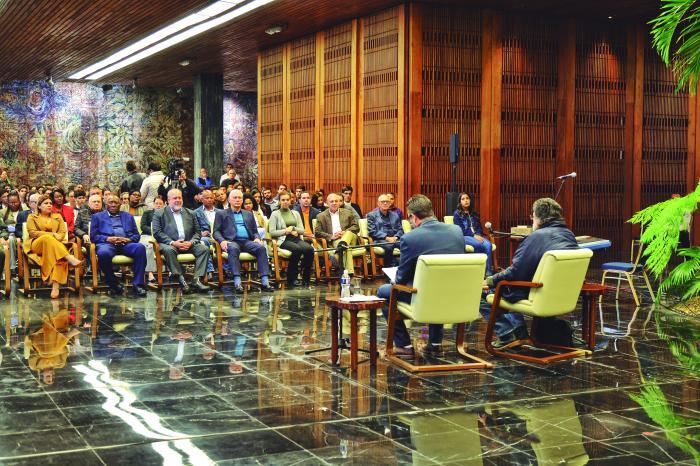
“Take advantage, study…” was the invitation, looking to the future, that the First Secretary of the Central Committee of the Communist Party of Cuba and President of the Republic, Miguel Díaz-Canel Bermúdez, extended this Tuesday morning to the young people who had attended the presentation of the Selected Works of Army General Raúl Castro Ruz in the Portocarrero Hall of the Palace of the Revolution.
He said this motivated by the need to better understand history in a world where truth is one of the most wounded virtues, and where the fight for noble causes seems to be out of fashion. His invitation to journey through nine volumes of substance and beauty has been stamped in the prologue, written by him, in which he expresses: "Raúl is part of that generation that valued life above all else and fought to defend it, even if it meant his own life."
In other lines of the foreword to the Selected Works, Díaz-Canel assures every potential reader that this same Raúl, the defender of life, is the one they will find in the pages, "throughout nine intense volumes that conclude with his pivotal speech on the 65th anniversary of the triumph of the Revolution." He speaks of the Army General as "the Cuban who has given everything for his country and who will always accompany the sacrificial and difficult, yet necessary and beautiful, path of the Cuban Revolution."
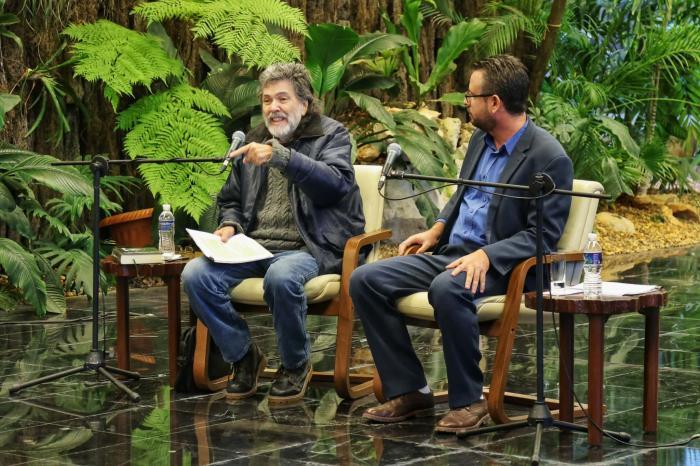
Before one hundred young people —50 from different sectors of Cuban society and another 50 students from the Vladimir Ilich Lenin Pre-University Vocational Institute of Exact Sciences— Dr. Elier Ramírez Cañedo, PhD in Historical Sciences, who gave the presentation along with the prestigious intellectual and president of Casa de las Américas, Abel Prieto Jiménez, made sure to acknowledge that this Tuesday was February 24th.
There couldn't have been a more fitting day, no better place to talk about the Selected Works, Elier said. And then he recalled, among other historical coincidences, the liberation struggle that resumed in Cuba on February 24th, 1895; and that on February 24th, but in 1899, General Máximo Gómez entered Havana, coming from the central region of the island; that the Revolutionary Directorate 13 de Marzo was founded on February 24th, 1956; and that on February 24th, 1976, the first Socialist Constitution of Cuba was proclaimed, and that at that very moment, Comrade Raúl delivered the keynote address.
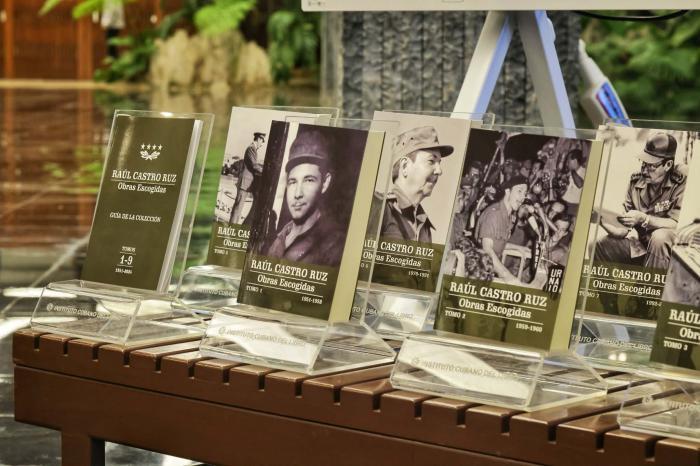
Regarding Army General Elier Ramírez, he emphasized that Raúl Castro has been the "helmsman of the Cuban Revolution for more than six decades," and that he remains firmly in the fold. He then referred to the published work, compiled by Ediciones Celia, recalling that it began to take shape a little over four years ago at the Office of Historical Affairs, the same office founded by Celia Sánchez Manduley.
As is known, the then-director of that office, Eugenio Suárez Pérez (now deceased), and the head of the Directorate for the Preservation of Documentary Heritage at the Palace of the Revolution, Alberto Alvariño Atiénzar, were the ones who envisioned and planned the first steps of a publication that includes more than 500 documents and over 5,000 pages, enriched by more than 2,070 footnotes.
Each volume, he explained, contains a QR code that links to images of Raúl Castro at specific stages of his life. The texts can be found on the Communist Party website and in the country's press outlets. This work, he commented, is not "for decorating shelves," but rather "a treasure of inestimable value for young people." The deputy head of the Ideological Department of the Communist Party's Central Committee was explicit in his desire that the collection be circulated, studied, and cherished.
WORDS ON AN "EXTRAORDINARY COLLECTION"
Abel Prieto Jiménez began his conversation with the hundred or so young people gathered in the Portocarrero Hall, and with the entire audience, with a beautiful detail: he remarked that many were there for the first time; that the hall owes its name to a work of Cuban avant-garde art by René Portocarrero; he spoke of the exquisite stained-glass window by Cuban artist Mario Gallardo, “Sun of America Revolution,” located in the Palace; and he noted that “here there are ferns from the Sierra Maestra, from the Escambray Mountains…”
In his reflections on the Selected Works, Abel affirmed that these books hold enormous significance for Cubans, and also for those who, from other parts of the world, continue to see the Island as a paradigm of steadfastness in times of betrayal and fear in the face of the threats of a grotesque emperor.
To the special recipients of the editorial work, the prestigious thinker said that reading the collection has allowed him to understand what Raúl's leadership is – which is different from Fidel's, while being a continuation of the Commander-in-Chief's legacy, as is also the case, he said, with Comrade Díaz-Canel.
He spoke of Raúl as deeply influenced by José Martí, of his tireless vocation as an educator—always concerned that the Cuban army understand the meaning of the struggle. He highlighted the Army General's unique, colloquial, and quintessentially Cuban style; and at another point in his remarks, he noted that, in his writings, "Celia is a very frequent presence, like a guardian angel."
The President of Casa de las Américas told the young people that it is vital at this moment for new generations, teachers, and families to know history, because the world suffers from oversimplification and many distortions. Abel warned of the serious cultural and ethical crisis that marks the planet.
Among references to quotes and expressions of particular value, Abel Prieto emphasized Raúl's humanism; his philosophy of never humiliating a subordinate; the naturalness with which he has always spoken about death; his sense of loyalty to friends; and the importance he has always given to unity and respect for the truth. The writer, referring to the Selected Works, spoke of reading them as experiencing an impressive journey through history.
It was a day filled with patriotic fervor, attended by, among other leaders and guests, Prime Minister Manuel Marrero Cruz; the Secretary of Organization of the Central Committee of the Communist Party, Dr. Roberto Morales Ojeda; the Vice President of the Republic, Salvador Valdés Mesa; and the Secretary of the Council of Ministers and Major General, José Amado Ricardo Guerra; all members of the Political Bureau.
FOR COLLECTIVE MEMORY AND FOR THE FUTURE
The documents contained in these pages allow us to trace the thread of a life in the Revolution and the fundamental historical events of Cuba over the last 70 years, stated historian Elier Ramírez Cañedo, Deputy Head of the Ideological Department of the Central Committee of the Party, at the presentation of the Selected Works of Raúl Castro Ruz at the University of Havana.
The date and location were not chosen by chance: at the University, "we always learn to be revolutionaries and to defend the Homeland," affirmed Daily Sánchez Lemus, deputy director of the Office of Historical Affairs, describing February 24th as a day of insurrection. Indeed, the Works, which constitute "a gift for Cuban youth," begin with a 1951 article published by Raúl in Saeta, the University's publication.
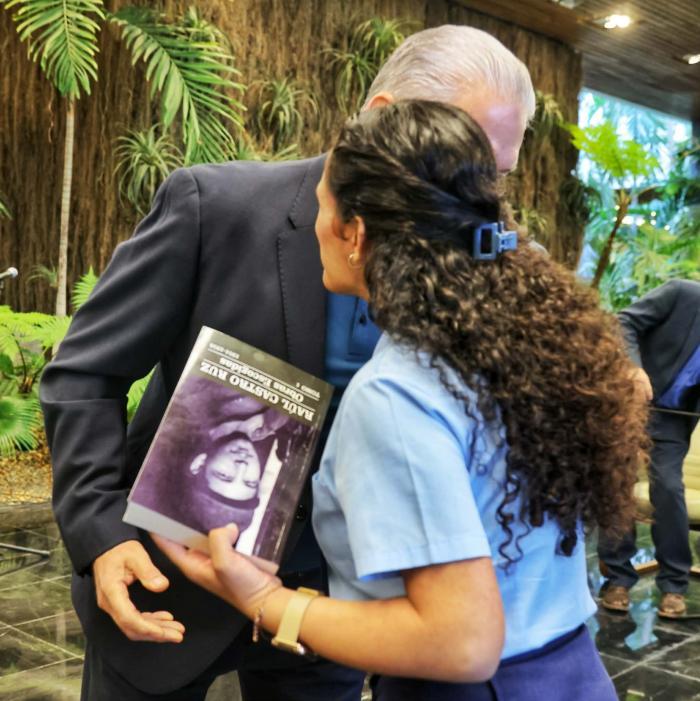
Before an audience of young students —who received the nine-volume collection as a gift from the National Committee of the Union of Young Communists (UJC)— the virtues of the Army General were highlighted. He was described as a paradigm for several generations of revolutionaries: simple, bold, honest, and demanding of others and himself.
The collection, Ramírez Cañedo noted, presents the strategist, the defender and builder of the Cuban Revolution, the statesman, the guide: it becomes a leadership manual, a treatise on revolutionary ethics, an ideological arsenal, and a hymn to unity.
In these complex times, these works must be studied and debated, he pointed out, because they nourish the collective memory and the future we are building.
This edition, published by Ediciones Celia, contains more than 500 texts, several of them previously unpublished. And it fits into the political movement taking place in our country surrounding Fidel's centennial and Raúl's 95th birthday in 2026.
For several months now, the digital version has been available on the Party's website and in the country's press outlets.
Related News

A date that marked the maturity and crystallization point of the project conceived by Mart...

Who is unfamiliar with cancer?

State Council approves relief from work duties for delegates of People
