


What changes in relations between Cuba and Venezuela after the U.S. government's military aggression against that country?
What is the scope of international solidarity with Cuba following the Trump administration's recent measures, including the energy blockade?
Is dialogue with the United States possible? Under what principles?
What is the current state of the national electricity situation? Is the strategy for its recovery being updated? How can we move more quickly towards dependence on national energy resources?
In the face of extreme blockade conditions, how can the country's life be shifted toward survival priorities that depend more on local production capacities, under the leadership of the Party, which, at the local level, must also be more effective in terms of obtaining more results and more quickly?
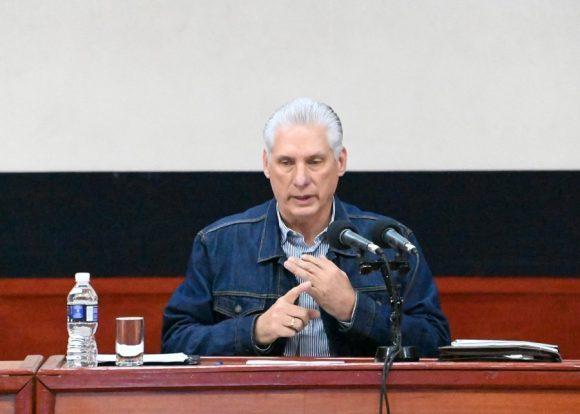
These and other questions were answered by the First Secretary of the Party's Central Committee and President of the Republic, Miguel Díaz-Canel Bermúdez, when he appeared before the national and international press on pressing issues of the current Cuban reality, which has become more complex after the military aggression against Venezuela and the direct threat to Cuba by the United States government, including the recent oil blockade against the island.
IN THE FACE OF THE ENEMY'S THEORY OF COLLAPSE, OUR RESISTANCE
At the beginning of his appearance, the Cuban president stated that the theories of both collapse in Cuba and failed state are constructs with which the U.S. government has tried to characterize the Cuban situation, in its historic goal of overthrowing the Revolution through two avenues: economic suffocation and military aggression.
He asserted that the former has just been explicitly acknowledged by the U.S. President himself: "He said that they had applied all possible pressure against Cuba, thereby acknowledging that there is no failed state, but rather a state that has had to face, with great resistance, the maximum pressure not from just anyone, but the maximum pressure for economic suffocation from the world's leading power, with an imperial foundation and a hegemonic purpose of domination.
"And, on the other hand, there is military aggression, when the second part of that sentence says that there was nothing left to do but take the place."
He emphasized how most of the current generations of Cubans were born under the U.S. economic blockade. "Under the signs of that economic affliction, we have always had shortages, we have always had complex difficulties, we have always had to function amid vicissitudes and impositions and pressures that are not imposed on anyone else in the world, much less in such a prolonged manner."
He confirmed that these times are particularly difficult, "but we will overcome them together, with creative resistance, with everyone's effort and talent."
THE RELATIONSHIP WITH VENEZUELA IS NOT ONE OF DEPENDENCY, BUT OF COLLABORATION
In response to a question from Russia Today, the Cuban president stated that the relationship with Venezuela cannot be described as one of dependency.
"Many try to see it as a relationship of dependency between two countries, and in doing so, they restrict it, reducing it to an exchange of goods and services, and that is not the reality of the relationship we have had with the Bolivarian Revolution.
He explained that, from the beginning, with Chávez, a relationship of cooperation and collaboration was forged, based on the principle of solidarity, above all on integration and complementarity, as two brother countries; and that is why, more than 25 years ago, the Comprehensive Cooperation Agreement came into being.
"And why comprehensive? Because it covers many areas. It covers energy issues, food sovereignty issues, education issues, higher education, literacy, cadre training, and human resources training.
"There are also issues related to industry, mining, telecommunications, cultural exchange, and political exchange. And that transcended the relations between Cuba and Venezuela."
He recalled that four years later, ALBA-TCP emerged, followed by Petro-Caribe, "with a focus on energy, but also on social issues, social justice, equity, opportunities, and benefits, and the development of the peoples not only of Venezuela and Cuba, but of Latin America and the Caribbean."
He assured that no other regional integration bloc has achieved in such a short time the social successes that ALBA-TCP has achieved, and he reviewed several concrete examples.
Of course, he pointed out, economic and commercial relations were also forged, as well as very important collaboration projects. And one of those projects, especially in energy, involved the provision of medical services in exchange for fuel, which accounted for a significant part of Cuba's needs.
"Not all of it, but a significant part, especially in more recent times. At one time, they did cover all of our country's fuel needs, but in recent times they no longer cover everything, because we must remember that Venezuela has been subject to sanctions, coercive measures, and pressure, and that has also affected this exchange, which has been maintained to a large extent, but has not always reached the levels of other times.
He explained that this exchange was further affected when the energy blockade began, the naval blockade of Venezuela, "which has prevented Venezuelan ships or ships from other countries from arriving in Cuba with Venezuelan fuel, and has been further exacerbated by the recent executive order from the United States government, manipulating countries that supply oil through the threat of tariffs." Under this pretext, he stressed, they have established an energy blockade on our country.
Díaz-Canel affirmed that "the future of Venezuela's relations lies in how we are able to build that future from the present situation, from a Venezuela that has been attacked.
"In terms of collaboration, we do not impose collaboration," he added. "We offer collaboration, we share collaboration, we share in solidarity when a government, when governments, when peoples of nations ask us to. And under that concept, we have maintained that collaboration with Venezuela in recent years," he argued.
He extrapolated Martí's phrase about his commitment to Venezuela, arguing that, with that Bolivarian land, "we also have commitments, very intense feelings, and as long as the Venezuelan government promotes and defends collaboration, Cuba will be willing to collaborate."
CUBA IS NOT ALONE
The First Secretary of the Central Committee of the Communist Party of Cuba reiterated that, immediately after the announcement of the energy blockade against Cuba, there has been internal and national support, and he mentioned several expressions of solidarity from spokespersons, foreign ministries, international leaders, and movements that bring countries together.
He referred, among others, to the telephone conversations between the President of Russia and the General Secretary of the Chinese Communist Party, who expressed their support, commitment, and decision to continue collaboration and cooperation with Venezuela and Cuba.
He noted that, in addition to these expressions of solidarity, "there are other things, things that we cannot openly explain today, because the enemy is persecuting every avenue that could be opened to Cuba, every path that could be opened to Cuba; but I can assure you, with every sense of responsibility, that Cuba is not alone.
"At a time like this, there are many people, governments, countries, institutions, and companies that are willing to work with Cuba and that have already sent us ways, mechanisms, and intentions of how we can do so.
"The energy persecution, the financial persecution, the intensification of coercive measures is such that we know we have to work very hard, very creatively, very intelligently to overcome all these obstacles; but there is courage in a group of institutions, people, and governments around the world to support us," Díaz-Canel said.
THE WORLD CANNOT ALLOW FORCE TO CRUSH MULTILATERALISM
On what the international community can do to contain the U.S. government's imperialist onslaught in multiple directions, the Cuban president told the Chinese news agency Xinhua that "the world cannot allow itself to be subjugated, the world cannot allow itself to be humiliated, the world cannot allow force to crush multilateralism."
He considered that all the peoples of the world are exposed, without exception, to a war that is political, ideological, and has a cultural and communicational component, involving the media.
"Why is it an ideological war? Because it is trying to impose the hegemonic thinking of the world's leading imperialist power. Why is it a cultural war? Because in order for the hegemony of that power to prevail globally, they have to break the links with the cultural roots of the peoples; they have to do everything possible to make the peoples see their culture or history as obsolete (...); to make people renounce their identity, to make them ashamed of their history, so that they can then assimilate and impose on them the paradigms and patterns of that hegemonic philosophy, of that imperial philosophy."
He gave the example of the aggression against Venezuela to illustrate why it is also a media war, and denounced that something similar is being done against Cuba, through psychological warfare, "pressure to fracture unity, to create mistrust, to promote uncertainty, and these are elements that demonstrate perversity."
He stressed that the nations of the global South must understand what is at stake in order to seek coordination, "a unity that cannot be only in discourse, but also in action, in constant denunciation, in seeking all possible integration into blocs, into a front, defending ideas, also seeking economic, commercial, cooperative, and collaborative actions that defend multilateralism."
He mentioned how there are blocs that are taking the lead: "the BRICS, with different perspectives for the Global South; the relations of powers such as China and Russia with the countries of the South are different; the Eurasian Union and other blocs... The Non-Aligned Movement has to play a fundamental role in this, the Group of 77..."
He emphasized that this mobilization must be anti-hegemonic, but also anti-fascist.
"They are acting like Hitler's hordes when they attack a country, when they subjugate the world, when they kidnap a president or when they commit criminal acts against ships, against people in an extrajudicial manner, without any element of legality," he said.
"There are ways, I am sure there are ways; the thing is that in order to take those paths and achieve that integration, all of us in the Global South must show courage and bravery," he concluded.
CUBA HAS ALWAYS BEEN OPEN TO DIALOGUE WITH THE UNITED STATES, WITHOUT PRESSURE AND ON EQUAL TERMS
Regarding relations with the United States in the current context and the real possibility of dialogue with that government, the Cuban president recalled that the history of those ties, after the triumph of the Revolution, has been characterized by the asymmetry imposed by the economic, commercial, and financial blockade of US governments, which has intensified today.
However, he said, there have always been people, groups, and organizations, both inside and outside the United States, that have favored routes, bridges, spaces for dialogue, or channels of communication.
"And many times this has been achieved, and when it has been achieved, it has allowed us to speak as equals on issues on which we may even share different views; but these are issues that we must address together, because we are in the same geographical area, we are very close neighbors."
He mentioned issues such as migration, security, the fight against drug trafficking and terrorism, the environment, and other issues related to scientific collaboration.
"There is a long list of issues that can be addressed. And Cuba has always had a historical position, a position that was defined and defended by Commander-in-Chief Fidel Castro, continued by Army General Raúl, and which remains unchanged and unalterable at the present time.
"Cuba is open to dialogue with the United States; to dialogue on any issue that needs to be discussed or debated. Under what conditions? Without pressure, because you can't have dialogue under pressure; without preconditions, on equal terms, with respect for our sovereignty, our independence, and our self-determination; without addressing issues (...) that we could see as interference in our internal affairs."
Díaz-Canel assured that, from such a dialogue, a civilized relationship between neighbors can be built, with benefits for the peoples of both nations. "Cubans do not hate the American people; we recognize the values of the American people, the values of their history, the values of their culture."
He noted that when opportunities for dialogue have been found (for example, in the scientific, sports, religious, cultural, and health sectors, and even at the political level), there are many things that can be worked on together, without prejudice, and which both peoples are deprived of due to the decadent, arrogant, criminal, and persistent blockade policy of the United States government.
He affirmed that the willingness to engage in this type of dialogue is not new, "it is also a position of continuity, and I believe it is possible."
Related News
"We are committed to Cuba forever"

Even with fuel shortages, Cuba will not be defeated by the empire

General Customs Administration of the Republic updates legal framework to strengthen borde...