
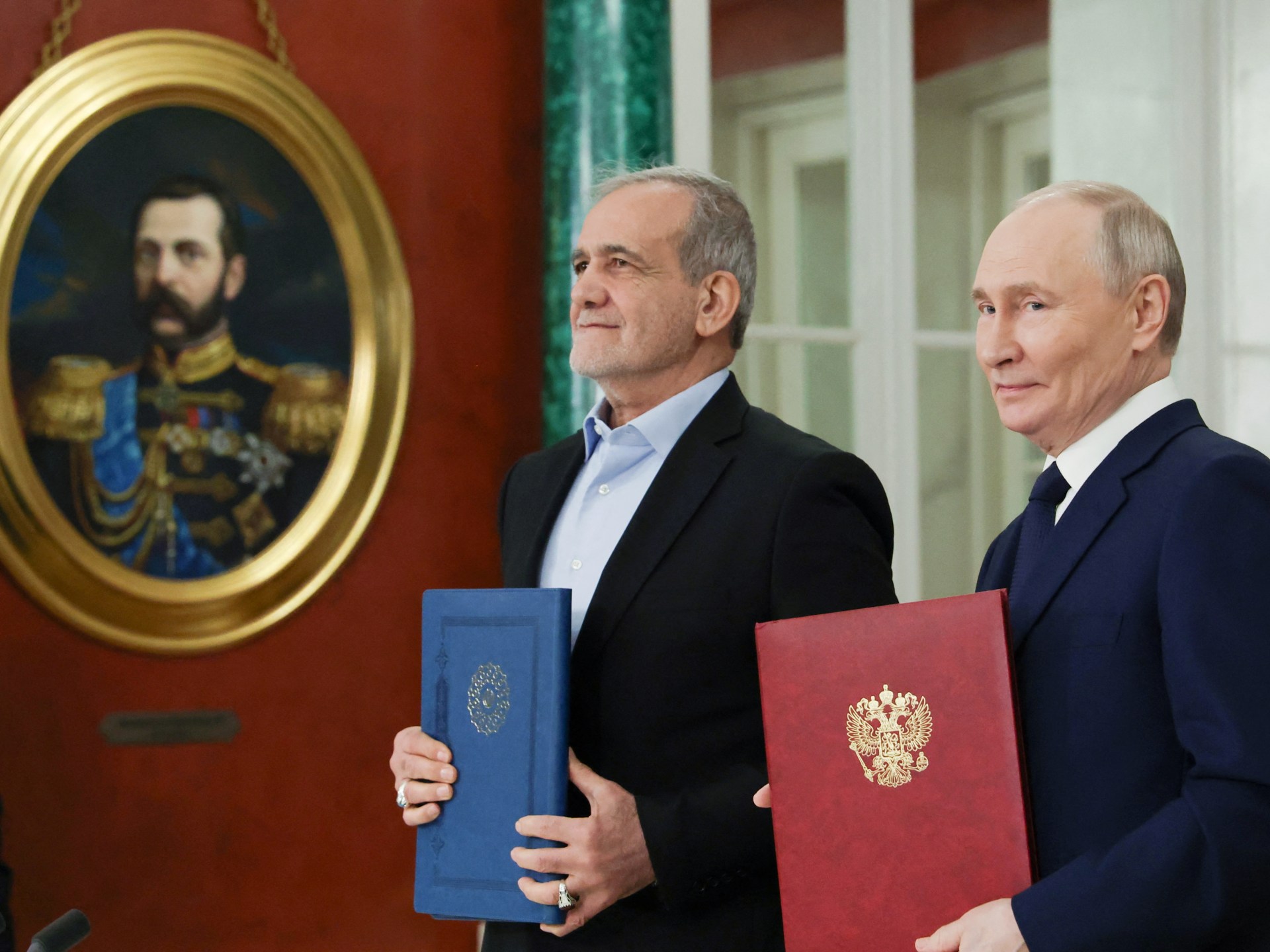

The Kremlin is confident that mass protests in Iran have peaked, and Tehran’s leadership has managed to squash domestic resistance to its rule, according to one of Russia’s pre-eminent experts on Iran.
Russia’s embassy in Tehran apparently informed Moscow that the protests have died down and that the Kremlin “can breathe a sigh of relief”, Nikita Smagin told Al Jazeera.
The protests over economic hardships erupted on December 28, spreading to hundreds of cities and towns throughout the sanctions-hit nation of more than 90 million.
Iranian law enforcement squashed them, possibly violently, and Moscow “thinks that nothing threatens Iran from within”, said Smagin, who fled Russia after its 2022 invasion of Ukraine.
On Tuesday, the Russian Ministry of Foreign Affairs condemned “the illegal Western pressure” and lambasted the unnamed “external forces” that strive to “destabilise and destroy” the Islamic Republic.
“The notorious methods of ‘colour revolutions’ are being used, when specifically trained and armed provocateurs turn peaceful protests into cruel and senseless lawlessness, pogroms, the killing of law enforcement officers and average citizens, including children,” Foreign Ministry spokeswoman Mariya Zakharova claimed.
She used a decades-old Kremlin mantra about “colour revolutions” allegedly organised and paid for by the West in former Soviet nations of Georgia, Ukraine and Kyrgyzstan in the early 2000s to topple Moscow-friendly authoritarian governments.
The threats from United States President Donald Trump to interfere in the Iranian protests are “categorically unacceptable”, Zakharova said, adding that the “decline in the artificially-instigated protests” may lead to stabilisation in Iran.
Advertisement
On Tuesday, Trump urged Iranians to “take over institutions” and claimed that US “help is on its way”.
On January 2, he wrote: “We are locked and loaded and ready to go,” and in June, called Ayatollah Ali Khamenei an “easy target”.
Russian President Vladimir Putin has not commented on the protests – just as he ignored the January 3 abduction of Venezuelan President Nicolas Maduro, Moscow’s closest ally in Latin America.
Despite the condemnation of Trump’s threats, Moscow “can hardly do anything about it”, Smagin said.
Prior to its Foreign Ministry’s rhetorical fireworks on Tuesday, for almost two weeks, Moscow was silent about the protests.
The Kremlin was not sure that Khamenei’s administration would survive and that any harsh statements “would hinder the mending of ties with new authorities” that could have replaced it, Smagin claimed.
Russia’s position appears similar to its response to the toppling of former Syrian President Bashar al-Assad in December 2024.
In October 2025, Syrian President Ahmed al-Sharaa visited Moscow and pledged to “honour” the deals al-Assad had made with Russia, including energy contracts and the presence of Russian air force and naval bases.
To an observer in Ukraine, Moscow’s fuming about “colour revolutions” is a tired cliche.
Russia interprets “any protests against dictatorship and mass rallies for democratisation as a result of external meddling”, Kyiv-based analyst Vyacheslav Likhachev told Al Jazeera.
Later, the pro-Kremlin figures used the term to describe popular uprisings elsewhere, including the Arab Spring protests of the early 2010s that toppled Moscow-friendly leaders in Egypt and Libya.
Similarly, any protests in Russia were seen as instigated by “foreign ill-wishers”, Likhachev said.
Iran has accused foreign nations of being behind the unrest. A television channel in Israel that is aligned with the government claimed that “foreign agents” had armed Iranian protesters.
Several analysts have told Al Jazeera in recent days that while the protesters have legitimate concerns, they believe Israel is playing a role in inflaming the tensions.
More than 100 security personnel have been killed in two weeks of unrest, Iran’s state media has reported, while opposition activists say the death toll is higher and includes thousands of protesters. Al Jazeera cannot independently verify the figures; the internet has been cut off in Iran for five days.
Centuries-old Russia-Iran ties have not always been cordial.
Advertisement
Russian tsars bit off huge chunks of Iranian territory that now constitute Russia’s Northern Caucasus and the ex-Soviet republics of Azerbaijan, Armenia and Georgia.
Communist Moscow strove to turn northern Iran into a “Soviet republic” in the early 1920s, briefly advocated for the independence of Iranian Kurds, and sought to control Tehran’s oil reserves after World War II.
But post-Soviet Moscow became Tehran’s main international backer, shielding it from United Nations’ resolutions and Western sanctions, building its Bushehr nuclear power station and supplying it with sophisticated weaponry.
The latter included the “advanced” S-400 air defence systems that failed, however, to repel Israeli and US drone and missile strikes on Iran’s nuclear infrastructure last June.
In return, Tehran aided Moscow’s war effort in Ukraine by supplying drones, artillery shells, mortar mines, small gliding bombs and, reportedly, ballistic missiles.
But the 20-year “strategic partnership” agreement that Russia and Iran inked a year ago did not foresee military assistance. Moscow’s words on Trump’s threats did not even amount to “sabre-rattling”, a former Russian diplomat said.
“Why rattle sabres if it will only result in yet another reputation failure?” Boris Bondarev, who quit his Foreign Ministry job to protest the invasion of Ukraine, told Al Jazeera.
The Kremlin is too afraid the White House could lose interest in its numerous concessions on the Ukraine war – while Trump does not need Moscow to agree to his possible actions in Iran, Bondarev said.
“What does Russia have to respond with? Withdraw troops from Ukraine and send them [to Iran]? Threaten Trump so that he completely loses interest towards Russia and the ‘deal’?” he asked rhetorically.
Western sanctions keep hobbling Russia’s economy, while average Russians are exhausted by the deaths on the Ukrainian front line, air raid sirens, airport shutdowns, galloping prices, pervasive propaganda and repression.
“Iran? What Iran? We’re busy surviving. My son is grieving the blocking of [popular online game] Roblox, my husband barely earns enough for our mortgage payments. Don’t pester me with questions about Iran,” Irina, a mother of two from the Urals Mountains city of Yekaterinburg, told Al Jazeera.
She withheld her last name for security concerns.
But a renowned pro-Kremlin analyst, Sergey Markov, optimistically predicted Moscow’s help to “reform” Iran after the protests are over.
“The protests will be suppressed, but problems will remain. That’s why Iran awaits reforms. It would be right if Russia could help Iran with advice on reforms – advice both political and in political technologies,” Markov wrote on Telegram on Sunday.
Related News
Extreme cold kills another infant in Gaza as Israel blocks vital aid
Trump poses with ‘Make Iran Great Again’ hat after Maduro abduction
Uganda cuts internet days before presidential election