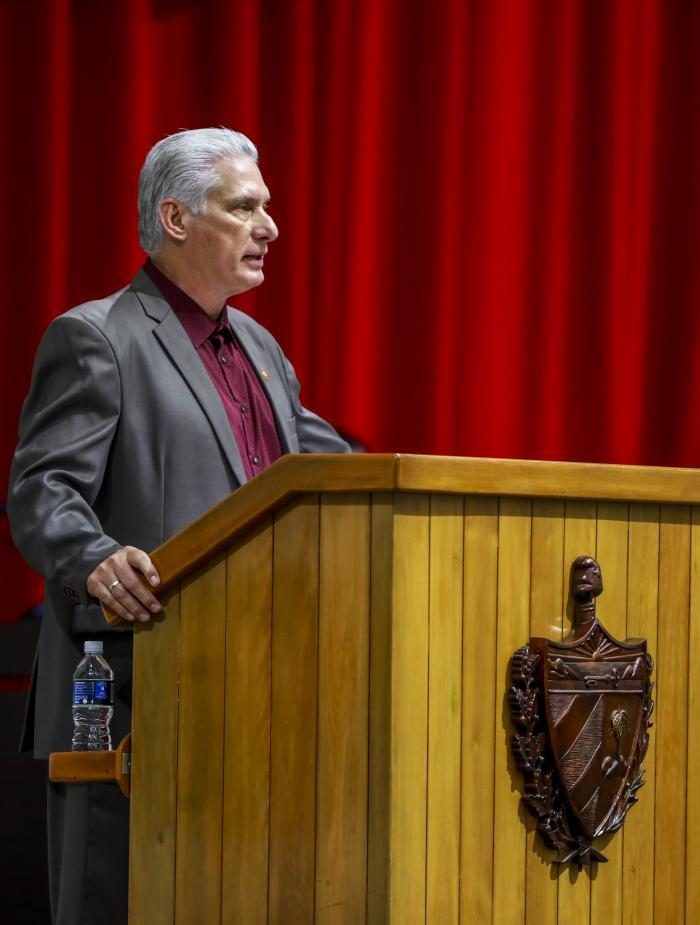



"Only a genuine assembly of the people is capable of facing the colossal challenges facing the nation at this moment with a sense of urgency, serenity, realism, and commitment, and of projecting itself into the future."
This was stated by the First Secretary of the Central Committee of the Party and President of the Republic, Miguel Díaz-Canel Bermúdez, when he spoke at the closing of the Sixth Ordinary Session of the National Assembly of People's Power in its Tenth Legislature, at which time he also thanked everyone for the profound, responsible, and concise debates "that allowed us to address crucial issues of our reality."
He added that "today we have discussed and approved the Economic Plan, the Budget, the Government Program to correct distortions and boost the economy, the Law on Science, Technology and Innovation, among other issues. All of them are connected by a challenging set of tasks necessary to address the country's current situation and the risks and threats looming over the Latin American and Caribbean region, he said.
"We are living in an extremely complex moment for the economy and the daily life of the people, which demands deeper, faster, and more responsible responses. This is not just another crisis.
"It is the accumulation of distortions, adversities, difficulties, and mistakes of our own making due to an extremely aggressive external siege, in an uncertain and dangerous context for the objectives of protecting peace, promoting cooperation, and advancing social justice, among other vital issues on the international agenda.
"This context has also become dangerous for the survival of multilateralism, international law, the United Nations Charter, and the norms and practices on which international relations have been based for eight decades.
"This threat is manifested in a unique way in impunity because the crime of genocide against the Palestinian people has been and continues to be allowed.
"It is also expressed in the new doctrine promoted by the United States, which they call, with outrageous impotence, peace through strength, but which in essence consists of imposing on everyone the arbitrary will and domination of US imperialism through threats and even direct aggression."
The recently published U.S. national security strategy leaves no doubt about its hegemonic ambitions against the peoples and nations of our America, ignoring and endangering the region as a zone of peace, firmly and officially proclaimed since 2014, Díaz-Canel said.
President Trump, he denounced, openly declares the U.S.'s intention to appropriate the resources and natural wealth that belong to sovereign nations in the western territory and their respective peoples. This explains the push for plans to establish U.S. military bases in various countries.
"The exaggerated and aggressive military presence in the Caribbean Sea and the growing and provocative threats against Venezuela with such untenable pretexts that change in a matter of hours.
"The Secretary of State, the Secretary of War, and other shady characters involved in dirty wars against the region have managed to corner the U.S. foreign policy apparatus in a conflict that appears to have no way out and no solution. The threat of open or covert war against Venezuela is a serious violation of international law.
He referred to the assault and hijacking of a fuel tanker and the illegal appropriation of its cargo, the nearly 100 extrajudicial executions carried out in full view of the world with air strikes against ships on the high seas, and the provocative incursions of U.S. warplanes into Venezuelan airspace.
"This is a brutal and risky wartime measure against a country that poses no danger to them. It shows the impotent desperation of those who have bet on the surrender of that sister nation in the face of the violent and ruthless offensive of a clique that has taken over U.S. foreign and hemispheric policy.
"At the recent ALBA summit, we had the opportunity to reaffirm our condemnation in the strongest and most categorical terms of the threats and aggressive actions against the sister Bolivarian Republic of Venezuela and Cuba's absolute support and solidarity with that Latin American and Caribbean nation.
In an almost parallel manner, and for much longer, Cuba has also been subjected to relentless economic aggression with a criminal intensification of the blockade and the unjustified inclusion of the country on the arbitrary list of states that allegedly sponsor terrorism.
The direct and indirect actions promoted by the U.S. government aimed at interfering with domestic macroeconomic performance, promoting inflation, and substantially depressing the purchasing power of the population are evident.
The Head of State pointed out that the imperialist leadership has continued to use its monopoly power over the media and the technological infrastructure of digital networks to promote despair and disenchantment, as well as to disorient and confuse, "fuel speculation and erode confidence in the leadership of the Revolution by thoroughly attacking the emotional fiber of the Cuban nation."
Even under these conditions and in this year of great challenges, the country's prestige and history of solidarity were evident.
He added that the United Nations General Assembly resolution once again called for an end to the blockade and received overwhelming support from the international community, despite the dirty tactics and brutal pressure from the U.S. government and the fallacies they spread about Cuba, some of which were repeated.
Díaz-Canel highlighted that it has been a year of conscious mobilization by solidarity groups with Cuba, political forces, popular movements, and civil society organizations in all latitudes on ongoing issues, thus expanding ties in various regions of the world and directing foreign policy to expand trade links and investment opportunities.
He said that relations with Cubans living in other countries continue to strengthen, with whom, in the year that is coming to an end, contacts have been expanded, as has their participation in national events and their involvement in commercial, economic, and development projects for the good of our society.
"In analyzing the current situation in the country, we have been realistic and self-critical, but we have also reaffirmed our confidence in the Cuban people's capacity for resistance and victory. The homeland does not surrender."
Today we conclude an intense working session, he pointed out, one that is profound and of vital importance for the present and future of the nation. We have addressed, with the revolutionary approach that characterizes us, core issues that touch the heart of the socialist project that we defend and build together. No one in Cuba needs to be told that the economy is under strain.
"The magnitude of the crisis is recognized, reality is not glossed over, and at the same time, the political will to change what needs to be changed in order to defend social justice and national sovereignty is reaffirmed."
Díaz-Canel insisted that the transformations that must be made are not only structural but also of mentality.
"The only limit to flexibility is that which threatens our principles, self-determination, sovereignty, and national independence; beyond that, we must increasingly and fearlessly promote an initiative that helps us overcome the powerful obstacles placed by the enemy and move forward," he said.
The president stressed that we are all writing history right now.
He highlighted the political will to prioritize attention to the people, investment in strategic areas, and the constant search for efficiency.
He acknowledged the enormous difficulties facing the country, aggravated by an economic blockade that affects us all, saying, "Our response is greater creativity, greater discipline, and greater control."
He stressed that by 2026, there will be a set of actions that seek to prioritize food production by guaranteeing basic inputs and, above all, generating real incentives.
He said that investments and operational solutions in the national electricity system are being accelerated, combining the repair of thermoelectric plants and greater efficiency with the growth of renewable energies.
Likewise, the allocation of foreign currency is regulated and made transparent so as to favor sectors that substitute imports and supply the domestic market with their own production, giving real autonomy to socialist state-owned enterprises to increase productivity and efficiency by demanding measurable results without tolerating inertia or immobility.
He added that, from the Assembly, we must demand that every peso in the budget be backed by productive or social support, which represents the priority of health, education, social security, and protection for the most vulnerable.
The president called for a drastic reduction in unproductive spending, projects that do not add value, and structures that do not generate results.
"Let the territories take greater responsibility for revenue collection and the efficient use of resources. It is not a question of adjusting for the sake of adjusting, it is a question of adjusting in order to continue redistributing fairly."
In this regard, he said that at the center of the debates is the Government Program to correct distortions in the economy, "a revolutionary necessity to perfect socialism under construction, to make it more prosperous, sustainable, and fair."
He added that while some measures may have a major impact on daily life, inaction would be the greatest danger.
"We must put order where there is disorder, properly value our work, stimulate productive effort, and put a stop to illegalities and imbalances."
This program, he said, is a call for the conscious participation of all Cubans, so that each one, from their position, can be a protagonist of rectification and progress.
For this reason, he said, prices and rates must be regulated, the exchange rate chaos must be addressed, the relationship between the state and non-state sectors must be improved, production must be encouraged, and those who have the least must be protected.
Meanwhile, the approved program seeks "precisely to correct distortions, strengthen the socialist state enterprise as an engine of development, and open the way to all forms of history that contribute to the collective well-being."
Regarding the recently approved Science, Technology, and Innovation Law, the Head of State said that this is an essential legal instrument for charting the path toward technological sovereignty and the development we need. "We must make science and innovation the driving force behind every sector of society," he stressed.
This law is a firm step in that direction so that the knowledge created by our talented people can be translated into solutions, efficiency, and well-being. Science cannot remain in laboratories; it must be converted into practical solutions for production, energy, health, and the daily lives of the people, he said.
He stressed that the country does not have infinite reserves of material resources, but it does have reserves of scientific, technical, and academic talent that are not always exploited. "Key economic decisions must be based on evidence, studies, moderation, and impact assessment. It is essential to bridge the gap between research and production," he remarked.
"Universities, businesses, and territories must be part of the same innovative cycle. Innovation is not only technological, but also organizational, managerial, and involves popular participation, communication, and social control. Science and innovation must cease to be a complement and become the engines of the economic change we need."
The challenges facing Cuba in 2025 and 2026 will only be resolved through concrete work, systematic control, and active popular participation. The 11th Plenary Session and this very session of the assembly agree on one idea. It is not enough to approve, we must comply, and it is not enough to comply, we must be accountable.
From this assembly, we must make several political commitments, strengthen the bond between each representative and their constituents by communicating, listening, explaining, and gathering concrete proposals to inform public policy.
The decision to postpone the 9th Party Congress cannot be seen as a setback, he said. It is a necessary and timely decision that will allow us to unite our forces, improve the situation of the nation, increase the confidence of the people, and create the conditions to consolidate the construction of socialism, as enshrined in the Constitution. "That is what the Army General has called us to do," he said.
He emphasized that this decision will be an opportunity to dedicate 2026 to recovering as much as possible and to making progress in fulfilling our commitments. It will also allow us to implement the adjustments we need to make in the structures of the Party, the Government, and the State to facilitate the exchanges of opinions and criteria that this process demands.
"All the forces and energies of the Party, the state, and the government, together with the people, must be devoted to improving the situation in the country," he insisted.
He argued that we must continue to move forward in implementing the approved economic measures with discipline and control, strengthening attention to the territories affected by natural disasters, promoting the participation of youth in all areas of national life, intensifying the ideological, cultural, and communications battle, and defending the truth about Cuba in the face of manipulation and misinformation.
During this period, the popular debate on the government program must also be completed and actions to achieve its objectives must continue to be implemented.
In addition, he added that work will continue on the drafting of documents that, after popular consultation, will be debated in Congress and are already well advanced.
"It is now up to us to turn what we have approved here into reality. May every law, every plan, and every budget be translated into tangible actions in the lives of the people.
"May science and innovation be translated into concrete solutions, may the economy regain its vitality without compromising social justice. Let us never neglect unity, the apple of our eye, as the Army General and Leader of the Revolution, Comrade Raúl, has called it. Indeed, it is our greatest strength in the face of all threats.
"We trust in our capacity for revolutionary offensive, in our resistance, and in our creativity.
"This will be the real test of our shared and assumed commitment, the true measure of the transformative power of this parliament and the vitality of the Revolution in Cuba."
"Here, in the National Assembly, the Assembly of the people of Cuba with its young talents, its women and men from the most visible professions and trades, white, black, mulatto, seasoned in a thousand battles, critical and committed, that of the Cuban Revolution, alive and active.
"The greatest proof of its existence is precisely the determined efforts of its enemies to suffocate it and destroy it down to its very foundations. This assembly has the honor of presenting a proposal of profound patriotic and revolutionary significance."
"Inspired by the legacy and precedent of our leader and the call for unity and continuity, reflecting the sentiment expressed in these times by many compatriots, we propose that the year 2026 be officially named: the Year of the Centennial of Commander-in-Chief Fidel Castro Ruz."
"It will be a year to study his thinking more deeply, to emulate his example of tireless work, fidelity to principles, and absolute confidence in the people and in the victory of ideas."
Díaz-Canel said that we will not lower our guard, we will deepen the ideological and cultural battle, and we will work tirelessly for the sovereign and prosperous country that this people deserves.
"The task is complex, but the will of this people is invincible," he said.
He pointed out that the ANPP, united in its determination to save independence, sovereignty, and the Revolution from the many dangers that threaten us today, cannot be separated from the history that brought us here, overcoming trials that seemed impossible.
"May 2026, the centenary year of Commander Fidel Castro Ruz, find us more united than ever," he concluded.